

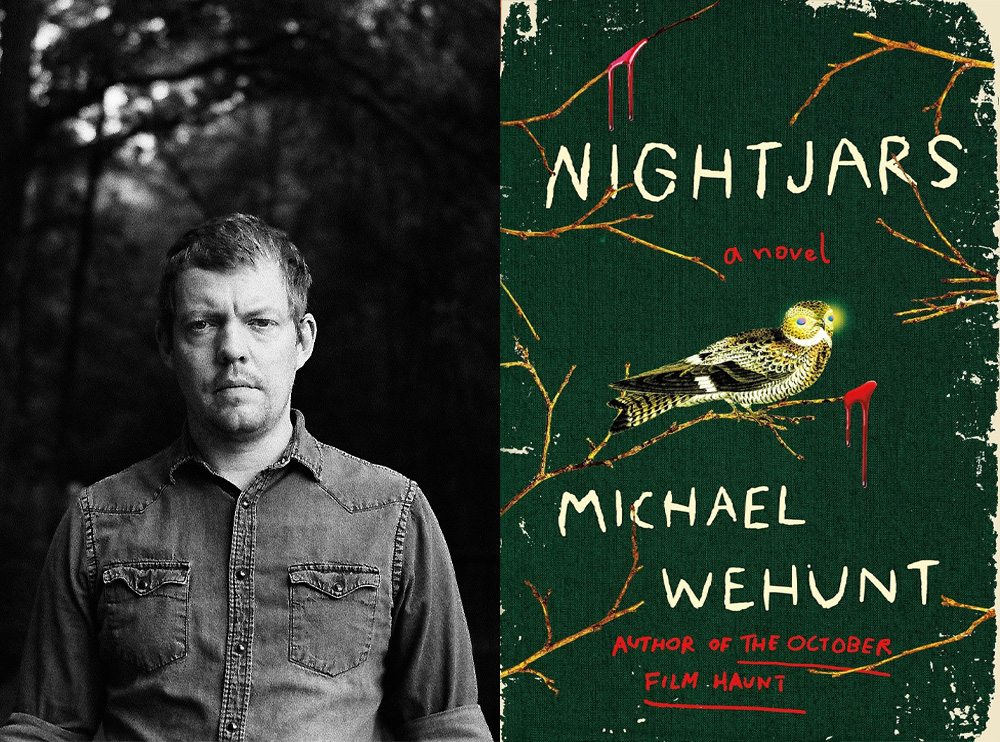
We chat with author Michael Wehunt about Nightjars, which is a heart-thudding, unpredictable, and beautifully crafted novel of a man exposed for crimes he doesn’t remember committing, and the monsters that dwell at the heart of us all.
Hi, Michael! Welcome back! How have you been since we spoke last year?
I’ve been much too busy, wishing the world would slow down a little…but doing as well as I can considering *gestures at many things happening globally*.
Your latest novel, Nightjars, is out now! If you could only describe it in five words, what would they be?
Appalachian serial killer…or worse?
What can readers expect?
A grim and frightening exploration of how our childhoods make us who we are vs. how much of ourselves we get to decide. A tender, emotional look at parenthood and redemption. A man’s journey to figure out what kind of monster his father was, whether monstrousness can be passed down like a birthright, and why this dark legacy is surfacing now.
A lot of early readers and Instagram influencers have been advising people to go in blind. I’ve tried to temper my responses here just a bit to help with that.
Where did the inspiration for Nightjars come from?
I grew up in the shadow of the North Georgia mountains, and I always knew I’d have to set a novel there. There was a certain type of creature I saw in that ancient landscape, too, and elements started falling into place. Meanwhile, I had this lingering idea about a man seeing photographs of himself doing terrible things but having no memory of them whatsoever. Can pictures lie? That question has become a lot murkier in the age of AI, so I wanted to dig into the incontrovertible truth of an old Polaroid before it’s too late.
Were there any moments or characters you really enjoyed writing or exploring?
There’s a scene in complete darkness that I had a wonderful time writing – cutting myself off from visual imagery for a little while and relying on other senses and other ways to convey sharp terror. And I loved the relationship between Luke and Sophia, his four-year-old daughter. I loved painting Luke’s powerful determination through the small things he says to Sophia.
Can you share some insight into your plotting process for Nightjars?
Once, I was a “pantser,” a writer who flew by the seat of my pants (hence the name). Nowadays, I’m much more of a plotter, the sworn enemy of the pantser. I have betrayed my kind. Nightjars was fairly straightforward to lay out, though there was a key shift at a certain point that I had to keep firmly in mind. And there was a major reveal later that I wanted to line up with a particular beat.
From the outset, though, there were a few choices I made with Nightjars to really differentiate it from my first novel, The October Film Haunt. I wanted a shorter book, much shorter chapters, fewer characters – basically just a more streamlined, less narratively complex story, which informed my plotting along the way.
Did you face any challenges whilst writing? How did you overcome them?
Keeping a few big things secret for such a long way into the book was challenging, not because I might let something slip but because the story had to stay highly engaging the entire time those things were hidden from the reader. The challenge of a mystery and keeping people in the dark and happy about being in the dark.
I also felt the book veering into heavy, grim territory – which was the plan, but only to an extent. I felt it was important to keep some light in the story, because there’s so much emotion in the family in this novel…and so little light around us in the real world.
What’s the best and worst writing advice you’ve received?
The best: Don’t compare yourself to other authors. Their circumstances are different from yours. If you have a busy day job, you might look at other writers longingly because they’re able to write full-time. That is a huge advantage, yes, but you can’t let it matter, because focusing on that is corrosive. Do your best with what you have. Once I learned that, it made me a happier writer.

The worst: Any variation on “butt in chair” or “you gotta hustle” that puts pressure on a writer and makes them think they have to write every day and just go, go, go. There’s usually good intention behind that advice, but work/life balance is crucial, and any author should emphasize self-care and mental health. Especially those who have day jobs. Don’t be afraid to take a day off.
What’s next for you?
I’m currently working on my third novel, which just might be my take on the holiest of all horror tropes: the haunted house. There are so many haunted house novels out there, but not many of them are genuinely scary and impactful. So I think of it as a sacred obligation – to do right by it and honor the legacy of Shirley Jackson and other writers who have crawled under my skin and changed the wiring in my brain.
Lastly, what books are you looking forward to picking up? Any you’ve read so far this year that you’ve enjoyed?
I’m looking forward to Marlon James’s The Disappearers. It just came out and is already on my shelf, but it’s going to be a while before I’m able to start it. I think it’s going to devastate me and win all the biggest literary awards. I’m excited to read Keith Rosson’s Crone and CJ Leede’s Headlights, too.
I loved Brian Evenson’s Phantom Limb, which is a sequel to his novel, Last Days. It comes out in mid-October, but I was fortunate to read an advance copy. It takes Evenson’s amputee noir to new heights.