


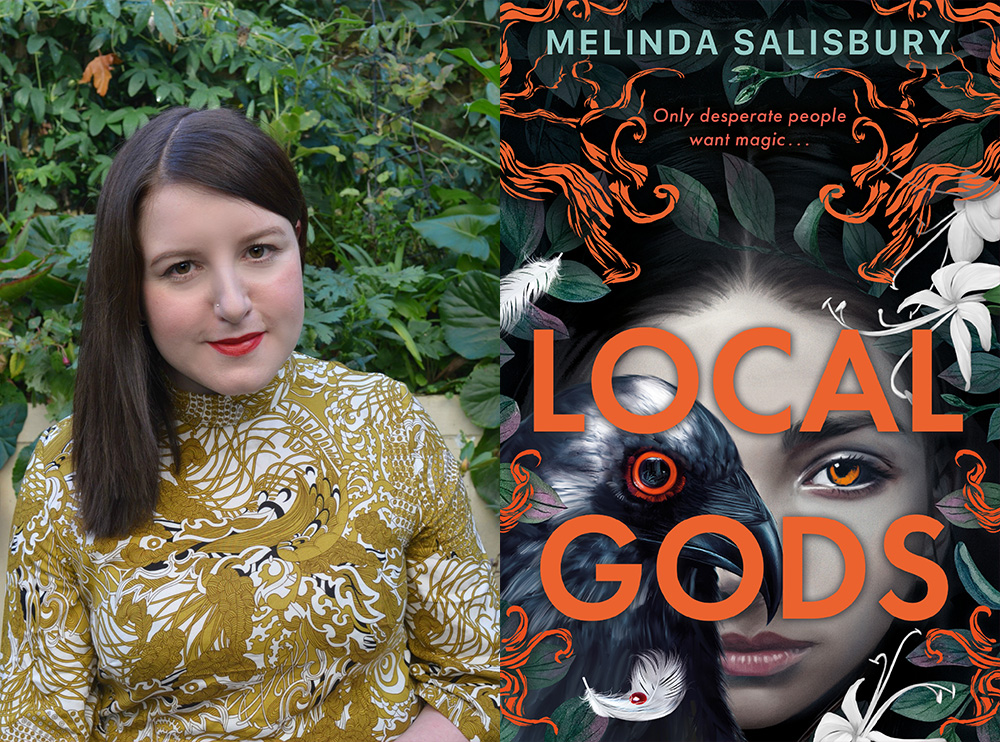
Guest post written by Local Gods author Melinda Salisbury
Melinda Salisbury is the four-time Carnegie nominated and bestselling author of multiple teen and young adult novels, including the Sin Eater’s Daughter series, Hold Back the Tide, and Her Dark Wings, a Guardian Children’s Book of the Year 2022 and a Reading Agency Book of the Year 2022 pick. Her debut teen novel, EchoStar, a tech thriller aimed at 12–14-year-olds, was published in March 2024 by Barrington Stoke, with AdelAIDE following in August 2024 and The Foundation in January 2025. In summer 2026 her next YA novel, Local Gods, will publish in the UK by David Fickling Books, and in the US by Sarah Barley Books.
About Local Gods: Deliciously sinister, mesmerising YA folk horror at its best in this stunning new novel by Melinda Salisbury. Shunned and living in an isolated wood, Sylvie comes across a scrawny, wasted monster named Illican: a local legend, a god made flesh. With their destinies entwined, Sylvie sees an opportunity for redemption, but the woods are watching and nothing goes as planned . . . Released July 30th 2026.
Twice a year in spring my town kills a man for the sake of humankind. The first killing will be familiar to many people—on Good Friday Jesus is tried, sentenced, and then he drags his cross from St Clements Church, along the High Street and over to All Saints, where the crucifixion happens. He’s escorted by Roman Centurions and if you head down to The Albion on the seafront on the night of Good Friday, you can sometimes see the Centurions, plumed hats resting on tables, drinking Guiness with the Marys and some of the disciples once it’s all over.
The second time happens at an event called Jack in the Green. Also beginning on a Friday—this time the one before the May Bank Holiday—Jack is released in Hastings Old Town, down by the Stade. Three meters tall and covered in greenery and ribbons, Jack is celebrated and feted, his bogies protecting him from a crowd whose blood is already hot and eager for what’s to come. There’s drumming and Morris dancing and folk music and face painting, people wear flower crowns and green clothes and it all continues through the weekend, getting steadily more debauched. On May Day itself, Jack goes on one final procession through the old town, trailed by giants and dancers, chimney sweeps and milkmaids and a menagerie of creatures, human and other. He is guided to the West Hill and we follow behind, eating and drinking and making merry. Then, at the height of the afternoon, we sacrifice him at the top of the hill to bring on summer. His leafy coat is ripped from his body and locals make sure we all have a piece to take home for luck.
It’s all pretty standard around here and I should probably mention that no one actually dies. It’s symbolic, you see. A story.
It might surprise some people Jack in the Green isn’t anywhere near as old as the crucifixion. It isn’t one of those pagan festivals that was supposedly coopted by Christians when they came here—in fact it isn’t a pagan festival at all, though it has the undeniable flavour of one; masked figures, dancing, drumming, sacrifice. But it’s because of those two elements – the relative modernity and the pagan-esque coding—that I used it as the basis for my own rites and rituals in my latest book, LOCAL GODS.
In LOCAL GODS, the townspeople of Pine Ridge Hollow celebrate Founders Day on June 21st – coinciding with the summer solstice. The townsfolk celebrate by wearing white and carrying flowers, picnicking and frolicking to commemorate the birth of the town and renew their connection with it. Very occasionally they celebrate in a different way, though I’m not sure ‘celebrate’ is the right word to use…
But as I mentioned above, like the Founders Day celebration, the origin of Jack in the Green is much more modern and a little more engineered than most people realise.
As far as we know from records, the Jack in the Green custom began somewhere around the 17th century. Celebrated diarist Samuel Pepys wrote in 1667 of milkmaids who’d decorated their pails with flowers and were dancing behind the fiddlers in the May Day Parade. By 1698 the decorated pails had become something closer to the flower crowns we wear today, though the milkmaids wore much larger structures based on silver plates owned by their employers, further decorated with flowers and silverware and not only did they dance in the parade but went door to door dancing and asking for payment. Not to be outdone, the chimney sweeps—who also paraded in costumes—began creating wearable frameworks of greenery and flowers to wear too, and so the custom was born.
It evolved over the next seventy years, because in 1770 Peter Grossley, a French visitor to London made record of the May Day procession he attended which featured a Jack, and in 1785 the term Jack in the Green was used for the first time, in connection with a masquerade held at the Pantheon in London.


But by the beginning of the twentieth century it was dying out, the raucous processions replaced by the virginal (but still flower-gilded) May Queen and her demure attendants. Over the years folklorists have tried to link Jack in the Green to older pagan practices and figures in the UK and they haven’t let the protestations of historians stop them, because Jack in the Green as we celebrate it today is in line with Christina Hole’s suggestion that Jack in the Green is a “’very ancient figure’ who represented ‘the Summer itself, the very old bringer-in of the time of plenty’.”

Why are we so desperate for these so-called pagan customs that, even with an abundance of evidence to the contrary, we insist on them—mythologizing them into existence if we can’t find them elsewhere. How did milkmaids dancing for money become a three-day festival about releasing the spirit of summer? Why do we go so far as to invent local gods of our own to believe in?
In LOCAL GODS, the answers to why Pine Ridge Hollow needs a little magic are revealed as the story develops. And in reality? In a world where everyone can be the local god of their own social media feed, where Internet prophets spout a new gospel or spin a new angle every week, maybe we long for something that feels ‘real’. Something established and old, tangible and rooted in the woods and the sea and the mountains, places most of us only rarely visit. Something that doesn’t feel advertised or algorithmized, but passes person to person, hand to hand, mouth to ear, moving through a crowd like a wave. Something real, made from the made up.
Of course, you could always come to Hastings to celebrate Jack in the Green one May Bank Holiday weekend. Maybe if you stand with us on top of West Hill, cheering as Jack’s body is torn apart and distributed to the crowd, you’ll find the answers there.