


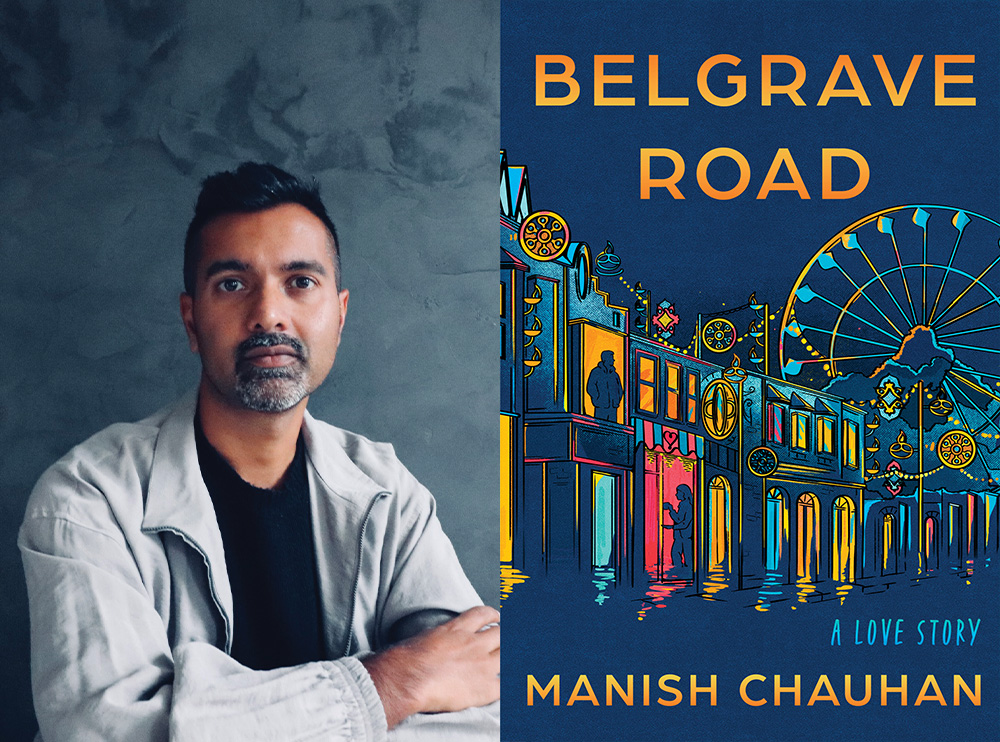
We chat with author Manish Chauhan about Belgrave Road, which is an unforgettable debut novel about two young people searching for better lives, and the blossoming forbidden romance between them that threatens their families and futures—a breathtaking story perfect for fans of Colm Tóibín and Monica Ali.
Hi, Manish! Can you tell our readers a bit about yourself?
Hi! Well, I’m a British-Indian writer born and raised in the UK (Leicester to be exact, which is where my novel is set). I also work as a finance lawyer in London (where I live). I started writing when I was 16 and I’m currently 42. Other than literature, I’m very into food and film. My writing centres primarily on the lives of Indians living in the UK and I would describe my style as realist.
When did you first discover your love for writing and stories?
I think this must have been when was I around fifteen or sixteen. We were asked to write a story at school and although I can’t recall details of what I wrote (I wish I could) I recall people enjoying it and asking me to write more. I wasn’t particular popular at school and didn’t feel as though I fit in, and I took this as an opportunity to increase my popularity. Then, when I was seventeen, I went to learn creative writing in a more formal setting at which point the interest took on a life of its own.
Quick lightning round! Tell us:
- The first book you ever remember reading: The Very Hungry Caterpillar by Eric Carle
- The one that made you want to become an author: That’s a tough one – either A Fine Balance by Rohinton Mistry or The English Patient by Michael Ondaatje
- The one that you can’t stop thinking about: The Bee Sting by Paul Murray
Your debut novel, Belgrave Road, is out February 10th! If you could only describe it in five words, what would they be?
Love and Freedom against society.
What can readers expect?
A love story between two people in their twenties who hail from very different backgrounds but who arrive in the UK in search of security and happiness. A story about the various systems in place which make their search very difficult. A story about the power of love and hope.
Where did the inspiration for Belgrave Road come from?
It was two things. The first was that I met a young woman who had come to England following an arranged marriage. I didn’t know much about her, other than that she wasn’t particularly educated and that she didn’t have any family of her own in the UK. Over the days that followed, I found myself thinking about her. What might become of her life? What if she decided she didn’t like it here?
The second thing that happened was that I found myself reading about the migrant crossings that were taking place from Africa into Europe. I was very interested in exploring the reasons that compel a person to flee their home country and, more widely, in the notion of ‘home’ itself. Leicester, where the novel is set, is home to many such people. As the son of immigrants, I found both stories equally compelling and, after some time, noticed the narratives begin to speak to each other.
Were there any moments or characters you really enjoyed writing or exploring?
I really enjoyed writing about Tahliil and his family, partly because it was a life and culture I was unfamiliar with but also because of the similarities between the Somali and Indian cultures that I discovered as I was writing which were unexpected but also fascinating. I really enjoyed the feeling of the world growing smaller as I wrote the novel, the way it does for Mira and Tahliil. I have always enjoyed writing female characters and Mira was no exception – I really enjoyed getting into her skin and seeing the world from that unique point of view.
Did you face any challenges whilst writing? How did you overcome them?
The most difficult challenge for me was keeping abreast of the changes in the asylum process as this was a very specific piece of research which had great ramifications for Tahliil and his story. Since I began writing the novel, the process for seeking asylum has changed. With the introduction of major delays, what should be a transparent and fair process ends up becoming the opposite. The way I ensured I was keeping up-to-date was by speaking with immigration specialists, often lawyers, who were heavily involved in helping asylum seekers. Their help was invaluable.

What do you hope readers take away from Belgrave Road?
I hope readers finish the novel curious and empathetic towards people whose lives might be very different to their own. I hope people will read the novel and understand that there are far more things that unite us as a people than separate us. Mira and Tahliil are a beacon of this belief. I hope reading this book is empowering – especially for those who in live in communities where it remains difficult to be oneself. But mostly I would like people to treat those who are different to themselves with more respect – especially in today’s political climate – and a will to understand the different stories that make up a person, of which there are many.
What’s next for you?
Another novel set in Leicester, but this time about a different sort of love – the sort that accumulates over the course of a very long marriage. My hope is to write three novels set in Leicester which follow people from different ages/classes/circumstances and showcase the vibrant city I was born and raised in.
Lastly, what books are you looking forward to picking up this year?
This is where the serpent lives by Daniyal Mueenadin, John of John by Douglas Stuart and Smallie by Eden McKenzie-Goddard