

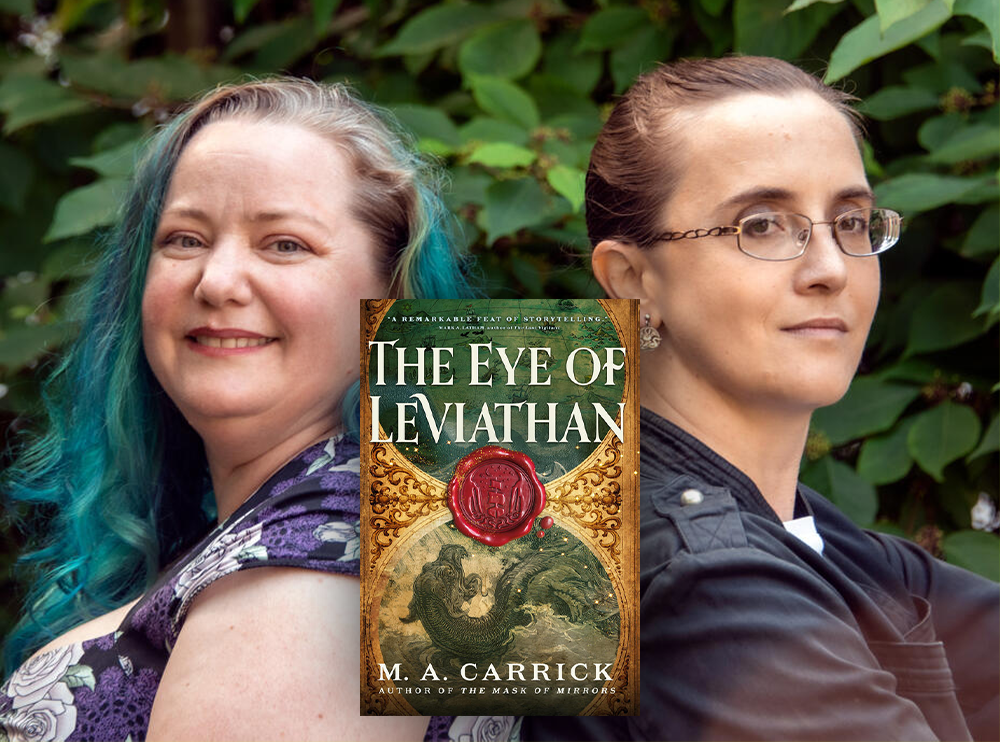
We chat with M.A. Carrick (the joint pen name of Marie Brennan and Alyc Helms) about The Eye of Leviathan, which is a sweeping adventure set in a world where fae secretly walk amongst those who seek to persecute them.
Hi, Marie and Alyc! Welcome back! What have you both been up to since we last spoke for the release of The Mask of Mirrors?
Marie: We finished out the Rook & Rose trilogy with The Liar’s Knot and Labyrinth’s Heart, and I’ve written some short fiction in the same setting — that’s something I’ve done for almost all my novels to date. With the richness of world we developed for the trilogy, it seemed a shame to use it for only three books! (Even if they’re chonky books.)
Alyc: Everything Marie said. We also ran a successful Kickstarter to produce a pattern deck and guidebook based on the version we created for Rook & Rose, and Marie also has some Lady Trent coloring books coming out. And although I can only tease about it for now, I’m working with some fellow authors to create book-related hand fans for several well-known series, including Rook & Rose. Marie and I have already seen some of the concept art, and it’s very cool.
When did you first discover your love for writing and stories?
Alyc: I’ve loved reading and telling stories for as long as I can remember, but my love for writing has been a slow burn. I finished my first story — an original fairy tale that had elements of the little robber girl from the Snow Queen — when I was in junior high. And I proceeded to start and NOT finish stories for the next decade or so of my life. Learning to see things through to the end was my first big hurdle as a writer, not helped by the fact that I much prefer writing long form to writing short fiction.
Marie: For me, it was when I read Diana Wynne Jones’ novel Fire and Hemlock at the age of maybe nine or ten. The two main characters in there are writing a story together, and it was the first time I’d thought about making up stories not just to entertain myself, but to entertain someone else. I put that book down with one thought in my head: “I want to be a writer.”
Your latest novel, The Eye of Leviathan, is out now! If you could only describe it in five words, what would they be?
Marie: Golden Age Spain, with faeries.
Alyc: The map isn’t the territory.
What can readers expect?
Alyc: Golden Age Spain, with faeries.
Marie: . . . okay, I won’t be that much of a smart aleck as to repeat Alyc’s answer from above. But let the record show that I was tempted!
This is a chewy historical fantasy about colonialism, religion, and identity. The same year that Columbus sails to the Caribbean, a different man figures out the secret of passing safely to and from the Sea Beyond: the Otherworldly ocean that lies to the west of the Strait of Gibraltar, if you traverse it under the right conditions. Ever since then, Spain has been exploring and colonizing the faerie islands there so as to exploit their magic . . . and, alongside that, baptizing fae.
Our protagonist, Estevan, is a changeling determined to learn the secret of how Spain is achieving their control over the Sea Beyond. As he infiltrates the halls of Spanish power, the daughter he displaced — known as the Hungry Girl — fights to find her way back home, to the mother she remembers only as a story.
Where did the inspiration for The Eye of Leviathan come from?
Marie: From Alyc!
Alyc: We had actually pitched an entirely different idea to our editor for the series we wanted to write after Rook & Rose, but she was concerned about how to market the idea, and requested something more ‘commercial’. Which stumped us a bit, and sent me spiraling on what ‘commercial’ even meant. Based on my awareness of Booktok/Booktube/Bookstagram at the time (autumn 2023), I decided it meant Romantasy, Cozy, Dark Academia, and Faeries, and I resolved to come up with the most romantasy-cozy-dark-academia-faerie idea of all time.
I knew I had to get Marie on board, and I figured I could do it through a call to mapmaking, which she was getting into at the time. I latched onto the Alfred Korzybski quote, “The map is not the territory,” and thought to myself, “but what if it was?” From there, the idea spun out to be a story about a faerie changeling infiltrating the institutions responsible for mapping Faerie and pinning it into place so it could be conquered and colonized.
So I failed at ‘commercial’ and only managed to hit 1.5 of my targets, but that’s the idea I ended up throwing at Marie.
Marie: From there, it was a matter of figuring out how to embed it properly in history. I was the one who suggested setting it in Spain, which of course implied that we should do something pivotal with the year 1492. But we also realized very soon that we wanted to embed it in mythology, too: while not all of our faerie islands come from real-world stories, some of them do, and our cosmology as a whole is a delightfully chaotic swirl of Mediterranean lore: Catholic, Jewish, Islamic, Greek, Phoenician, we even get some blink-and-you’ll-miss-it Sumerian bits in there. (Though I think those don’t really show up until the second book of the duology.)
Were there any moments or characters you really enjoyed writing or exploring?
Alyc: If I’m not careful, side characters can easily take over my entire brain, and we have several in the story that ended up becoming far more important than I think either of us originally intended. One of those is Erauso, based on the real historical person of Catalina/Antonio de Erauso. In history, and by his own (apocryphal) account, he was kind of a belligerent jerk, but we caught him while he was still young, and dragged him to the Sea Beyond to give him a slightly kinder life path and the opportunity to become more of a lovable jerk as opposed to an unrepentant one. He still tends to solve problems by punching them, but that’s part of his charm.
Marie: I have to give a shout-out to the bull-fighting portion of your thesis defense. While reading up on early modern university education, I discovered — and this comes from an unimpeachably scholarly source, not some random internet post — that “in Salamanca, the new doctor was not in full possession of his title until he had killed a bull in a corrida (the paseo doctoral) and had written his name in the bull’s blood on the walls of the town.” Which is the kind of detail you can’t not include! Not when your protagonist is studying at Salamanca and also your invented cosmology features Behemoth, a creature often depicted in bull-like form. History is full of these outrageous, amazing things that seem too over the top for reality.
Did you face any challenges whilst writing? How did you overcome them?
Marie: Research, definitely. I’ve fallen down this rabbit hole before, with my Onyx Court novels (different faerie fantasies set in various eras of English history), only this time I was starting from a position of knowing much less about Spain. But Alyc and I are both the kind of people who really want to embed our story in historical specifics when we can, because those give us amazing nuggets of weirdness alongside the kind of details that make the whole thing feel grounded.
So that meant a lot of research. And since writing is my full-time job, whereas Alyc also has a day job, I took point on the bulk of the reading — including bludgeoning my Spanish back up to something vaguely resembling reading comprehension, so I could check out a few sources not available in English. It was a hell of a challenge, but I’m pleased with the results!

Alyc: Research, and time. Marie was the research rock star on this one, and I was mostly reading to keep up. Writing was also generally slower due in part to research, and in part to disruptions in both our lives. Ultimately, I think the slower pace worked because it gave us time to do the spot research we needed, and to let ideas compost and develop. But it was a different experience than the four-month miracle that was writing our first collaboration.
How has your co-authoring process developed now over the years?
Alyc: We used to mostly write remotely, tagging each other and working out details via chat. These days, we’re writing in person almost all the time, one of us going to the other’s house. We used to only do that for sections that we knew would need a lot of discussion and fiddling, but I think the Sea Beyond books required us to take a lot more care around incorporating real historical details, plot, character motivations, and the multi-layered, syncretized mythologies we’d worked out for this version of the world.
Marie: We’re also a lot looser now with who takes point on which bits of the story. Because the Rook and Rose trilogy grew out of an RPG, there was a much more distinct divide where Ren (formerly my PC) was My Character, Grey and Vargo (formerly NPCs) were Alyc’s Characters, and so forth. We became more comfortable with crossing that line as we got deeper into the trilogy, but it was still there. Here, though in some ways Estevan is Alyc’s character and the Hungry Girl is mine, we were working all of it out together from the start, and so we tend to swap more freely as we go back and forth in writing a scene.
What’s next for you both?
Marie: I’ve got a solo series that will launch next year, with The Worst Monk in Omnu. It’s about a Buddhist-style monk with really terrible karma who goes on pilgrimage to try and fix that, so disasters will stop happening in their immediate vicinity. I’d call it one of the coziest things I’ve written, even though there’s the ghost of a murder victim in it!
Alyc: We’ve got our eye on the original idea we pitched to our editor before we pitched the Sea Beyond. It’s a sort of magical girl space fantasy where people use fantastical projections of their souls to fight giant chaos kaiju. It’s about as opposite to the dense, grounded historical setting of the Sea Beyond as we’re likely to get, though at this point, I think we can guarantee interesting worldbuilding and complicated and nuanced characters and relationships. Those are the things we love and strive to do justice by in every book.
Lastly, what books are you looking forward to picking up? Any you’ve read so far this year that you’ve enjoyed?
Alyc: Fonda Lee’s Green Bone Saga is my favorite series of the past several years, so I was very excited to grab her standalone novel, The Last Contract of Isako, when it came out last month. She’s so good at creating cool, interesting characters and personalizing the stakes of corporate espionage/intrigue. I’m also very excited for one of our pub-day siblings, which is John Wiswell’s The Dragon Has Some Complaints. It just sounds like a fun book, and I’m a sucker for dragons.
And although I’m not usually a horror fan, I want to pick up another July release, Megan Bontrager’s The Sea Hides its Dead. It doesn’t sound like it has any actual overlap with our book, but it’s about some academics who get trapped in a sea cave while looking for the Cult of Leviathan, and I’m left with the ‘I’d have two nickels… which isn’t a lot, but it’s weird that it happened twice’ feeling. So I’m interested in checking it out.
Marie: Earlier this year I discovered Margaret Owen’s Little Thieves trilogy, which I absolutely inhaled. You can tell in reading them that Owen must actually know her history, because her world is so full of solid little bits that make it feel real. Then she pairs that with compelling characters, great prose, some excellent touches of humor, and intermittent folkloric twists, and it’s like it was tailor-made for me!
As for what I’m looking forward to . . . oh, yikes, too many to name. I’m very bad at keeping up to date with what just came out — I’m constantly reading older books from two or five or ten years ago, if not longer — so my TBR is a giant stack of extremely eclectic stuff.