

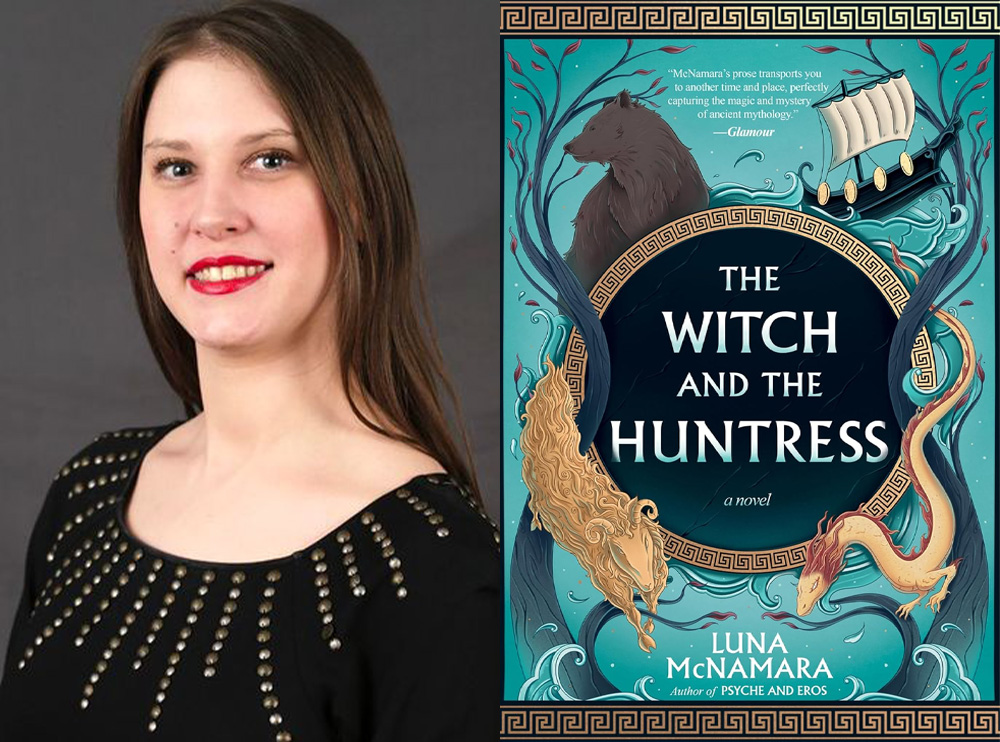
We chat with author Luna McNamara about The Witch and the Huntress, which sees two of Greek mythology’s most complex and powerful women—Medea and Atalanta—join forces on Jason’s quest for the Golden Fleece in this suspenseful, sapphic reimagining from the acclaimed author of Psyche and Eros.
Hi, Luna! Welcome back! How have you been since we last spoke for the release of Psyche and Eros?
I’ve been doing pretty well, thank you! I finished my masters’ of social work degree, volunteered at a wolf sanctuary, and bought a new (well, new to me) car. I also finished a novel entitled The Witch and the Huntress, which is what we’re here to talk about today.
Your latest novel, The Witch and the Huntress, is out April 21st! If you could only describe it in five words, what would they be?
Epic, bittersweet, witchy, sapphic, slow-burn.
What can readers expect?
The Witch and the Huntress is a sapphic retelling of the Argonautica, an epic quest narrative. Think of it as Chappell Roan’s “Good Luck Babe!” meets Madeline Miller’s Song of Achilles. It’s a book about mistakes and redemption and striving toward the life you want, which is a prize more elusive than the Golden Fleece. Also, there are pretty women with spears.
Most of all, it’s about the parts left out of the stories we think we know, and the simple truth that love is never wasted.
Where did the inspiration for The Witch and the Huntress come from?
After Psyche and Eros, I wanted to write a darker, more complex story. It was my hope to keep exploring the ancient world and the realms of mythology, but from a different angle. I found my direction when I read a passage from Diodorus Siculus’s Bibliotheca Historica, which records Medea (the famous witch) healing Atalanta (the renowned huntress) after a battle during the Argo’s journey. I was intrigued by the idea of these two powerful women sharing such a tender experience. What might have led to this moment, and what came from it? What has been lost or never written down in the first place?
Were there any moments or characters you really enjoyed writing or exploring?
I always love writing the character of Atalanta. She was a joy in my first novel, and it was a delight to explore her younger years in The Witch and the Huntress. I love her combination of vulnerability and brash self-confidence, her skill at wilderness survival and her baffled puzzlement at everything to do with the human world. And it was fun to write her falling in love.
There were also many moments from the ancient quest narrative of the Argonautica that I loved bringing to life, particularly Medea’s battle with the giant bronze automaton Talos, who stalks the beaches of Crete. But I shouldn’t spoil things for readers.
Did you face any challenges whilst writing? How did you overcome them?
Oh certainly. Second book syndrome is real, and I was writing on a compressed timeline with much bigger expectations. I had all the time in the world to write Psyche and Eros, but my second novel came with a deadline. Additionally, I was in graduate school, working, and studying for the state social work licensure exam – there was quite a lot on my plate for a while there.
I eventually found my way through these challenges by enlisting the help of trusted friends and beta readers, and by reconnecting with the stories I’d enjoyed in the past. The experience helped me solidify my values as a writer, and showed me the importance of telling stories in my own unique way.
Were there any key lessons you learned from your debut that helped with The Witch and the Huntress?
The biggest lessons I learned from my debut were about the non-creative sides of writing, such as preparing for interviews and author events, and citing my sources. However, the experience also impressed upon me the importance of my best piece of writing advice, which is: “If you enjoy writing it, someone will enjoy reading it.”
What’s next for you?
To be honest, I’m not sure yet. I’ve been thinking a lot about Persephone lately, and her familial relationships with her mother Demeter and her aunt Hera. I also find myself drawn to historical settings, especially the city of Alexandria during the fall of the Roman Empire and Salem, Massachusetts, at the height of the witch trials. It’s possible that my next novel won’t be a myth retelling at all, but only time will tell.
Lastly, what books are you looking forward to picking up this year?
I’m very excited about Servus by Emma Southon, which is a nonfiction book about slavery in the Roman empire. I’ve loved all of Southon’s previous books and can’t wait for this one.

On the fiction side of things, I’m looking forward to Peacock by James Hynes. It’s the sequel to his novel Sparrow, about a young boy raised in a brothel during the end of the Roman Empire. The first book was both brutal and beautiful, and I’m excited to read more about Sparrow as he grows into adulthood.