

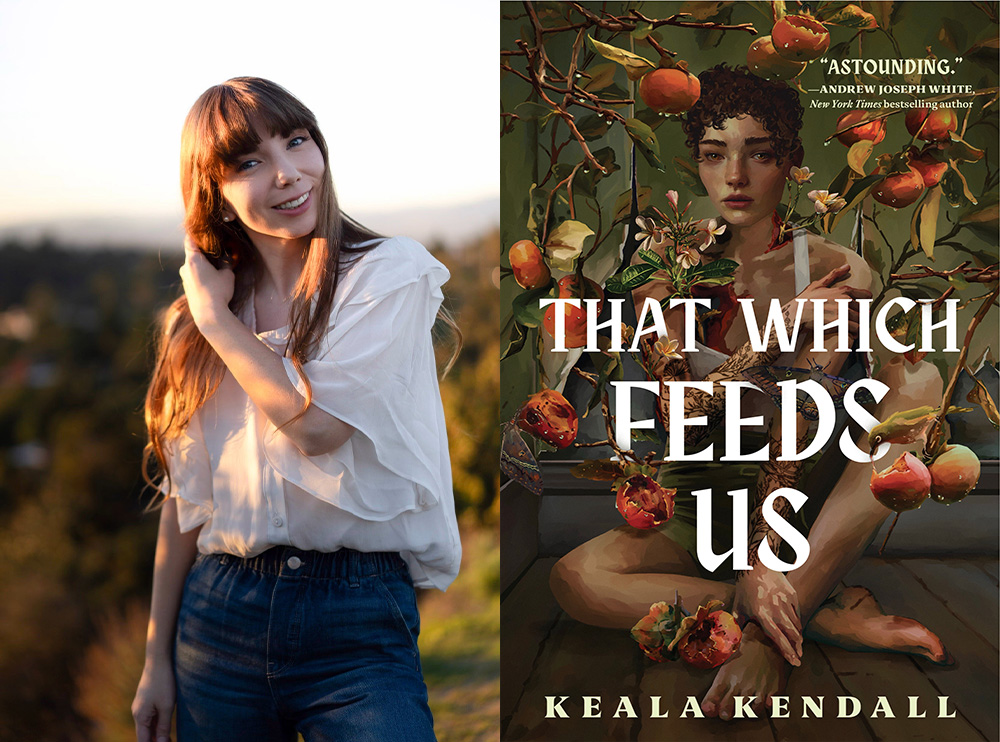
We chat with author Keala Kendall about That Which Feeds Us, which follows a native Hawaiian teen who travels to a luxury island resort in search of her missing twin and uncovers the dark side of paradise, in this riveting supernatural thriller.
Hi, Keala! Can you tell our readers a bit about yourself?
Hi! I’m a hapa Native Hawaiian author of sci-fi, fantasy, and horror, currently living in Los Angeles as part of the diaspora. I’m best known for my work on Disney’s A Twisted Tale series (How Far I’ll Go and Nobody Gets Left Behind), where I get to reimagine stories for characters like Moana and Stitch.
When I’m not writing, I’m probably co-running Pacific Islanders in Publishing, a community I co-founded to support other Pacific Island creators, hiking with my dog Mele, playing video games, or looking for a new book to read.
When did you first discover your love for writing and stories?
Honestly, it’s hard to say when exactly as I feel like I’ve always been writing. But when I was eight, my older brother got me into fanfiction writing about Inuyasha. Those stories were really my first “published” work, and writing them taught me that I could take a world I loved and make it my own.
Quick lightning round! Tell us:
- The first book you ever remember reading: My older brother read The Invasion (Animorphs) to me, but the first book I ever read entirely on my own was Inuyasha Vol. 1 by Rumiko Takahashi. After that, I got hooked on reading and read everything in the house, from The Hobbit to every romance novel my family had by Jude Deveraux and Nora Roberts.
- The one that made you want to become an author: Daughter of Smoke and Bone by Laini Taylor. Her prose made me ache, and I realized that I wanted to learn how to write sentences that could make someone else feel that deeply.
- The one that you can’t stop thinking about: Circe by Madeline Miller. Her reimagining is the only way I can see Circe’s story now.
Your latest novel, That Which Feeds Us, is out May 5th! If you could only describe it in five words, what would they be?
Hawaiian Gothic about paradise’s cost.
What can readers expect?
Expect a mix of Hawaiian folklore, atmospheric horror, and a critical look at wealth and escapism. If fans enjoyed Mexican Gothic or Welcome to Derry, this book is designed for them.
Where did the inspiration for That Which Feeds Us come from?
I was homesick and needed to go home, even if it was only on the page, so I started writing a story about a diaspora Native Hawaiian girl going home for the first time. But to show readers the real Hawaiʻi I knew, I realized I had to uproot the commodified, tourist-driven myth of my homeland they were familiar with: a paradise created for consumption.
Influenced by social commentary horror (Jordan Peele’s work, Mexican Gothic, and When No One is Watching), the story naturally evolved into a modern Hawaiian ghost story to tackle the haunting, ongoing impacts of colonialism.
Were there any moments or characters you really enjoyed writing or exploring?
I enjoyed writing Lehua’s dry humor and her observations about the resort’s guests. I also have a soft spot for the resort manager Chiyo.
What do you hope readers, especially those unfamiliar with Hawai‘i’s history, take away from the novel?
Although That Which Feeds Us is fiction, the novel’s supernatural elements serve as metaphors for the very real suffering and injustices Native Hawaiians endure. I hope readers recognize that the pervasive view of Hawaiʻi as paradise is a carefully constructed myth. One that has a very real human cost. And the only way to achieve real change is to acknowledge the truth of the past, rather than the fantasy of the present.
How did you approach reimagining traditional gothic tropes within a Hawaiian cultural landscape?
The gothic was a natural fit, given its focus on isolation, the inescapable influence of the past, and how it can prey upon the present, as I wanted to explore the haunting impact of colonialism and the ghosts that still linger in our homeland. I shifted the traditional gothic setting from a haunted house to a luxurious Hawaiian island resort to explore the gothic tradition of homesickness through a diasporic lens. In That Which Feeds Us, Lehua comes home to a land that has been transformed by tourism, making her feel like an outsider in her ancestral homeland. For the horror elements, I wove in my own upbringing and the Hawaiian folklore I grew up learning about.
Did you face any challenges whilst writing? How did you overcome them?
Like all writers, I run into writer’s block and imposter syndrome. While I haven’t figured out a way to overcome the latter, when I get stuck in a story, I try to check my outline and ask myself either 1) “What’s the worst thing that could happen”, or 2) “What would make me feel more excited about this scene?” to push myself to think outside the box and get unstuck.
What’s next for you?
I’m staying busy! I’m working on another Hawaiian Gothic about possession gods set within a haunted Hawaiian homestead community. I’m also looking forward to meeting more readers in May when That Which Feeds Us releases. Beyond that, I’m continuing my work with Pacific Islanders in Publishing to help bring even more Pasifika voices to the shelves.
Lastly, what books are you looking forward to picking up? Any you’ve read so far this year that you’ve enjoyed?
I recently read, loved, and blurbed Salt Water Blood by Manuia Heinrich. It’s a haunting YA thriller packed with Tahitian culture. It follows a girl who can hear the sea’s prophetic thoughts, and she has to embrace her gift to clear her brother of murder. It comes out November 17 and is available for pre-order now.

You can find Keala on Instagram, TikTok, Bluesky, and Goodreads.