

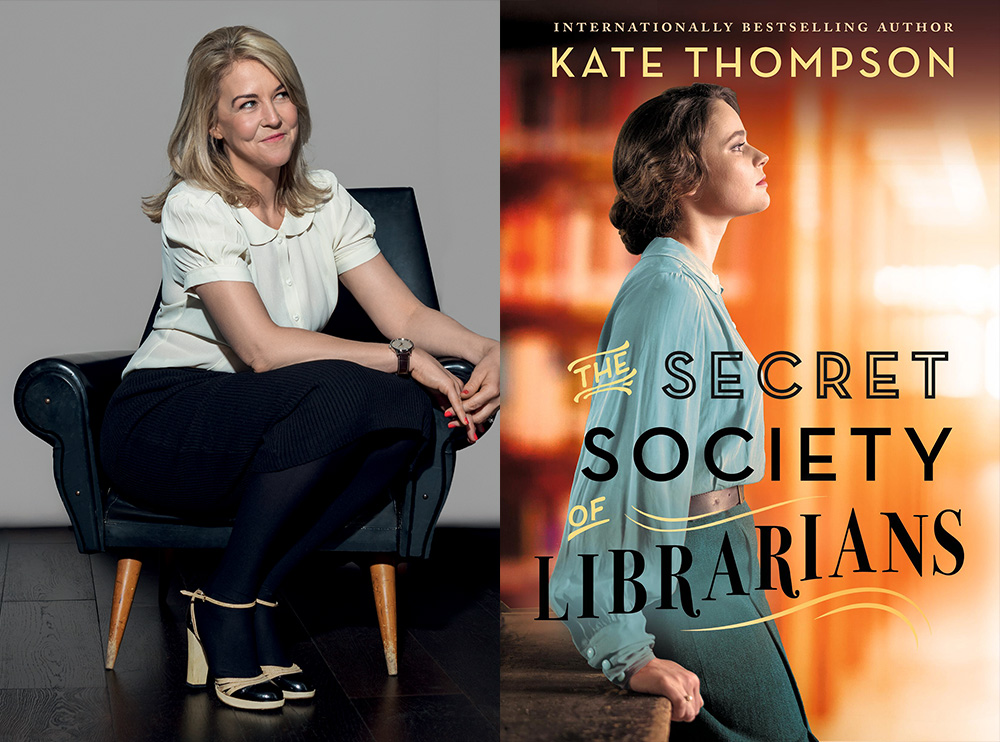
We chat with author Kate Thompson about The Secret Society of Librarians, which is a heartbreaking yet heartwarming wartime library-set novel, inspired by real people, real stories, and extensive research.
Hi, Kate! Can you tell our readers a bit about yourself?
Hi everyone. My name is Kate Thompson. I am a journalist, author and mum from Surrey in England. At the moment, I spent my days interviewing centenarians about their wartime experiences for my book, and when I’m not doing that, walking my two rescue lurchers, or cleaning up after two messy boys.
When did you first discover your love for writing and stories?
When I was about 7 years old in primary school, I remember sitting in a maths class feeling absolutely stumped. Everyone around me seemed to understand the lesson, but I felt like my maths teacher was speaking a foreign language. Then I went into my English creative writing class and it was like coming home. Writing stories and reading is the only thing that ever truly made sense to me.
Quick lightning round! Tell us:
- The first book you ever remember reading: Wind in the Willows by Kenneth Grahame.
- The one that made you want to become an author: Black Beauty by Anna Sewell.
- The one that you can’t stop thinking about: The Lion, the Witch and the Wardrobe by C.S. Lewis
Your latest novel, The Secret Society of Librarians, is out now! If you could only describe it in five words, what would they be?
An Emotional Love Letter to Books (sorry that’s six words)
What can readers expect?
A harrowing yet redemptive story of two libraries and their power to change lives in wartime.
Where did the inspiration for The Secret Society of Librarians come from?
In October 2022, I had a life-changing encounter. I met a 95-year-old Holocaust survivor in London and agreed to help her write her life story before it was too late. Renee Salt is a survivor of two ghettos and three concentration camps. For nearly six years, she stared into the abyss of almost unimaginable darkness. With the exception of two aunts, her entire extended family, numbering almost 200, were murdered by the Nazis and their collaborators.
Renee doesn’t remember her experiences of the Łódź ghetto, Auschwitz-Birkenau and Bergen-Belsen – she relives them through a series of vivid flashbacks.
I learnt that her trauma was a living thing. On many occasions, she would sit and weep, and I would hold her hand in silence, for what words of comfort could I possibly offer?
I vowed to help her piece together her shattered past. This meant travelling in her footsteps, from her old family home in Poland, across Europe to the sites of her persecution.
It was a delicate dance between roles. Journalist, writer, researcher and, finally, friend.
Whilst in Łódź researching Renee’s two-year incarceration in the ghetto, I came across the The Chronicle of the Łódź Ghetto, an extraordinary, lasting testimony of day-to-day life in the ghetto, written in secret by a group of prisoners.
Through this, I learnt that there were libraries in the ghetto. Prisoners set up clandestine lending libraries and loaned out books which they stored in hidden rooms.
In September 1942, after a Nazi selection, prisoners in the ghetto searched the attics, basements and apartments for forgotten books.
Some 30,000 books, from age-old family heirlooms to holy books, were rescued and lovingly preserved and catalogued. Shelves reaching up to the ceiling were filled with books that had been handed down for generations, forming a unique, but precarious ghetto library.
I couldn’t shake this library from my mind, and I knew that when I finished Renee’s book – A Do Not Cry When I Die – I would return to the library, if only in my imagination. Aren’t human beings remarkable? The ghetto library testified to the prisoners’ will to do more than just exist and to their desire to hold on to even the most fragile kind of beauty.

The novel began to take shape in my mind. I wanted to share a picture of two very different experiences of war and two very different libraries. One operating under Nazi Occupation in Poland, and the other running in Blitz-battered Britain. I was intrigued by the transformative power and escape of reading, whether that be by candlelight in an underground shelter in London, or in secret in a Nazi ghetto. And it dawned on me, reading is resistance.
Were there any moments or characters you really enjoyed writing or exploring?
As obviously painful as this history is, I felt some power in writing the scenes set in the Lodz ghetto. Reading providing prisoners with intellectual freedom and that all important ingredient for survival, hope! Borrowing, reading and discussing books helped to rehumanise the men, women and children in the ghetto. Giving Dorotha a voice felt, in some small way, like I was providing some of those nameless victims of Nazi persecution, the dignity and identity that the Third Reich stole from them.
Can you share some insight into your research process for The Secret Society of Librarians?
Research always starts with being curious, reading, listening, interviewing and then, travelling. In this case, to Lodz and Auschwitz in Poland, to archives and museums to really understand and learn about this dark period of history. My favourite part of research will always be sitting in front of an elderly wartime survivor and listening rapt to that unfiltered gush of social history.
Did you face any challenges whilst writing? How did you overcome them?
One of my characters was in a Polish ghetto that was hermetically sealed from the outside world, so she could not communicate with her friends in the Secret Society of Librarians based in London. That put up a wall between the friends. I created a device where the friends started a secret society at the outset of war and wrote to each other monthly with a bulletin entitled ‘”Libertum Per Lectio”, which means Freedom Through Reading.
This gave me a way for the friends to be able to communicate with each other through their words, even if they could not actually post their letters. Then, when the war ends, and liberation day comes, so too does their reunion. It was a challenge not to be able to rely on day-to-day scenes and dialogue to show friendship. I am obsessed with female friendships I’ve realised and how it nourishes us. I seem to return to it over and over through my writing.
What’s next for you?
I am currently writing a non-fiction for Penguin in the UK and Harper Collins in the US called Children of War. I am weaving together the threads of five women’s stories who all came to England in 1939, as refugees from Germany, Austria and Czechoslovakia fleeing Nazi persecution on board the Kindertransport. The youngest woman is 92, the oldest is 102. They are are all incredible characters and I’m enjoying writing it immensely. It’s coming out in the build up to the 90th anniversary of the Kindertransport scheme in 2028. It’s a tale of adventure, bravery and how we forge a meaningful life from chaos and despair.
Lastly, what books are you looking forward to picking up? Any you’ve read so far this year that you’ve enjoyed?
Like most people, I absolutely adored The Correspondent by Virginia Evans and Theo of Golden by Allen Levi. I have just heard that one of my favourite authors, Jodi Picoult has a new book out in September. Excitement levels are high.