


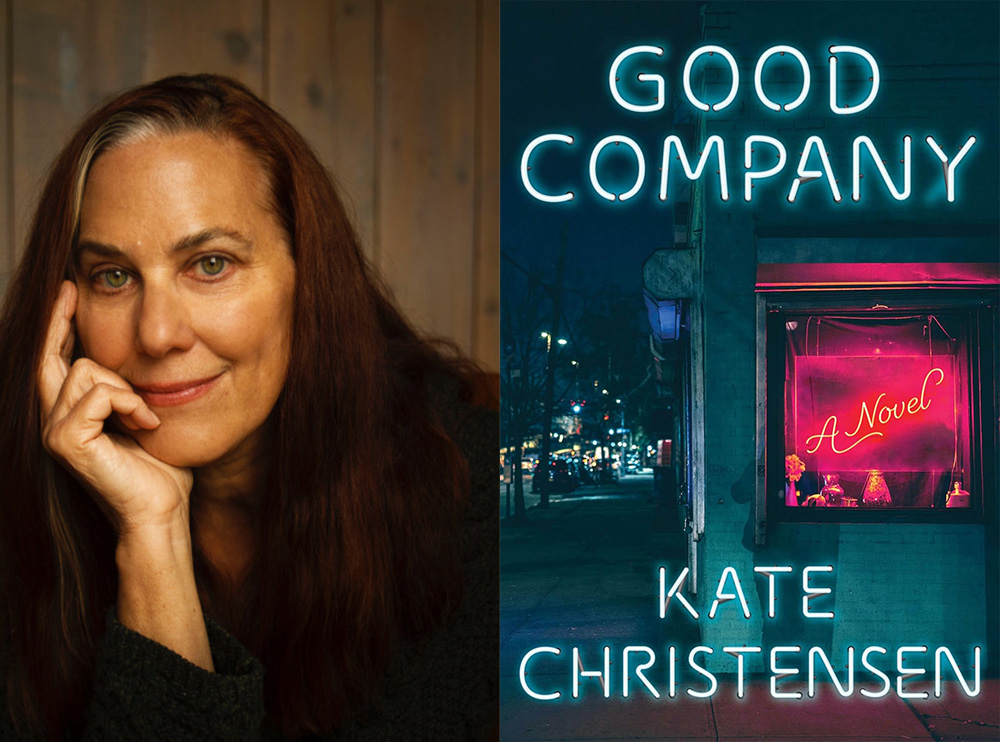
We chat with author Kate Christensen about Good Company, which is a compelling, searing, funny novel about women, sex, power, and self-reckoning.
What made you write this book? What was the initial impulse, and what was the inspiration that allowed you to see it through to the end?
Over the past ten or fifteen years, I’ve been feeling increasingly aware, both personally and generally, of how men treat women, but also how women treat one another, in ways that feel destructive but aren’t necessarily personal or intentional. Misogyny is widespread, entrenched, and shared by both men and women. Women tend to internalize it. Men tend to externalize it. But the source is the same, an almost universal view of women as less-than.
I wanted to write a novel about this. But to write a novel about something, you have to tell a story, you have to create characters whose interactions spark the ideas you’re writing about. Good Company isn’t a screed or a manifesto, it’s a fictional expression of my own recent deep dive into the sources of my own internalized misogyny and my complicity in the way certain men have treated me all my life.
What does the term “good company” mean?
In the context of the novel, the term “good company” means the kind of woman who isn’t needy, who never complains or criticizes, who takes it on the chin like one of the boys, no matter how sexist the jokes are, no matter how demeaned she feels. The price of admission to the club is to be the Hemingway dream girl, as I’ve always called it to myself. Hard-boiled, hard drinking, no trouble, nothing but fun.
The other, hidden price of admission is a loss of self-respect. But all you have to do to get that back is to leave quietly and never enter those rooms again, relinquish the need for male approval, get out of the female dance of judgment and competitiveness, move through it all toward real connection.
Good Company is set at a writing festival over the course of a weekend, but the chapters in real time are interspersed with excerpts from the memoir your protagonist, Julia, is there to promote. You published a memoir in 2011, fifteen years ago. How did your own experience of writing Blue Plate Special inform Julia’s in the novel?
Ever since I published Blue Plate Special, I’ve been aware of how much I had to leave out, how curated the memories were, no matter how real and honest they might have felt. This was partially because I was writing about a lot of people who were still alive; I had to couch the truth. But also, memory is a tricky, slippery thing, largely subjective, unlike the fictional imagination, which has an authority that cannot be denied or argued with.
I can be so much more honest in fiction than memoir. In my novels, I’ve always written about my family, exes, former friends, people who’ve done me wrong, people I’ve loved. But I used those relationships as springboards into wholly invented, fictional characters. This allows me to tell the truth in a way that doesn’t feel dangerous.
There’s always a tension in a memoir between what’s told and what’s left out. In Good COMPANY, I used Julia’s memoir excerpts to inform the present of the novel. She’s more brutally honest in her memoir than I was in mine, but she has blind spots. She’s not entirely aware of all the forces at play in her life, her own part in the dance of her relationships, and that was the point of including the chunks of her memoir, to illuminate her present-day life.
How much of your own life did you draw on for this novel?
It’s true: Julia is a middle-aged female novelist whose life and professional trajectory bear a glancing resemblance to my own. I used some of my own experiences in creating the tension between her memoir and her life; I felt that same tension in my fifties following the publication of Blue Plate Special. But I also made a lot of things up, created composites of real-life people, invented others. And ultimately, the great joy of writing this novel was that It’s not about me.
There’s something very raw and vulnerable about this book, as well as structurally risky. Was this a deliberate choice?
One of my early readers called this book “punk rock.” And I think that’s true, in the sense that it might feel subversive and truth-telling. It wasn’t a choice; the book demanded to be written like this. The style emerged organically in a way that felt very natural to me, without deliberate artifice or stylistic irony.

I wanted to show a woman at a moment of both personal and professional crisis, rooted in the present but informed by the past. And to do that, I had to figuratively open a vein and let it flow onto the page. It felt cathartic, but it also felt scary in a whole new way. It’s a new kind of book for me. And yes, it felt very risky, but I needed to write this book for so many reasons.
What are you hoping readers will take away from this book?
I hope readers will relate to Julia, even if they don’t always approve of her or even like her. By this, I mean that I hope they see some of their own experiences in hers and recognize her struggles. I’ve watched two “waves” of feminism rise and die. I watched the #MeToo movement ignite and become extinguished. Two of the most qualified presidential candidates in American history, both women, were recently defeated by a serial sexual predator. And through all of this, not very much has changed for women. In fact, things are getting worse for us. We need to talk about this. We need to talk about misogyny, including the ways in which we’re complicit.
Most of all, I hope readers are moved and provoked and affected by this book.