


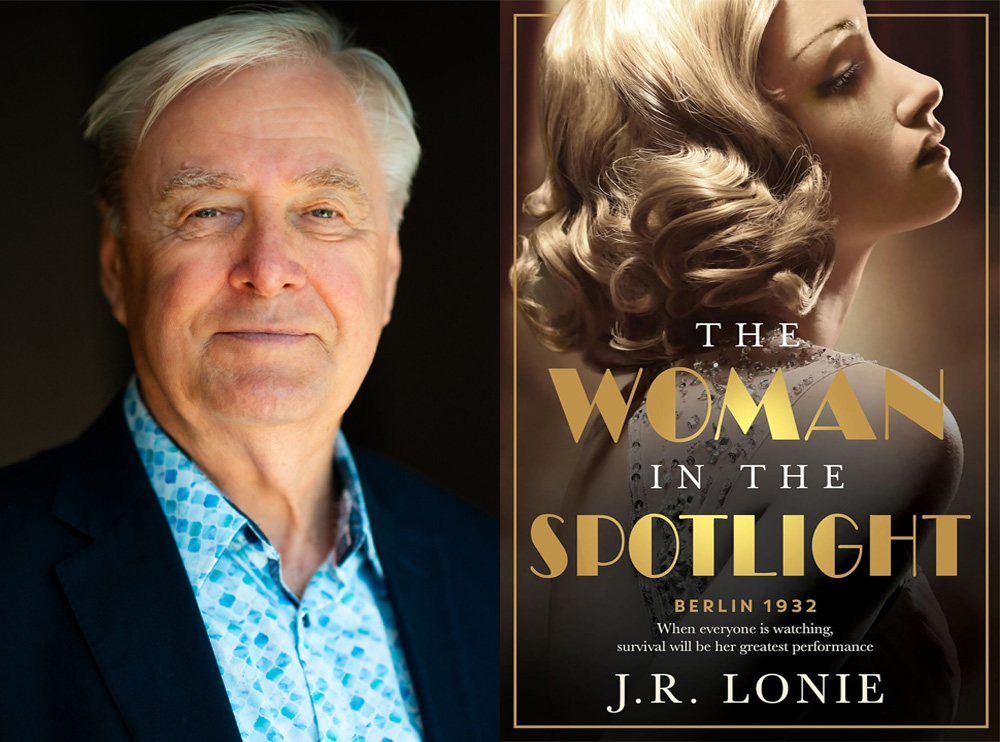
We chat with author J. R. Lonie about The Woman in the Spotlight, which is a gripping, utterly absorbing novel about survival and art as defiance on the 1930s Berlin stage, from the bestselling author of The Woman from Saint Germain.
Hi, John! Can you tell our readers a bit about yourself?
I’m Australian, originally from Queensland with red neck to prove it, but now I live in the centre of glorious Sydney with my partner who is a senior medical consultant. After a ‘career’ – word used loosely – in theatre, then film and television, including being Head of Screenwriting at the AFTRS, I can now devote myself to my greatest love, writing historical novels.
When did you first discover your love for writing and stories?
I always loved reading. The Queensland primary school readers were then very strong on stories and especially history, and I caught both bugs. When my dear parents took me to the nearest council library many miles away, I would always choose something historical, fiction or non-fiction. I studied history at university at UQ and the University of Adelaide, but blew up an academic career, thank God. I then worked in the local state theatre where I discovered you could write historical work for the stage. I was set.
Quick lightning round! Tell us:
- The first book you ever remember reading: A book about Charles the First and Cromwell, whose title I have long forgotten. But not the characters.
- The one that made you want to become an author: The Charioteer by Mary Renault.
- The one that you can’t stop thinking about: A toss up between Patrick White’s The Twiborn Affair and The Aunt’s Story, also by him.
Your latest novel, The Woman in the Spotlight, is out now! If you could only describe it in five words, what would they be?
Character
Thrilling
Atmospheric
Spiritual
True
What can readers expect?
A strong female lead character who is pitched into an impossible time, Germany under the Nazis, and who finds herself up against one of history’s monsters, Joseph Goebbels. From the wrong side of the tracks in Bavaria and despite being young, she arrives armed with native wit, cunning, perseverance and the rock of a strong religious belief. The world and her goal are the great theatres of Berlin which she and her gay director pal, also from the wrong side of the tracks, set out to conquer. The love of her life is Kurt, rich, sophisticated, Jewish and very political, which makes for a very bumpy journey to stay in love, let alone survive.
Where did the inspiration for The Woman in the Spotlight come from?
Mostly another novel, Mephisto, by Klaus Mann, about a young German theatre director who sells his soul to the Nazis, hence the title. But brilliant though it is, it’s a very one-sided fictional account of the man upon whom Mann bases the main character. I wanted in a way to right the balance, by telling the story of someone in the theatre who doesn’t sell their soul to the Nazis but who must live and work during the Nazi tide. Also, the question I asked my self – what would I do if such a regime took over my country?

Were there any moments or characters you really enjoyed writing or exploring?
Research is a real joy. There’s still a historian hidden inside me. I love going to the wonderful State Library here on Macquarie street, to the reading room to collect the book or books I have ordered. For this novel, the breakthrough discovery was that those fantastic Weimar years of German theatre, of which I suppose Cabaret is the best example in English, are a myth, best summed up by the great and late English satirist Peter Cook, who lauded “all those wonderful Berlin cabarets which did so much to stop the rise of Hitler.” Yes, those years gave us Brecht and Weill, whom I worshipped when young, but mostly they were years of politicised destruction. Had it not been for Max Reinhardt, who single-handedly kept the theatres alive and magical, most Berlin theatres would have closed during the Depression. This freed me from a myth and allowed me to see what happened afterwards in a different light, thus allowing me to understand why people like my main character didn’t go into exile after the rise of Hitler and who stayed and continued working.
Did you face any challenges whilst writing? How did you overcome them?
I wrote an earlier iteration of this novel which followed a different character who was neither an actress or a director and thus incapable of producing the story I eventually discovered. This wasted time of course but the research wasn’t wasted and going down the wrong ally, especially a long one, is part of the writing process. I overcame this mistake by throwing the earlier version away and starting again. But I was by then well-armed.
What’s next for you?
Another historically based novel, set in a real time and place, the Soviet Union in early 1953. I’d pitch it as Alice in Wonderland [Lewis Carrol] via The Towers of Trebizond [Rose Macauley] and the 2017 film The Death of Stalin.
Lastly, what books are you looking forward to picking up this year?
I’ve just started a novel in German titled Lichtspiel by Daniel Kehlmann, which I wouldn’t read until now because Joseph Goebbels is one of its main characters, as in The Woman in the Spotlight. Next will be The Fall of the Stone City by Ismail Kadare [definitely not in the original Albanian] which I got at a wonderful second-hand bookshop in Newtown here in Sydney. Then, returning home, Dreamwives by my ex-student at AFTRS and now novelist colleague Alexa Moses, writing under the name Claire Novak with Catherine Jinks.