
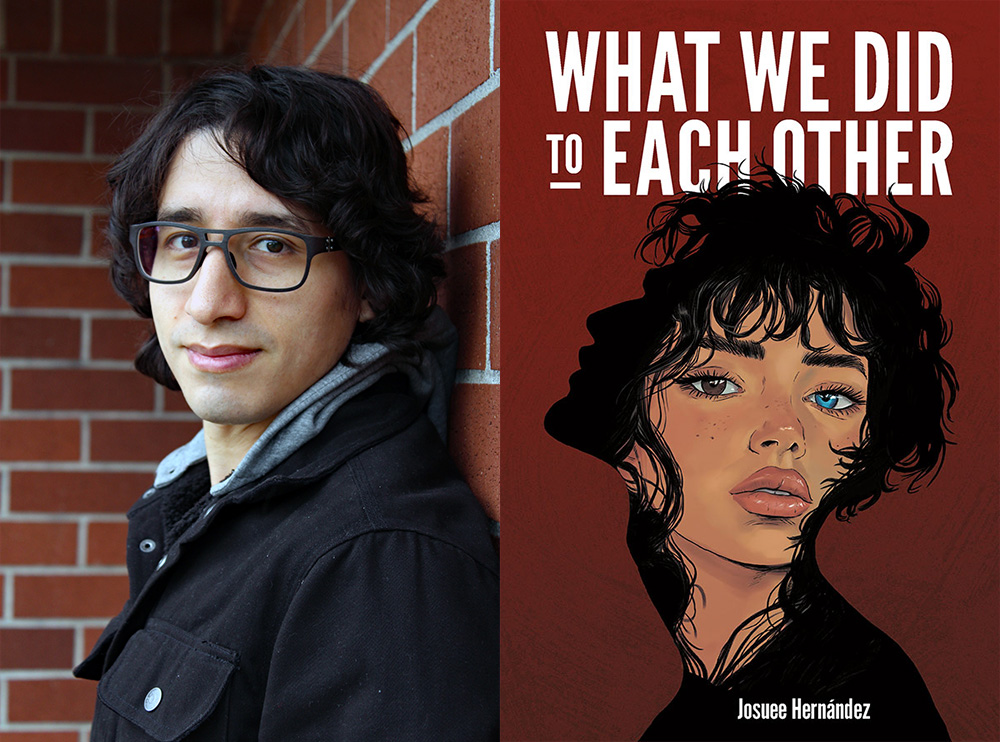
We chat with author Josuee Hernández about What We Did to Each Other, which follows two Latinx teens—one who strives to pass as white at her new school to earn the popularity she’s always desired, and one who settles into a stereotyped version of himself in exchange for being needed by his white peers. The pair grapple with the power and privilege of whiteness until the costs of their actions put them on a dangerous collision course.
Hi, Josuee! Can you tell our readers a bit about yourself?
Thanks for having me! My name is Josuee Hernández, and I’m an educator and author. My debut novel What We Did To Each Other releases September 30th, 2025; be sure to look for it at your local library or bookstore. When I’m not reading or writing, I teach Spanish and Language Arts to students K-12. The classroom is where I learned to love literature, so I’m happy to impart that same love and joy to my students. Beyond that, I like being on my bike whenever I can.
When did you first discover your love for writing and stories?
When I was a child. My mother would tell bedtime stories to me; sometimes she would sing them. La Llorona was one she’d tell to frighten me and my siblings (in a delightful way, of course), while a lullaby like Los Cochinitos she’d sing to put us to bed. These were Mexican myths and lullabies that she enjoyed telling as much as we enjoyed hearing. In many ways, I’m simply continuing my mother’s legacy of storytelling.
From there, I started imagining stories. I’d watch a show or a movie and think of a different ending for it, or wonder how characters would react if placed in different situations. I suppose I was imagining fanfiction in my head before I could even write!
By the time I learned to read, it was game over. The breadth and depth of writing, of storytelling within words? All love to the other artistic expressions, especially music, but there’s nothing like a good book.
Quick lightning round! Tell us:
- The first book you ever remember reading: Green Eggs and Ham.
- The one that made you want to become an author: “Never Marry a Mexican,” a short story by Sandra Cisneros’s Woman Hollering Creek, is the one that truly tipped me over the author edge, and I’ve been falling ever since.
- The one that you can’t stop thinking about: Passing by Nella Larsen.
Your debut novel, What We Did to Each Other, is out now! If you could only describe it in five words, what would they be?
What you see, isn’t always.
What can readers expect?
What We Did To Each Other focuses on the lives of two first-gen Latinos growing up in the Pacific Northwest as they navigate assimilation, racism and classism in their own gendered ways. Yesenia, wanting to fit in, dyes her hair blond and dons blue contacts to pass as white at her new school. Guillermo, a classmate, is immediately suspicious of “Jessie” Rivera, the new blond girl in class. The story unfolds as Guillermo tugs and unravels her mystery, and Yesenia begins realizing she’ll do anything to keep it.
It’s a non-traditional story of a Chicana and a Chicano coming of age in the United States. Not coincidentally, these are the people I had in mind when writing this story. It doesn’t intentionally try to subvert any tropes or address any issues, and it isn’t speaking for all first-gen folks, but I’m hopeful readers of any ilk can find the themes and situations familiar and relatable.
Where did the inspiration for What We Did to Each Other come from?
I’d read a lot of “passing” stories from Black American authors of the 20th century and prior, and I always found the concepts fascinating. Novels from James Weldon Johnson, George Schuyler, and the aforementioned Nella Larsen. As is the case with literature, those stories forced me to apply their perspectives to my own experiences. I asked myself: what would passing look like—and what would it mean—for a Latine? It’s already a phenomenon that’s happening in a lot of ways, but I thought it would be an interesting angle with which to explore a more committed story. So, I committed to writing that story. And the more I wrote, the more I realized how much culture, language, aesthetics and class complicated the question. These realizations, in turn, inspired me to continue until I truly finished.
Were there any moments or characters you really enjoyed writing or exploring?
Guillermo came much easier to me, but Yesenia was more challenging and thus more satisfying. It took a lot of imagination to create the situations she’d soon place herself in, and it pushed me to get more creative with her voice, personality, and drive.
Did you face any challenges whilst writing? How did you overcome them?
The biggest challenge was making the time to write. If you’re a working class writer—and most of us are—you’re going to have to sacrifice many things for the time and energy to write. Aspiring authors: what you’ll need to sacrifice, you’ll eventually find out on your own, and whether it’s worth it or not in the end, you’ll have to decide for yourself.
Another challenge: at a certain point, I began feeling a heavy sense of responsibility to tell this story correctly. To represent the speech and culture of my particular Mexican background in a non-superficial way, to truly delve into the themes and not try to answer easy questions. All this, while also trying to spin an entertaining web, made for an interesting set of difficulties. Looking back on it, I know I could’ve gotten away with a lesser book given the circumstances, but meeting these challenges was its own reward.
This is your debut novel! What was the road to becoming a published author like for you?
Not an easy one, and much bumpier than I would have liked, but very much worth it at the end of the day.
I wrote a short story in 2015 in a Creative Fiction class at Portland Community College. The instructor gave me a lot of great feedback, and it got me thinking about expanding the piece—Dr. Gardner Mein, if you’re out there, thank you for that class!

In 2016, I committed to writing a full manuscript based on that short story. I spent the next several years grinding in workshops with The People’s Colloquium (then The People’s Ink). Every week myself and other amateur poets and writers would critique each others’ excerpts, short stories and manuscripts.
Then Covid happened, and that threw most everything into disarray. Luckily, I was able to receive an offer of representation from my future agent in late 2020. Because I was also working a full-time job and studying for my Masters in Education, the next few years were an extremely busy time, arguably the most so of my life. Revising my manuscript, writing papers for class, teaching full time, all of that demanded a very strong dedication. Despite all that, I never felt like giving up on my book. It needed to be told, and I wanted my people to read it.
In early 2024, my agent messaged me with an official offer for What We Did To Each Other. Now, in September of 2025, my book will be available to the world. I never thought that short story in 2015 would take me on the decade-long odyssey it did, but I recall every moment since with fondness.
What’s next for you?
I’ve got some more adult characters stewing in the proverbial kitchen.
Lastly, what books have you enjoyed reading this year? Are there any you’re looking forward to picking up?
Right now I just picked up Hailey Alcaraz’s Rosa By Another Name, about a young Latina passing for white in the 1950s, shortly after Brown v. Board of Education. Kim Johnson’s The Color of a Lie I also had to devour earlier this year. Fiction about passing for the win.