

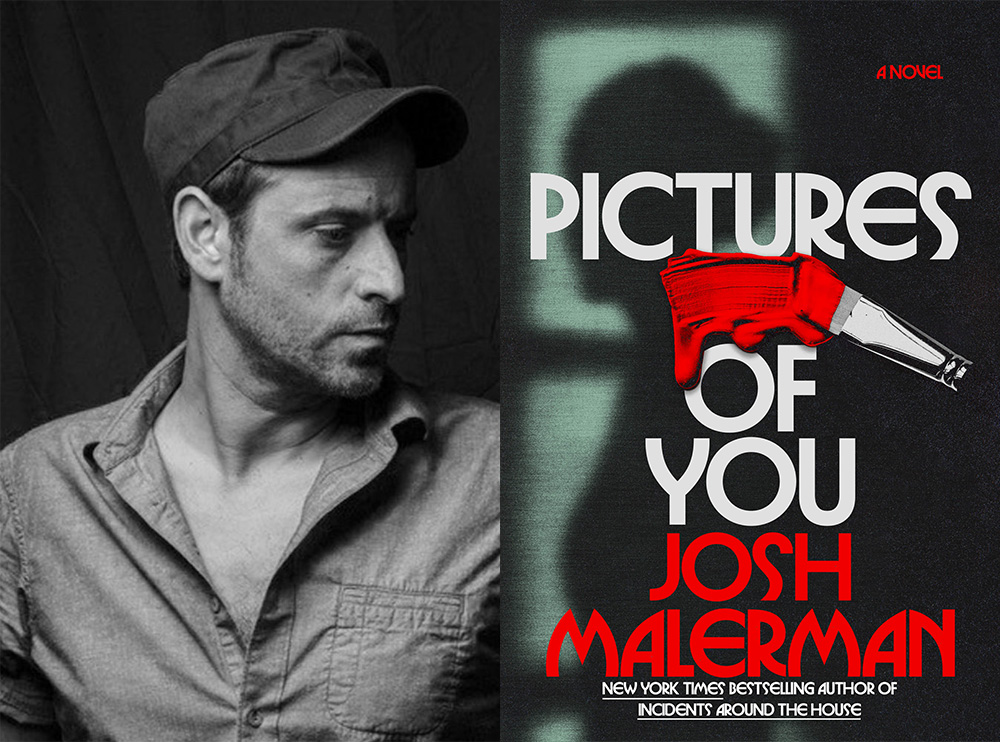
Guest post written by Pictures of You author Josh Malerman
Josh Malerman is a New York Times bestselling author and one of two singer-songwriters for the rock band The High Strung. His debut novel, Bird Box, is the inspiration for the hit Netflix film of the same name. His other novels include Unbury Carol, Inspection, A House at the Bottom of a Lake, Pearl, Goblin, Daphne, Incidents Around the House, and Malorie, the sequel to Bird Box. Malerman lives in Michigan with his fiancée, the artist-musician Allison Laakko.
About Pictures of You: A woman becomes the unknowing subject of an artist’s dangerous work in this intense Hitchcockian thriller from the New York Times bestselling author of Incidents Around the House. Releases on September 8th 2026.
Despite novelists often being last to know what their books are really about, I like to think the core of Pictures of You lies in the encouragement and discouragement of the arts, and how far the smallest compliment, or gibe, can go.
I was once a teenager in the backseat of my friend’s car when I absentmindedly sang along to a Doors song on the radio. The girl sitting beside me told me I had a “cool” voice. This was a moment. Would I have gone on to sing and write songs for The High Strung if Melissa hadn’t said those few words? I really don’t know. And had she told me I wasn’t any good… would the thousands of shows and dozens of albums have followed?
Scary thought, that.
Well, as someone who has now written a bunch of books, I can’t help but look inward. At least a little. And to notice the breadcrumb trail of moments that have led to a (truly) crazy (and wonderful) life of writing songs and books. And if I follow that trail back far enough… what did my first exposure to art look like? Who opened these doors so that I would one day feel comfortable enough to sing along to The Doors in the first place?
That answer is Mom. As Moms often do. And the place was here at home in Michigan, The Detroit Institute of Arts, as magisterial and full of wonder as any edifice I’ve ever been. The time was any time I begged Mom to take me to the DIA, so I could again see the pieces that were shaping me in a way I was too young to understand. But observe:
Pictures of You doesn’t only feature a dangerous artist with a dangerous vision, there is also Emily, the star of our story. And while she is captive in this other’s horrifying vision, she also has her own uncomfortable relationship with art. She gets anxious when her (awesome) boyfriend Jack brings the subject up. She goes quiet with friends at the Chaps Art Institute (you can now guess what place this fictional museum was based on). Emily constantly examines why she feels the way she does about art, even as she tries to escape the piece in which she wakes.
I don’t have that relationship with art. Neither Emily’s nor the woman who keeps her captive, but I do have a history of my own, a history that, now, examining the breadcrumbs on my own path, make total sense: a straight line from those afternoons with Mom at the DIA to the writing of the art-thriller Pictures of You.
Allow me to exhibit five pieces that blew my young man’s mind. Five that haunted the museum, I felt, and encouraged my imagination to reach out, to add to the pieces, even if a ten-year-old could not yet know how something like that could be done.
Observe:

Watson and the Shark
Self-explanatory, of course, why a preteen would beg Mom to take him to see this American piece from 1782. The artist John Singleton Copley made three versions, and I do believe this is the most unsettling of the bunch. For me, it was the near translucence of the water surrounding the boy Watson and the shark, the fact you could put your hand in that water if you really had a mind to, if Mom wasn’t near, if you were alone in this corner of the museum. The fact the painting depicted a real event was enough to give me nightmares. But it’s what Mom said about people calling it sensational at the time, shock-value, before it went on to become a classic… that was something extra that stuck with me. And while I don’t know if this is true, it was true for me, as a kid, and that idea opened conceptual doors beyond the fear I felt observing: doors that have remained open since and, maybe, probably, likely played a part in me writing about a woman who is certainly working with shock, and whose vision could be seen as something classic itself one day. But I suppose the fact she keeps her subject captive might hurt those chances. Still… who can be sure?

Celadon and Amelia
William Hamilton likely knew he’d infused canvas with despair in 1793 with this one. But when I was a kid, I didn’t know the story behind it. I didn’t see lovers at all; I saw a dark wizard (not dressed as wizards usually are, but also kinda) casting a spell on a woman in fantastical woods. It was the equivalent of a fantasy novel for me then and it still is. Sure, Hamilton meant to render a woman dying in her lover’s arms mid-tempest, but what is art if not the story we make of it before we know anything about it at all? I think our mad artist in Pictures of You would’ve liked to study this piece with me. Maybe she would’ve seen herself as a voyeur, framing the scene, doing nothing more than recognizing the artistry of a gesture, and the inherent power that lies within every moment, everywhere, literally everywhere, we look. Because to her, the act of seeing is the act of framing. Therefore, looking is art.

Armor in the Gothic Style
A pattern is emerging… a young horror-novelist-to-be, begging Mom to see the most sensational exhibits at the museum, choosing the art museum over video games and movies. I suppose Pictures of You was only a matter of time. And let me tell you, passing between multiple displays of Medieval and Renaissance armor, still young enough and therefore small enough to fit into these outfits… it was enough to make you want to nab one and set out on quixotic adventure on the beaches of the Great Lakes. It made you want to… cross a line. A pattern, here, indeed. Just like the mad artist of Pictures of You… crossing lines, fancying yourself chivalric… putting the art above all else, including, of course, the safety of any and all involved.

The Nightmare
I mean, come on. Come on. Henry Fuseli’s 1781 iconic symbol of sleep paralysis, housed permanently in the Detroit Institute of Arts, the museum just down the street. Do you have any idea what proximity to a thing like this might do to a young mind? Especially at night, feeling for your own chest, sleeping on your belly, making sure nothing could perch. It was one of my first introductions to the macabre, the gothic, and a brilliant one at that. But the truth is, the museum harbors only images that encourage the imagination, if the imagination is willing, and not all of them are “scary” by nature. Sometimes it’s just the look in the eyes of a portrait, the emptiness of a pub, the oily black shadows behind a heralded religious figure. Still, knowing The Nightmare is up the street is like having Dracula up the street. A bona fide centerpiece of the genre. I wonder what our artist in Pictures of You might think of this one? I imagine she would say placing an empty frame beside the bed of a sleeper would be more unsettling. And I’m not sure I’d disagree.

The Court of Death
Helluva title. Rembrandt Peale’s 1820 epic painting (almost 13×26 feet, framed). And what young man wouldn’t observe in horror the dead body at the feet of such ceremony? Symbolism abounds, but I didn’t need any of that back then. Not sure I need it now. The scope is big enough to put you in the room with the characters, to be present as either judgment or finality or morality is made.
I’ve always been a sucker for the giant paintings of any era, the original immersive theater, and I wonder if I studied this painting for ninety minutes if I wouldn’t walk away with the satisfaction of an entire movie, sinking into depth painted two hundred years ago. It’s almost an inverse of our artist’s philosophy in Pictures of You. Here, Peale uses scale to put us into the art. But the artist in Pictures of You believes art is already here, there, everywhere. And seen through a frame makes masterpieces of us all.
(thank you to Mom and the DIA for opening so many minds to the possibilities of the imagination)
(all photos by Allison Laakko, Josh Malerman, or Allessandra Abdo)
(pictured are Josh Malerman and Allison Laakko)