

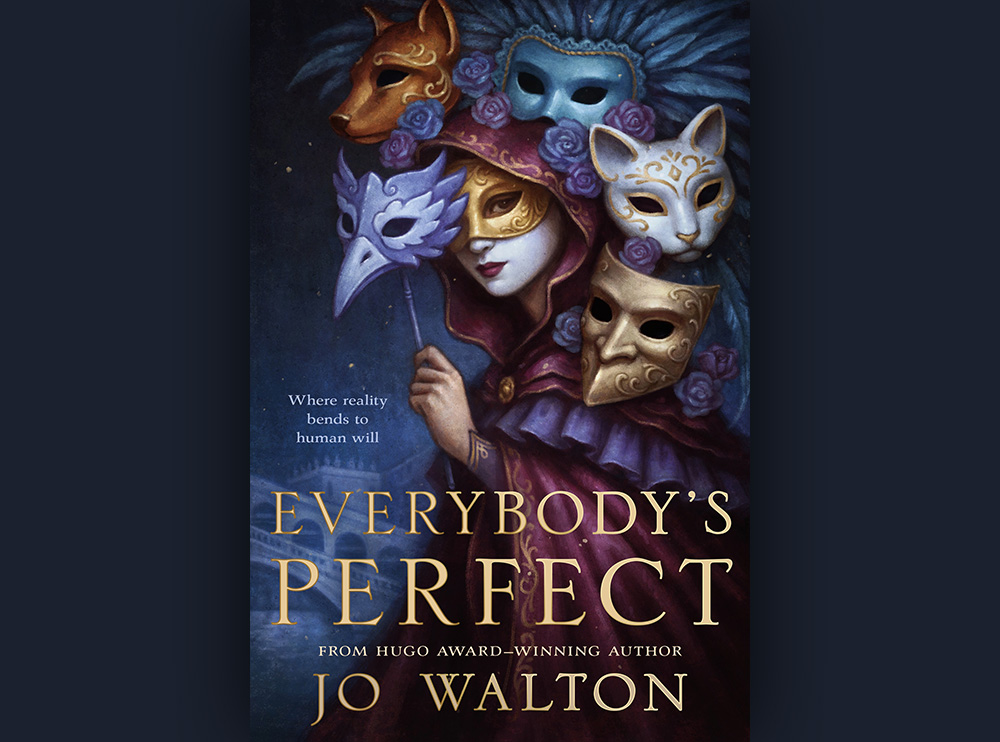
We chat with author Jo Walton about Everybody’s Perfect, which is Piranesi meets Swordspoint in an elegant relay race through fantasy Venice.
Hi, Jo! Can you tell our readers a bit about yourself?
I’m a writer, I live in Montreal, Canada, and Florence, Italy. This is my sixteenth novel, and I’ve also published three essay collections about SF and fantasy, one short story collection, and half a ton of poetry.
When did you first discover your love for writing and stories?
I’ve loved stories from before I can remember. I’ve also been able to read since I was ridiculously young — I was reading the Narnia books aloud to my sister before I stared school. As for writing, the urge to tell my own stories goes back to childhood as well. But I started writing seriously when I was thirteen. I got myself a notebook and started writing down story ideas and thinking about how stories worked and what I liked and how I could do that.
Quick lightning round! Tell us:
- The first book you ever remember reading: My very first memory is of standing up in my cot, holding on to the cot bars, and howling because my book had slithered out of the cot and was on the floor out of my reach. I stopped sleeping in that cot when I was eighteen months old. I want to say the book was Green Eggs and Ham, but actually I don’t remember what it was. It was a picture book, and it wouldn’t have been the first one I read.
- The one that made you want to become an author: Poul Anderson’s Guardians of Time, with a truly terrible psychedelic cover. I wanted to figure out how to write like that.
- The one that you can’t stop thinking about: One? One? That’s a really hard question. OK, yesterday I was reading Cameron Reed’s What We Are Seeking and it made me think about the subgenre of SF books where there’s a small colony on an alien world and they’re trying to find out about it, and how Ursula Le Guin’s The Left Hand of Darkness is sort of the origin of that subgenre, even though it isn’t really one of them, and then I went into a long daydream about Estraven and the Gobrin Ice, so that is clearly what I can’t stop thinking about right now.
Your latest novel, Everybody’s Perfect, is out now! If you could only describe it in five words, what would they be?
Knowing yourself, changing, blurring, home.
What can readers expect?
So the Serenissima is a fantasy version of Venice, which connects to our Venice and also to eight other worlds, inhabited, with cultures of people who have heads like Venetian masks, because the masks we know are based on what they look like. And the book has nine narrators, whose POV we get once each, like a relay race, and they come from those different cultures, one from each. So we see the Serenissima from all these different angles and build up a picture of what it is for different people.
Where did the inspiration for Everybody’s Perfect come from?
Venice.
Venice is really a very strange place. And the work of Alexis Shotwell on purity, and how requiring purity can prevent you getting good things done, and also her work on people living with AIDS.
Were there any moments or characters you really enjoyed writing or exploring?
Yes, all of them. Tiry, our first narrator is a Bauta, that’s the kind of mask that’s flat, no expression, straight right down to the chin, and he’s very warm and thoughtful and also very working class and practical, and also he has a kink where he’s attracted to Venetians, that’s what they call humans in the Serenissima. I really enjoyed his point of view. And then he hands the point of view off to Khadsha, who’s a Zanguni with a big mane of feathers and a domino around the eyes, and she’s a seer who can predict the future, and she’s been told not to stay in the Serenissima too long, so she keeps asking “Is this too long? Is this too long?”

Did you face any challenges whilst writing? How did you overcome them?
So I got very very blocked during the pandemic. We were locked down for a long time here, and I was lonely and depressed, and I didn’t write any fiction at all for a long time. So with this novel, which I wrote in 2024, I deliberately tried to make it easy for myself. It’s all beginnings, all new points of view, all first person but a new first person every ten thousand words. Those are all things I like, that are fun for me. So the challenge was believing I could write another book and then actually doing it.
What’s next for you?
I’ve just finished another novel called Sunlit Uplands, it’s very different, very political. It’s a road trip novel, where the characters are on a road trip across America through alternate versions of 2020.
Lastly, what books are you looking forward to picking up? Any you’ve read so far this year that you’ve enjoyed?
I loved What We Are Seeking! And I just read Ada Palmer’s And Loki In His Prison which will be out next June, and which is really wonderful. So now I’m waiting impatiently for her to write the second half of that, which will be called And Odin In His Tree. I recently read the first K.J. Parker Sister Svangerd book, which was a ton of fun, and I have the second one and I’m saving it for now. The third one comes out in December. I have the most recent Lois McMaster Bujold Penric novella, I’ll probably read that next. I’m looking forward to the new Marko Kloos, and the new Jennifer Crusie, and the new Lily Chu, I have those all pre-ordered. Volume 2 of Samuel Delany’s journals is coming out in January, that’s really exciting. And I’m really hoping that Rosemary Kirstein’s City in the Crags gets finished soon, because when it does I’ll drop everything else to read that.



I have read it, and it is utterly brilliant!