


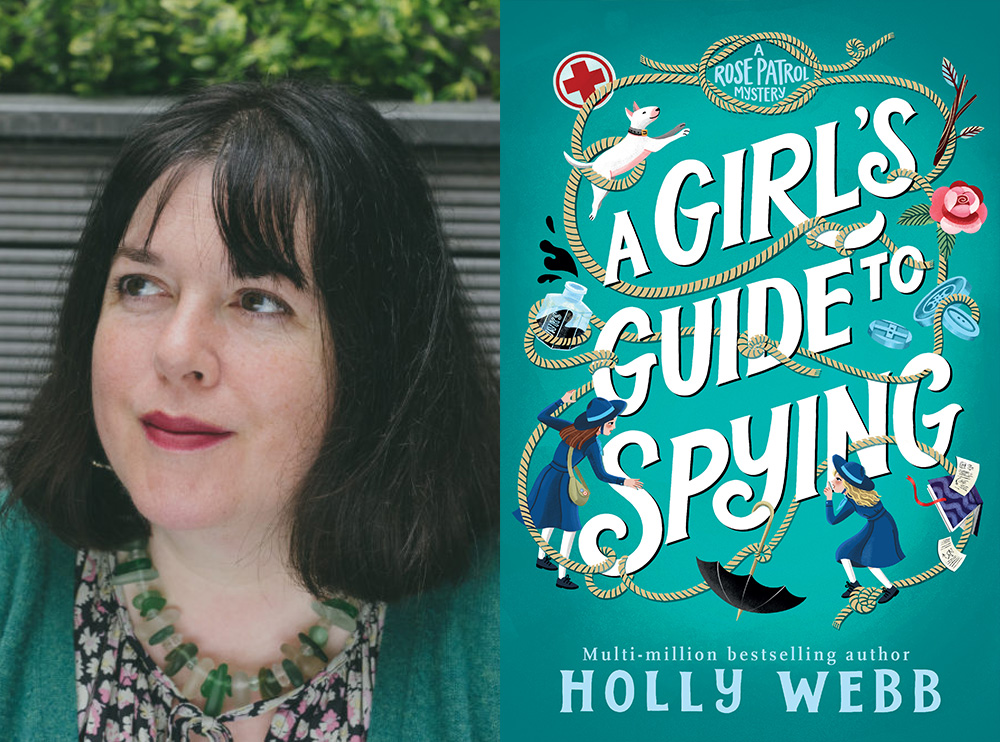
Guest post by A Girl’s Guide to Spying author Holly Webb
Holly Webb started writing while she was working as an editor at a children’s publisher and is now one of Britain’s best-loved children’s authors. Her books have been translated into 33 languages and sold going on for 2 million copies. Holly joined the Brownies aged 7, and still volunteers as a Brownie and Guide Leader. Holly lives in Reading with her husband, three children and two cats.
About A Girl’s Guide to Spying: The first in a thrilling new historical mystery series from internationally best-selling author Holly Webb, inspired by Holly‘s passion for girl guiding. Perfect for fans of Robin Steven’s Murder Most Unladylike series, Fleur Hitchcock and Katherine Woodfine.
One of the best bits of working on A Girl’s Guide to Spying has been the London setting. I love doing research for historical fiction, and this book had the added benefit of being set around places I already knew. (Although I did a lot of revisiting, and then even more intense studying of Google Maps while muttering to myself, my geographical skills are lacking…)
My main characters, sisters Phyl and Annie Dean, live behind their parents’ grocer’s shop in Marchmont Street. I have to admit that I didn’t pick the area just because it worked well for the plot. From when I was about eight years old, my father’s graphic design studio was in Marchmont Street, and it was a treat to visit – the designers had the best pens, scraps of beautiful papers I could steal, dummy books… I loved tapping back into those memories!
Phyl and Annie join the Girl Guides in 1914, back when the organisation was still relatively new. Guides were founded in 1910, and initially met with some public disapproval, as the skills and activities that were popular for Boy Scouts were seen as unladylike for girls. However, the outbreak of the First World War meant that Guides were needed for war work – they worked in hospitals, ran tea stalls for troops at stations and even worked as government messengers – and their reputation improved dramatically. It was becoming far less unusual for women to be seen in uniform.
From September 1915 MI5, which was then known at MO5(g), employed Girl Guides as messengers, carrying documents and spoken messages around the building and other War Office departments. Phyl and Ruby, her patrol leader at 1st Holborn Guides, join the messengers at Watergate House, the original home of MI5 (and then from 1919, GCHQ). The Guide messengers actually took over from a group of Scouts, who found the job too quiet, and kept getting into trouble!
Watergate House is in York Buildings, a tiny street in between Victoria Embankment Gardens and the Strand. It’s named after the original water gate, a grand landing stage built by the Duke of Buckingham for his mansion, York House. You can see the water gate in Victoria Embankment Gardens, but it’s now no longer anywhere near the water, due to the construction of the Thames Embankment!


Phyl, Ruby and the other Guide messengers are investigating a murder – they’ve been unfortunate enough to discover a body crammed into a cupboard in the ladies’ loo at Watergate House. Their investigation leads them on a wild chase through Victoria Embankment Gardens, at the edge of the River Thames. They end up at the steps leading down to the water by Cleopatra’s Needle. This was a landmark I’d been vaguely familiar with, but I didn’t realise until I started researching that one of the two sphinxes on either side of Cleopatra’s Needle actually has scars from a Zeppelin bombing in 1917. The final showdown takes place at the base of the steps down to the river, where the Guides chase their suspect into the water – and Hector, the bull terrier, performs a daring rescue…
London has other relics of the airship bombing campaign too. On 13th October 1915 five Navy Zeppelins left Germany intending to bomb London. L15 dropped a series of high-explosive bombs over Essex, and then appeared over London around 9.30pm. One of the bombs landed at the corner of Wellington Street and Exeter Street, between the Lyceum Theatre and the offices of the Morning Post newspaper. It killed 17 people, and injured 21 more. I was a student at the Courtauld Institute in the Strand, very close to the Lyceum, so it was a building I walked past often. I found it really moving to see photographs of the damage from the bombing, the arched brickwork on the walls of the theatre is so recognisable.

This is the first Zeppelin attack that Phyl and Annie experience – seeing the airships, and hearing the explosions. Their shop in Marchmont Street isn’t far from Russell Square Underground station, and the family argue about going to shelter in the tunnels. Russell Square station has its original tiled façade – it was built in 1906 – so it looks almost exactly as it would have done during World War I.
I’ve loved these moments, seeing the London landscape just as my characters would. I have to admit that the research also swallows time – I spent a couple of days trying to work out exactly where the Lyons tea shop Phyl visits would really have been, for example – but hopefully it adds a layer of realism to the story!

For a guide to the real-life locations in A Girl’s Guide to Spying visit Rock The Boat
A Girl’s Guide to Spying by Holly Webb, Rock the Boat, £7.99, Paperback