

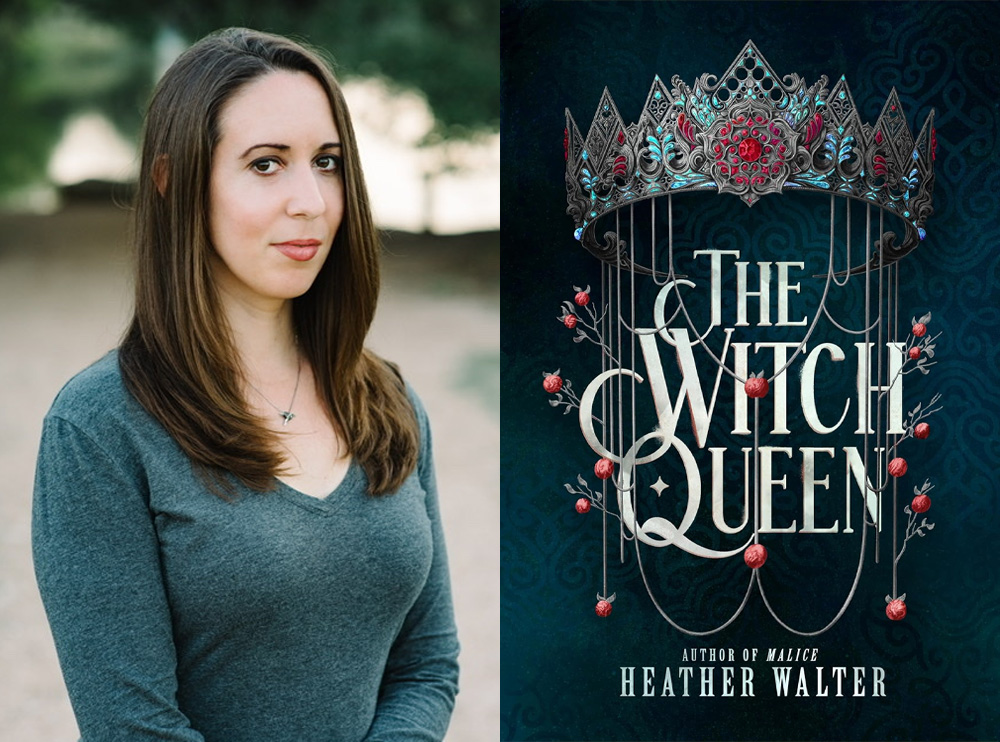
Guest post written by The Witch Queen author Heather Walter
Heather Walter has been telling stories for as long as she can remember. A graduate of the University of Texas at Austin with both English and Information Science degrees, books are–and always will be–a definitive part of her life. As an author, Heather loves writing about what-ifs, flawed protagonists, and re-imagined history. Her favorite characters are usually villains. When not writing, you can find her reading (duh), knitting, binging TV, and planning her next travel adventure.
About The Witch Queen: Pay the price of blood and snow: Snow White’s wicked queen rises to her destiny in the second book of a queer, witchy duology that’s hailed as “an alluring, vengeful origin story that brings tremendous dimension to the classic fairy tale” (Chloe Gong)—from the author of Malice. Releases August 11th 2026.
For as long as I can remember, my favorite character in any story has been the villain. Can you blame me? Sleeping princesses and epic quests to save humanity are boring. Villains, on the other hand, have much more fun—not to mention better wardrobes.
Which is why it’s always annoyed me that villains rarely get to leave their evil lairs long enough to tell their side of the story. Female villains, in particular, are often depicted as being youth-obsessed, baby-snatching (or cursing) homewreckers. Don’t get me wrong—I’m here for a petty grudge (I might actually be part crow), but don’t they deserve to have their say?
In my latest book, The Witch Queen, Snow White’s iconic villainess finally gets her chance to explain her version of events. Was she the jealous woman fixated on murdering her stepdaughter? Or did she have a good reason for poisoning the apple? You’ll have to find out for yourself. In the meantime, here are five novels that feature multi-faceted female villains worth rooting for.
The Heiress by Rachel Hawkins
If you support women’s wrongs, this book is for you. A delicious mix of southern gothic thriller, Succession-style inheritance games, and debutantes behaving badly, Hawkins delivers a fantastic story about woman who isn’t afraid to take what she wants.
At her prime, Ruby McTavish Callahan Woodward Millar Kenmore was one of the richest and most sought-after women in North Carolina. And one who just happened to leave a string of dead husbands in her wake. Coincidence, naturally.

Upon her own death, Ruby bequeaths her entire estate and fortune to her adopted son, Camden. But when Camden and his wife, Jules (who is hiding her own dark past), return to Ruby’s estate, they find more than a lavish mansion. The discovery of Ruby’s hidden letters unearths secrets that should have stayed buried forever. Camden and Jules must decide who Ruby really was—and if staying in the family is worth the cost.
This book was pure fun and I loved Ruby’s utterly unapologetic voice. Did she do some “bad” things? Maybe. But she also blazed fearlessly through a world built to cage her. Whether you condone Ruby’s actions or not, Hawkins has certainly crafted a novel which explores the lies—or truths—we tell ourselves in order to survive.
All’s Well by Mona Awad
You may already know Awad from her horror masterpiece, Bunny. This sister novel, All’s Well is just as unhinged and features a dazzling exploration of a hero’s descent into villainy.
The story follows Miranda, a former actress who suffers a debilitating accident during a performance of Macbeth. Years later, Miranda is still spiraling from the incident. Her acting career (and relationship) is over, she’s living with chronic pain (which no one believes is real), and she’s stuck running the theatre department at a failing arts school.

But things start to turn around for Miranda after she meets three mysterious men who might hold the key to a glittering new life. At first, that’s exactly what Miranda gets. Her pain suddenly vanishes, her mutinous students fall in line, and Miranda wreaks her vengeance on everyone who wronged her. But Miranda’s success comes with a cost. As events begin to spiral out of control, Miranda must decide how far she’s willing to go to be the star of her own show.
Like much of Awad’s other works, this book is a feverish mix of supernatural, horror, and comedy (I’m still cackling at Puffy Nips). But what I enjoyed most about the book was following Miranda down the rabbit-hole of corruption. Given her excruciating pain and disastrous personal life, no one can really blame Miranda for wanting to restore her career and vanquish her enemies. But how far is too far? I’m still not sure I know—and I loved that.
Diavola by Jennifer Marie Thorne
We’ve all heard that we’re the villains in someone else’s story, right? Well, what if that “someone” was your own family?
Thorne’s novel takes a classic haunted house narrative and drops it in the most dysfunctional family vacation you can imagine. Anna Pace is well aware of her status as the black sheep in the Pace clan. She’s not as successful as her siblings, she’s single, and everyone seems to be holding their breath, waiting her for next screw-up.

When the Pace family rents a villa in Monteperso, Italy, Anna vows to lay low and survive the week without incident. But the family drama sparks immediately, with Anna—predictably—at its center. And the passive-aggressive digs are nothing compared to the strange happenings in the house itself. Strange noises echo in the night, shadows follow Anna’s every step, and even the villagers try to warn the family to leave. As Anna investigates the history of the villa—which may be haunted by the ghost of a vengeful 15th century Italian socialite—her family becomes increasingly unhinged and blames the mysterious circumstances on Anna herself. By the end of the novel, Anna isn’t sure if they will survive the trip—or even if she wants them to.
To be fair, Anna isn’t necessarily a villain here, but she’s certainly made out to be one by the rest of hertoxic family, which made for an interesting perspective. What do you do when you’re unwilling cast in a role? Perhaps being a villain just means choosing yourself.
Lady Tremaine by Rachel Hochhauser
What if Cinderella was kind of a brat? Hochhauser executes this premise perfectly in her reinvention of Cinderella’s supposedly wicked stepmother.
Lady Etheldreda Verity Isolde Tremaine Bramley is in a bind. Her first marriage (a love match) ended in tragedy. Her second—which was supposed to grant her financial and social security—left her destitute and powerless. Now, living in a (literally) crumbling manor, Ethel must find a way to support herself and her daughters—including her stepdaughter, Elin, who refuses to lift a finger to help the family and openly despises Ethel.

When a royal ball is announced, Ethel hopes the opportunity will rescue her family from ruin. But Elin swoops in, scheming to secure her own engagement with the prince and leave her stepsisters—along with Ethel—destitute. As the royal wedding draws nearer, however, Ethel discovers disastrous secrets that will doom Elin. She must decide to whether to intervene on Elin’s behalf, or to let her ungrateful stepdaughter get what she deserves.
What made this book sing for me was how much it was rooted in reality. Was Cinderella’s stepmother a scheming fortune-hunter? Or was she just willing to do what it took for her own—and her daughters’—survival? With her grit, resourcefulness, and determination, Ethel is an achingly real person. And that humanity is what makes for an excellent villain.
Manor of Dreams by Christina Li
Part old Hollywood, part haunted house, all drama—Li’s novel is a masterful examination of generational trauma and the lengths we go to protect our own stories.
When Vivian Yin—the first Chinese actress to win an Oscar—dies, her daughters expect to inherit their mother’s crumbling estate. But in a surprise power move from beyond the grave, Vivian leaves the house to another family, one whom the Yin children haven’t heard from in years.

Refusing to give up their claim on the inheritance, both families move into the house, each scheming to kick the other out. But as the days pass, the walls of the estate start to close in, and its inhabitants begin to worry that they’re not alone. As paranoia rises, so do Vivian’s secrets—as well as those of the house itself. Soon, it may be too late to leave at all.
Li’s strength in this novel is the depth of the characters—each is selfish and bent on achieving their own ends, but also undeniably relatable. Vivian’s narrative is especially compelling. By the end, you’ll wonder who the real villain really is—or whether everyone carries some darkness in their heart.