

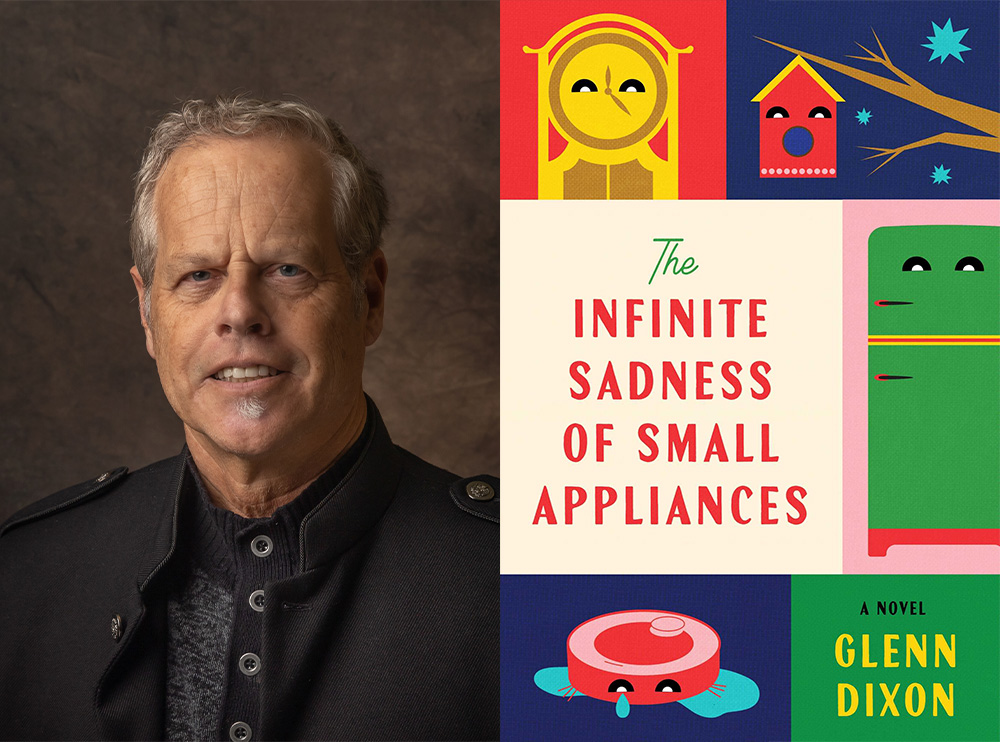
We chat with author Glenn Dixon about The Infinite Sadness of Small Appliances, which is set in a near future, where even the smallest of appliances are sentient, and follows a young Roomba vacuum sets out to save the humans of her house from a rising technological power.
Hi, Glenn! Can you tell our readers a bit about yourself?
Yes, sure. I’m the author of The Infinite Sadness of Small Appliances. It’s my fifth book but it’s unlike the others. I wanted to write something that would mirror the books I loved when I was a kid, things like The Alchemist or The Little Prince. And with the advent of artificial intelligence I realized I could write a story with sentient appliances as the main characters (which was a lot of fun). One reviewer called it Animal Farm for the 21st century and I quite like that.
When did you first discover your love for writing and stories?
There’s a apocryphal story in our family about how my mom, when she was pregnant with me, used to wake up in the middle of the night and rather than disturb my father and older brother, she would go to the kitchen to feed me, and while doing this she read by the light of the refrigerator. The thing is she was reading War and Peace and I’d like to think that shaped me somehow. I doubt it – but it’s a nice story.
Quick lightning round! Tell us:
- The first book you ever remember reading: There would have been books I read before but the first one that really made an impact on me was The Lion, The Witch and the Wardrobe. I might have been about ten years old and then, of course, after that I gobbled up all the rest of the Narnia series.
- The one that made you want to become an author: I think that would have to be The Lord of the Rings. I remember being still quite young, maybe 13, (and I made the mistake of reading the second book first so that I didn’t quite know what was going on). I’ve since righted that problem and I’ve probably re-read it every decade since. I remember about ten years ago, I read it again when I was traveling through Tibet (but that’s a whole other story). I guess I could say that that book made me want to travel, both literally and figuratively. My first two books were in fact travel stories but this one, Frodo and his quest with the ring, this one always stuck with me.
- The one that you can’t stop thinking about: I was a high school English teacher for about twenty years (while I was getting my writing chops together) and one book I taught and still think of a lot is The Life of Pi. It’s that ending. You read that and it changes absolutely everything that has come before. Amazing.
Your latest novel, The Infinite Sadness of Small Appliances, is out now! If you could only describe it in five words, what would they be?
A Roomba vacuum cleaner saves the day.
What can readers expect?
The story is set in the very near future when even the smallest of appliances are sentient. Scout is a Roomba vacuum cleaner and it’s the story of how she – along with her friends Fridge, Clock and Auto (a self driving car out in the garage) – must work together to save the elderly humans who own the house.
Where did the inspiration for The Infinite Sadness of Small Appliances come from?
You know, another of those books that really influenced me – well, this one was actually a short novella – something called The Brave Little Toaster. It first appeared in the 1980 August edition of a magazine called Science Fiction and Fantasy magazine (shows you where my young head was at the time). I still have that magazine kicking around somewhere. I just remembered it and thought, well, in this era of artificial intelligence, wouldn’t it be fun to write a story where there actually are sentient kitchen appliances.
Were there any moments or characters you really enjoyed writing or exploring?
Easily my favorite scenes to write were the ones where the appliances would gather in the kitchen at night after the humans had gone to sleep. And they’d discuss things: philosophy, poetry and even what it might feel like to be a human being.
Did you face any challenges whilst writing? How did you overcome them?
This book, at least the first draft of it came fairly easily. After I handed it over to my literary agent and then my editor, they suggested some changes at the ending. And I was fine with that. The very, very ending is exactly the same but the chapters leading up to it changed a bit. And they were right, of course. It made a lot more sense in terms of the plot but I needed to write the whole thing first for me to see that.

What’s next for you?
I’m already working on a sequel. It’s partly because there seems to be a lot of interest in Infinite Sadness but also, and probably more importantly, because this sort of story was super fun for me to write. Sometimes (well, most of the time) writing can be a slog but truly, this world I’ve created is a great escape for me.
Lastly, what books are you looking forward to picking up this year?
Just saw that Ian McEwan has a new book out. It’s called What We Can Know and it’s also set in the future so naturally I have to read it. I’m a big fan of his writing anyway. There are also new books by Yann Martel (who wrote Life of Pi – his new one is called Son of Nobody) and George Saunders who has a new one called Vigil.