


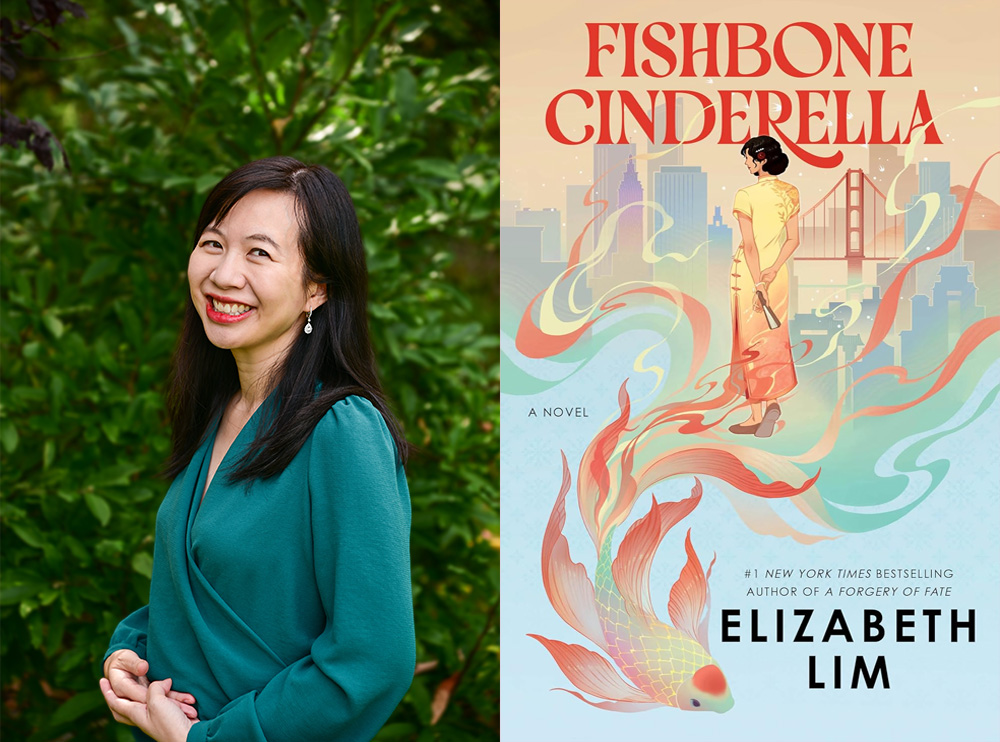
We chat with author Elizabeth Lim about Fishbone Cinderella, which follows a mother and daughter who must break their family’s curse through trials of war and immigration, love, loss, and redemption in this riveting multi-generational saga with a shimmer of magic.
Hi, Elizabeth! Welcome back! How have you been since we last spoke for the release of Her Radiant Curse?
I’ve been keeping busy, thank you! Lots of writing and spending time with my kids (my oldest has started picking up my books to read which is a whole new kind of awesome/anxious) and I’ve also been getting back a little into music.
Quick lightning round! Tell us:
- The first book you ever remember reading: Good Night Moon by Margaret Wise Brown
- The one that made you want to become an author: Ella Enchanted by Gail Carson Levine
- The one that you can’t stop thinking about: Daughter of the Forest by Juliet Marillier
Your latest novel, Fishbone Cinderella, is out now! If you could only describe it in five words, what would they be?
Generational curse hurts mother (and) daughter – for a sentence
Or — fairytale, women, heartache, immigration, love
What can readers expect?
Fishbone Cinderella is a multigenerational family saga about a girl who discovers she can turn invisible when the Japanese invade her village during World War II; then, forty years later, in 1980s San Francisco, her daughter has to find a way to stop her from vanishing completely. It’s a story about mothers and daughters, and a family that suffers a generational curse that divides them through war and trials of immigration, and love and loss—with a shimmer of magic.
Where did the inspiration for Fishbone Cinderella come from?
The inspiration for Fishbone Cinderella came from the stories my grandmother told me about her life: from escaping the Japanese during WWII to moving to Hong Kong and having to live with her father’s second wife, to meeting my grandfather and moving to America and working in the restaurant business.
The book was also inspired by the Chinese version of Cinderella, often called Yeh Shen or Ye Xian, in which there are magical fishbones instead of a fairy godmother, golden slippers instead of glass slippers, and a far more ambiguous happily ever after.
Were there any moments or characters you really enjoyed writing or exploring?
I have a soft spot for writing about food and romance, so I adored writing all Yut Ying’s cooking scenes and about the bakery she opens in California. I also loved writing the romance for Marigold in the second half of the book. What was also meaningful for me was getting to infuse the book with Cantonese food and culture—things like salted egg and congee, soymilk and wind-cured duck, and superstitions like avoiding fours and not sleeping with wet hair. They’re tiny bits of my heritage that I’m proud to have included in this book, and makes it feel even more personal.
Did you face any challenges whilst writing? How did you overcome them?
I found it very challenging to write a dual timeline book (my first, published!) and I spent a long time mapping out the structure for both Yut Ying and Marigold’s chapters and how their timelines would converge. Another challenge was self-doubt. Most of my previous books have been straight fantasies, and though I knew I wanted to write something different, I wasn’t sure whether I was ready to pull it off. But I’m very proud of how Fishbone Cinderella turned out, and grateful that the hard work paid off.

With Fishbone Cinderella spanning multiple decades, can you share some insight into your research and plotting process?
A lot of my research was based on the stories that my grandmother told me about her life, and of course I expanded upon that with my own studies. One of my favorite anecdotes from the research process involved the soymilk arc – I always planned on one of the characters in Fishbone Cinderella being the young heir to a soymilk tycoon, but what I didn’t know was that the mass consumption and production of soymilk in Hong Kong dated back to World War II. I learned that soymilk was vital to combatting malnutrition and food shortages during the Japanese occupation, since it was made from soyabeans rather than from milking live animals, and some of this history found its way into the character’s backstory.
This is your adult debut! Can you tell us about any changes to your writing?
Most of my YA books tend to be coming-of-age stories revolving around characters who are either in the teens or early 20s. While writing Fishbone Cinderella, you get to spend forty years with the main character Yut Ying, who is introduced as a six-year-old girl. You see her grow up, experience her first love and loss, get married, and have children—and I think as she matures, my writing and story within the book also matures. But it isn’t only her life cycle that’s explored – I also touch upon her mother’s and her daughter’s, which makes for a deeper reflection of the relationships between these women, and how it changes over the years.
What’s next for you?
I’m back to YA fantasy next, for a project I’ve been thinking about for a long time. Then I’m drafting a secret adult project that I’m very excited to get some words on.
Lastly, what books are you looking forward to picking up? Any you’ve read so far this year that you’ve enjoyed?
I have a lot on my list! Since I have some fantasies that I plan on writing, I usually stray away from that genre for my reading. I’m excited to read Kin by Tayari Jones, and When Sleeping Women Wake by Emma Pei Yin.