

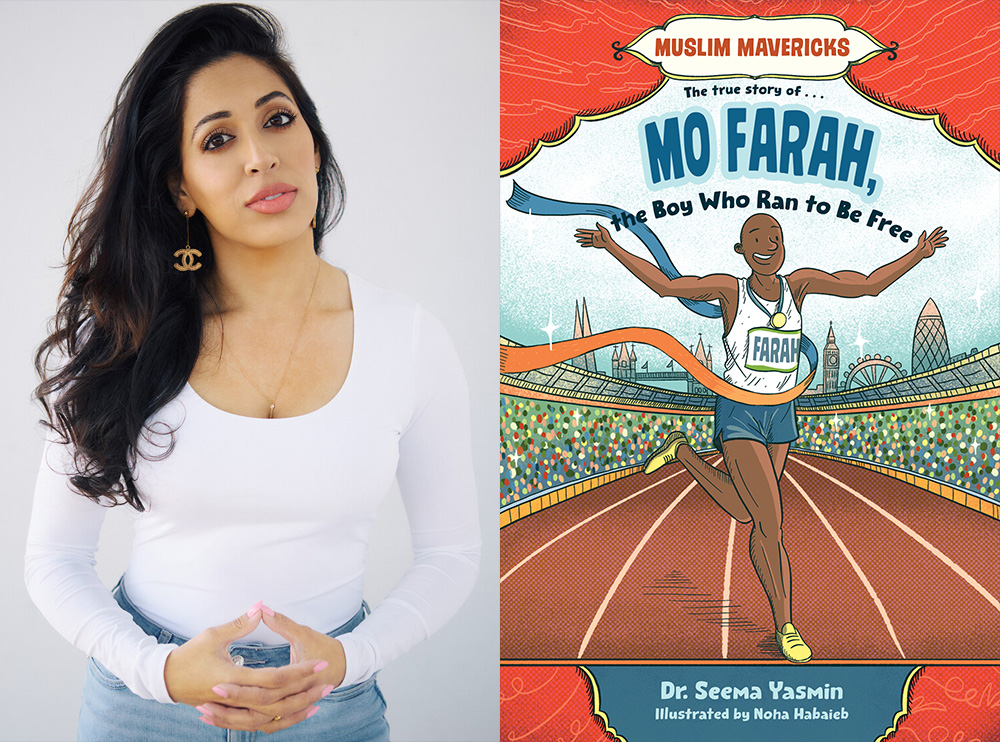
We chat with Dr Seema Yasmin about Mo Farah, The Boy Who Ran to Be Free, which releases on September 29th 2026 and it is the second book in the exciting nonfiction Muslim Mavericks chapter book series, about Olympic gold medalist Mo Farah.
Hi, Seema! What inspired Mo Farah, The Boy Who Ran to Be Free?
The first volume in the Muslim Mavericks series is the story of Maysoon Zayid, a brilliant and hilarious actress, stand-up comic and author, who has cerebral palsy. Her story shines a light on dreaming big and standing up for yourself. For the next book, I wanted to invite young readers into the world of a boy who grew up to achieve almost superhuman feats, as an athlete, and who managed to do that even during and after a difficult childhood. Maysoon’s story encourages us to think about ableism and disability; Mo’s story forces us to contend with the reality of millions of children worldwide who are trafficked, including 100,000 American kids who are trafficked each year. It’s a tough topic to broach and the book approaches it in an age-appropriate manner.
What research did you have to do for this book?
Lots of reading and lots of watching videos of Mo’s old races and interviews. I also learned about the prevalence and realities of trafficking and child labor, which was heartbreaking. I think of how many children we see in our day-to-day lives who might be living through what Mo endured as a boy.
What does your writing process look like?
I teach writing to graduate students, and I coach people with full-time jobs who want to write a book, so I think and talk a lot about the process of writing, and how different that looks for different people. For me, it also looks different at different times in my life. Right now, I’m on summer break before I commence the second year of acting school, so I am typing away like the Jim Carrey and Kermit memes: furiously. While I’m in acting school, it’s a challenge to write as vigorously as I am now. And even in this moment, I have stretches of days where my “writing” process looks like reading in bed, watching Netflix, and talking to friends. It’s all part of being a writer!
Tell us about the cover for Mo Farah, The Boy Who Ran to Be Free?
The book cover is illustrated by Noha Habaieb, who also illustrates inside the book, and who did the artwork for Vol I of the Muslim Mavericks series. It shows a smiling Mo winning a race with a gold medal already around his neck and a cheering crowd all around him. So, an average day in the life of Mo Farah, basically!
Why do you write in the genre (or for the age level) that you do?
I’ve written picture books, both fiction and non-fiction; middle grade non-fiction, as with the Muslim Mavericks series; fiction and non-fiction for young adults; as well as books of poetry, fiction and non-fiction for adults. My philosophy is “genre is but a line,” which I believe is a quote (possibly from the days of Twitter) by the poet Safia Elhillo. I am a perpetual line-crosser, I write what I want for whomever I want. I once met a novelist I admire who told me to pick a genre and “stay in my lane.” That’s a hard no from me. We need stories at every age and not only do I love writing for every age group, I encourage my friends to pick up a picture book or an MG or YA novel. In fact, just this morning, I told a poet I am book-coaching to read The Red Tree by Shaun Tan. It’s a picture book from 2001 and it is profound.

What do you hope readers take away from Mo Farah, The Boy Who Ran to Be Free?
That Muslims are not a monolith. That faith is a form of power. That people overcome hardships some of us can barely imagine. And that storytelling has the power to open minds and hearts.
What are you working on now?
I am revising my second YA novel, writing a screenplay adaptation of my first YA novel, and working on the third volume in the Muslim Mavericks series…but I can’t tell you who Vol III is about yet. Sorry!