


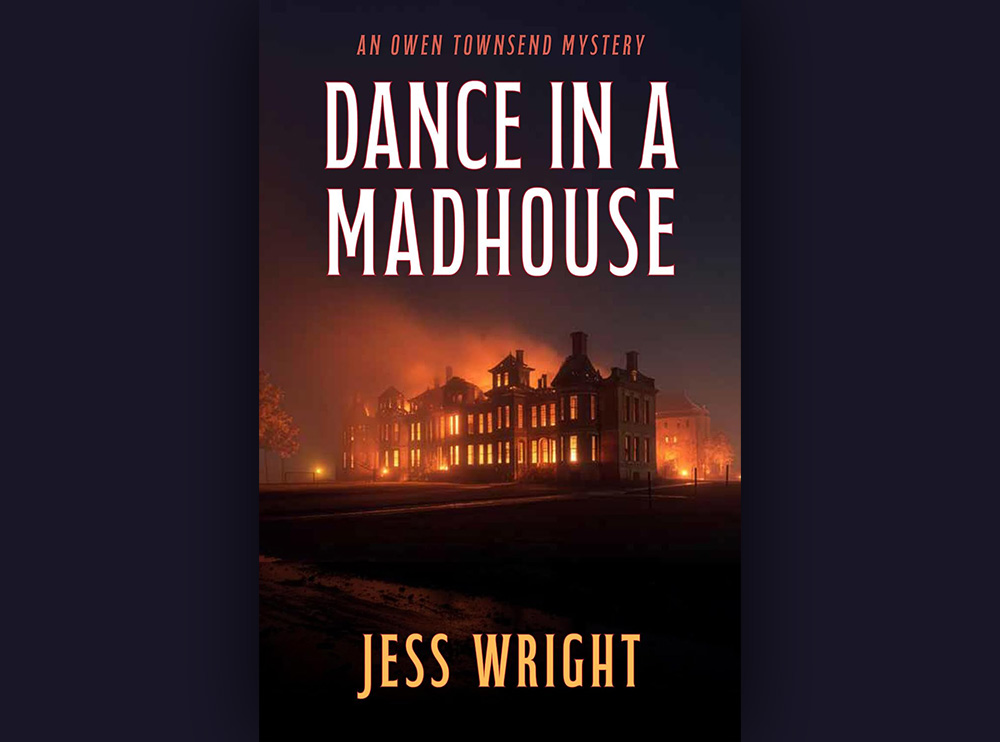
The gripping psychological tale of a young doctor who fights to escape an early-1900s Philadelphia asylum―and expose the plot to destroy him.
Intrigued? Read on to discover the synopsis and an excerpt from Dance in a Madhouse by Jess Wright, which releases on October 6th 2026.
Philadelphia, 1905. A month ago, Owen Townsend was a medical intern primed for success. Now he is locked in Fairmount Lodge, an asylum where the public is invited to gawk at the patients. His fall was sudden: typhoid fever, delirium, an act of violence. Is Owen sane―a victim of a toxin no longer in his system? Or is he as psychotic as his doctor claims?
There are fires at Fairmount. Attacks that defy logic. Terror instead of treatment. Though others dismiss his concerns as paranoia, Owen soon realizes that someone wants him put away forever―or dead. To survive, he not only must navigate the labyrinth of the madhouse but also must recruit someone on the outside to his cause. Brumbaugh, a shrewd police inspector, is the man for the job―and Celeste, an enigmatic young opera singer who transfixes him after he saves her from suicide, might have the clues they need to solve the mystery. But if Owen is going to find a way to freedom, he’ll first have to decipher riddles from Celeste’s tortured past.
Set at the dawn of modern psychiatric treatment, Dance in a Madhouse is a thrilling testament to courage and resilience. Can Owen and Celeste overcome the odds against them? Are redemption and healing possible? The dances will tell.
EXCERPT
Chapter 1
I didn’t know when I set off with Maude on that summer day that I was about to lose her and all the traces of success that had come my way. My degrees from the Ivy League, even a father set to run for governor of New York, were next to worthless tokens where I was to go. Asylum, retreat, lodge—might as well call it a madhouse, for that word captures what it was. Fairmount Lodge would be my prison, a terminal sentence. Fairmount Lodge, where the marked ones are hidden away, their shame locked behind the tall gates.
Months would go by before they told me about the horror I wreaked on that day in Central Park and then forgot in the haze of brain fever. Snippets popped back, then slipped away before making any sense. But there were some things I knew without doubt. My family had abandoned me and would be relieved if I was never seen again. People were being killed at Fairmount Lodge. And I was a target.
Paranoia, you might think. Owen Townsend is in the madhouse for good reasons. Keep him there.
I wonder myself. Was part of this story a phantasm? Or did every bit of it happen?
New York City, Late July, 1905
Maude and I were standing at the edge of the lake in Central Park when the first signs of my descent began. Something was wrong with my vision. The boats flickered like they were in a moving picture, jumping in quick volleys from frame to frame. Silvered mirrors reflected arcs of light from the water’s surface. When I looked at the dock, the light became more intense, so bright I thought it might blind me. Wood changed to glass. Fractured crystals where the dock had been.
When I closed my eyes, trying to reset my senses, rivulets of mercury appeared. Red penumbras were ready to ignite. Then a crashing wave of nausea—a reminder of the deep-in-the-gut curse of the typhoid infection. The doctors had discharged me from Bellevue yesterday, said I was cured.
The typhoid had been hellish. Made me wonder if my brain was ruined. It killed Josh Winters, another intern on my service at the hospital. Were the fevers coming back? Were the toxins still in me? Poisoning my mind?
Shivers of fear ran through me. The nausea surged, and I had to struggle not to wretch. But I tried to beat down the fears. You survived. A few aftershocks, that’s all.
The nausea began to subside as I talked myself down, used my medical learning to throttle the run-away fears. My fiancée was beside me. And I had a week to rest before going back to my internship at Columbia. Illusions. Be patient . . . They’ll go away.
I squeezed Maude’s hand and snapped my lids open again. Red and yellow boats were tied to the dock, just where they should be, ready to be rented. Four couples were on the water, rowing in the afternoon sun.
“What happened?” Maude asked. “I lost you for a while.”

“A little twitch,” I said. “Last of the typhoid. I’m okay now.”
I gestured for her to walk with me, away from the scene that had triggered the aberrations. Too much bright sun, I said to myself. A bit of photosensitivity. I had studied with the psychologist William James at Harvard and knew enough to understand these phenomena—not overreact. Of course, I wasn’t entirely well. My brain had been battered by the fevers. I needed more time to heal.
Maude put her arm in mine as we went down the grand boulevard in the shade of arched elms. “Being an intern almost took you,” she said. “It was those nights without sleep. Weeks with no break. Three of you with typhoid after eating in that grimy cafeteria . . . One of you dead.”
She had a point. We were worn down after only a month of the internship. I’d had one night free all month to be with Maude. There were dozens of patients with typhoid on my wards. We’d washed our hands with carbolic soap. Used gowns when we could. It hadn’t been enough. But Maude couldn’t convince me to quit.
“You could leave your internship, and no one would blame you. Take the job my father offered. We could be married at Christmas.”
I glanced sideways at the folds of her white dress and blinked. But the little fires in the depths of the folds wouldn’t go away. Maude’s voice was full of static, like it was coming from a damaged Victrola. I had ventured out too soon.
“Wall Street instead of wasting away in medicine. No more weeks when I can’t see you. No waiting for three years till you finish at Columbia.”
My family would second her arguments. Doctoring was beneath their social standing, though they would never say so. Since I had caught typhoid on the crowded hospital ward, the pressure had escalated to choose a more suitable profession. No one but my professors understood my attraction to medicine.
More flames were licking from the folds in Maude’s dress, and the path was starting to shimmer with arcs of light—chimeras like I’d seen at the lake.
Without warning, a chilling vision flashed in front of me. I was a patient in the neurology ward at Mass General, my bed in the line of hopeless cases. Korsakoff’s Syndrome, terminal syphilis, decorticates. Shells of humans. No purpose left but to be a teaching case. The chief neurologist with his silver-headed cane came by with his troop of medical students. A curt nod, and they continued their rounds. I was a non-being.