

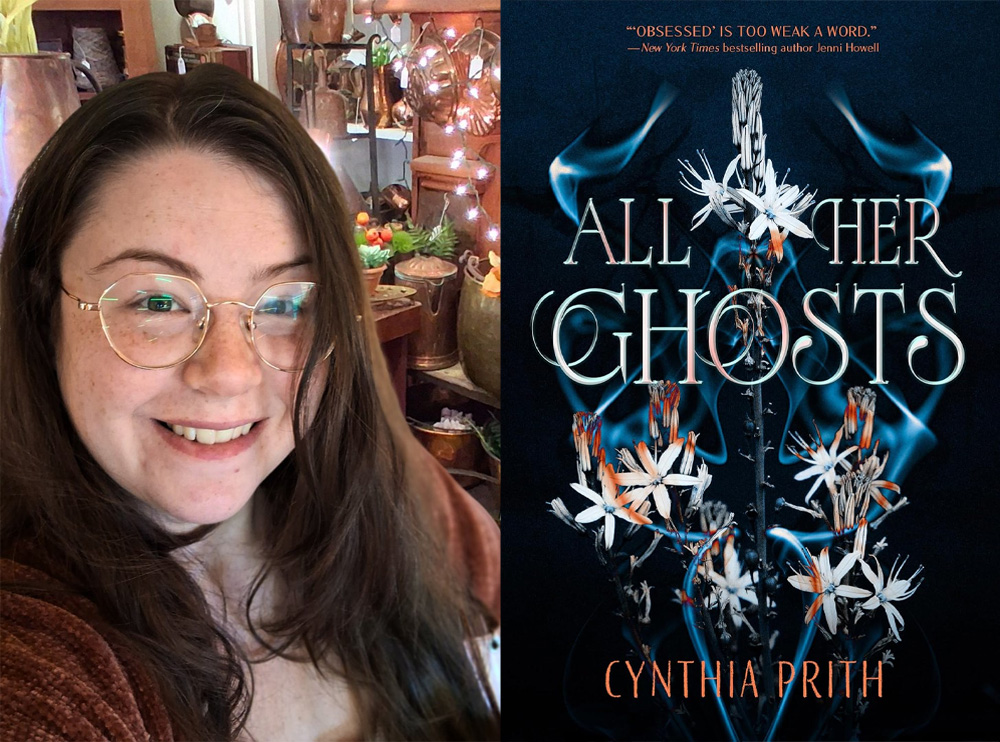
Guest post written by All Her Ghosts author Cynthia Prith
Cynthia Prith is a fantasy author working on becoming a swamp hag in the backwoods of Pennsylvania. She splits her time between writing in her cozy hobbit hole and wandering unique roadside attractions and vintage thrift stores in search of magical curios. All Her Ghosts is her young adult debut. She is also the author of the adult series, The Uncivil Wars.
About All Her Ghosts: Inspired by ancient mythology, Cynthia Prith’s All Her Ghosts is an otherworldly retelling of the Hades and Persephone story full of danger, action, and star-crossed romance, perfect for fans of Rebecca Ross and Sarah J. Maas. Out July 7th 2026.
PLUS you can read the first chapter at the end of the post!
I think by now everyone has heard at least one version of Persephone and Hades. There is something so compelling—so invocative of human nature—about a story that changes (and yet, crucially, doesn’t) based on who tells it and how they frame it.
When Hades is the main character, their story is the seed that grew Beauty and the Beast—a monstrous guy from the wrong side of the universe who falls in love with a woman who is sunshine and life. Basically, she’s everything he isn’t. And when she somehow miraculously sees the good in him, he’s helpless. Love is a transformative force of nature. Hers alters not only his world but the literal framework of reality itself, her presence or absence from the world above determining the seasons.
When Persephone is the main character, it’s a story about how scary it is to grow up. To leave the safety of your mother’s house and brave a terrifying new world so different from your childhood. To fall in love for the first time, transforming into someone new, someone who must risk the careful negotiation of six pomegranate seeds—balancing your responsibility to the family that created you and the family you create yourself.
When Demeter, Persephone’s mother, is the main character… well, that’s a story of loss. The last evolution of love is always change. Because everything changes, no matter how much you love it. Change, like death, is inevitable.
But let me tell you another story. In a lot of ways, it’s a different one.
On the other hand, in a lot of ways, you’ve heard it before.
Once upon a time, Loki, a trickster sort-of-a-god-if-you-squint, had a daughter. Like all his children, she was a little bit monstrous. In her case, that meant she was half corpse, half woman. And like her daddy, she was deviously clever. Unfortunately, Odin heard a prophesy once about the kind of mischief Loki’s kids might get up to—eating the sun, ending the world, you know how it is—so he stuck her down in Helheim where he thought she couldn’t get up to trouble, forced her to caretake the dead. Apocalyptic problem solved…
Right up until the day Loki happened upon a shining god of the harvest whose mother loved him so much she made every plant and animal in the world swear an unbreakable oath never to hurt him. As you can imagine, Baldr was a hit at parties. Used to let all the drunks use him as target practice, laughing when they couldn’t hurt him.
But Loki, well, he’s a bit of a turd. So he went looking for a loophole to that perfect invulnerability. Found one—mistletoe, a new plant, overlooked by that mother trying desperately to protect her child from change—made an arrow out of it, stole that shining harvest god out from under her nose, and shipped him express straight down to his daughter.
Happy birthday, kid. Daddy picked you out the best boy in the catalogue.

Of course, Baldr’s mom wasn’t thrilled. She immediately sent someone down to rattle Hel’s gates, demanding her son back. But remember—Hel is devious like her daddy. She told the guy, “Sure. You can have him back. Just so long as everything alive and dead weeps for his passing.”
But here’s the thing: there are no other creatures alive and dead but her.
So Baldr stayed. Harvest and Death. Hades and Persephone. A story about love—between partners, between parent and child, between life and death. A story about the unavoidable necessity of transformation. The pattern repeats over and over in myths once you know where to look for it. The same story, the same two entities—only the perspective changes.
When I sat down to write ALL HER GHOSTS, I wanted to pay homage to that tradition by changing the perspective yet again. Rather than write a retelling, I wrote a sequel. The names change—their names always change—but when the sun sets, Harvest and Death are Harvest and Death. And as time moves forward, so do they… Some things are different now. The ancient Norse and Greeks didn’t have high school and stolen RV road trips and U.S. government conspiracies to uncover. But some things—love; how it changes you, how it doesn’t, how it reveals the person you were always meant to be—stay exactly the same as they have always been.
As Sebastian says in ALL HER GHOSTS—“I knew you when you hung the stars. I knew you in the Nile, in the asphodel and in Helheim. I knew your legs under a shitty library table. I’d know you anywhere, any piece of you. I have always known.”
EXCERPT
Excerpted from All Her Ghosts by Cynthia Prith. Copyright © 2026. Available from Union Square & Co., an imprint of Hachette Book Group, Inc.
 Loading…

 Reload document
  Open in new tab