


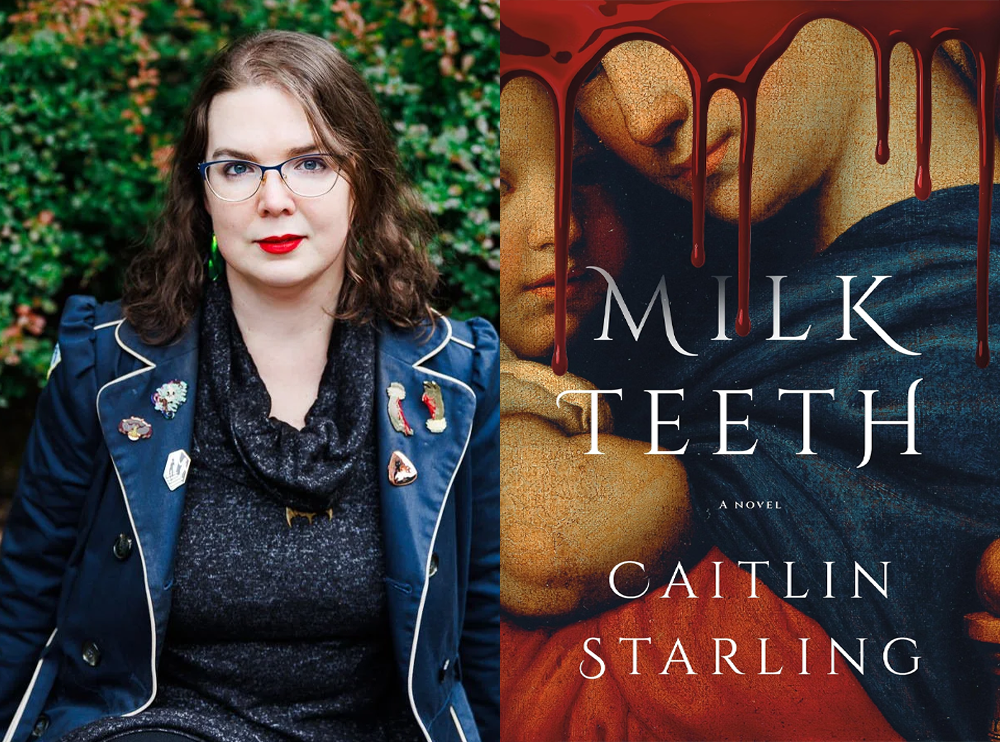
We chat with author Caitlin Starling about Milkteeth, which is a dark, seductive tale of hunger, love, and transformation.
Hi, Caitlin! Welcome back! What have you been up to since we last spoke for the release of The Graceview Patient?
Way, way too much! Edits and promo run up for Milkteeth, and I’ve turned in the draft of a new book in the world of The Starving Saints. I’ve also made an unhinged number of sweaters.
Your latest novel, Milkteeth, is out now! If you could only describe it in five words, what would they be?
What if… breastfeeding vampires?
What can readers expect?
Milkteeth is the story of Beatrice, a vampiric broodmother. She’s essentially a wetnurse and den mother to newly-turned vampires, guiding them through a three year maturation process that the rest of her kind prefer to be… hands off during. Beatrice is very good at what she does, but as the book opens, her body is beginning to change in ways she has no explanation for. When she’s given a third charge, things really start to go off the rails, and Beatrice starts running up against the bars of her (depending on your perspective, either filthy or gilded) cage.
It’s both very domestic/quiet and also extremely rancid and violent. As much as some of Beatrice’s experience is an exploration of mortal maternity and lactation, she’s also very much still a monster.
Where did the inspiration for Milkteeth come from?
I, unsurprisingly, have a four year old. I pitched the book when he was two years old and still nursing, and wrote it while I was weaning him. It was a way for me to capture and process my feelings about a very weird transitory portion of my life. It was also a really fun “what if” to spin out the worldbuilding on. What if vampiric transformation was lengthy and messy? What if it was insanely demanding on the vampire feeding them? Who would choose to take on that burden, and how would that influence the power dynamics between vampires?
Were there any moments or characters you really enjoyed writing or exploring?
There’s a scene involving a kitchen table that is definitely up there, but also ridiculously spoilery to talk about in any detail. There’s also the character of Gorgeous, who started half as a joke (a vampire named Gorgeous who looks like a corpse), and quickly became intensely relatable and tragic (he’s the standard, “my hot vampire boyfriend made me immortal,” except that hot vampire boyfriend hasn’t come to visit in three years, and isn’t going to like what he finds…)
How did you develop the concept of a broodmother, and how does it challenge traditional portrayals of vampires?
In answering all my what-ifs, I learned into the monstrous and animalistic side of vampirism. The predatory and cruel element, and the alien from human morality. With Beatrice staying almost entirely in her own enclosed world (for her, a hidden set of offices; for her progenitors, fetid crypts and stinking abandoned industrial areas) and only dealing with other vampires, she has less incentive to act human.

The story blends gothic horror with elements of bodily transformation. What drew you to explore these genres together?
They go together so naturally! Especially when it’s a vampire story, where we’re asked to imagine a corpse that still hungers, that still desires. Of course, vampiric bodies don’t usually change, given their immortality… but that makes it all the more interesting to violate that rule. Beatrice has to figure out what it means that she’s now swelling like a tick when feeding, and why certain parts of her seem to be atrophying. You could almost make the argument that Beatrice is the decaying manor on the hill…
Did you face any challenges whilst writing? How did you overcome them?
If I had waited any longer to write this book, it wouldn’t have gotten written. There’s a liminality to lactation. Your body changes, produces something new, and then… stops. And once my time nursing my kid wrapped up, I found I lost a lot of the sense memory of it, and the complexity of the emotions I felt during it. I’m extremely grateful that I could pivot to work on this book instead of needing to write what was officially on contract.
What’s next for you?
Right now, I’m working on edits for a follow up to The Starving Saints. Where that book is claustrophobic, this one is almost agoraphobic. It’s in some ways a more traditional fantasy story… but still horror. It should be out early 2028, so keep your eyes peeled for The Waking Stones.
Lastly, what books are you looking forward to picking up soon? Any you’ve got your eye on that are releasing in 2027?
Whitefish by Catherine Cheng is high up on my TBR! And I’ve already gotten to read This House Is Not A Home by Jessica Lewis, which is absolutely fantastic.


