

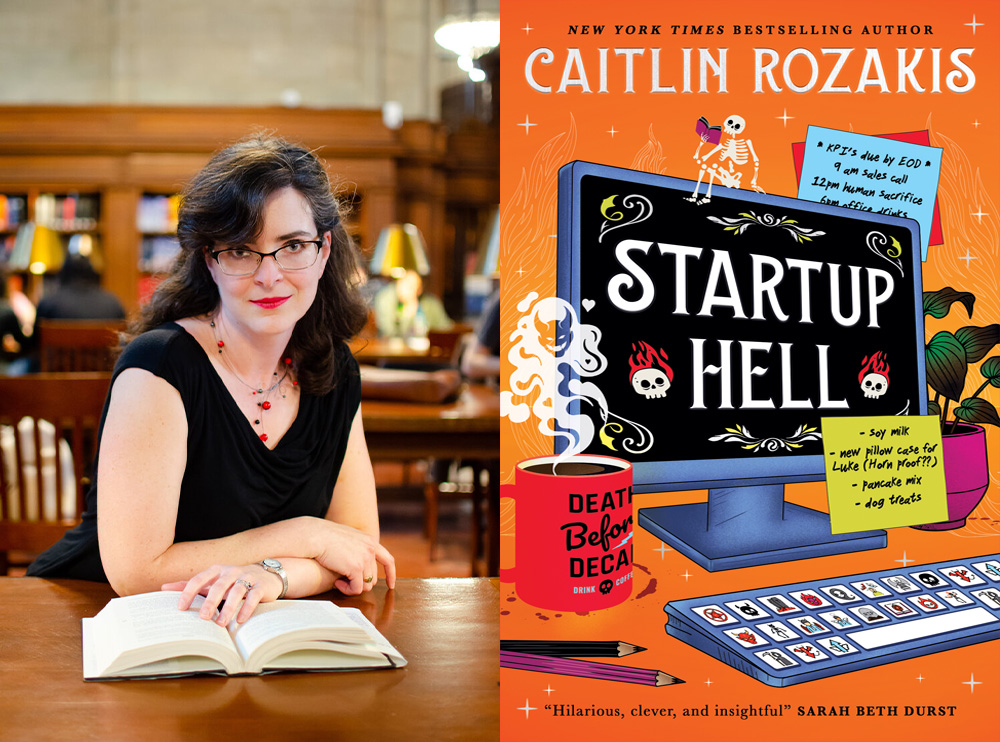
We chat with author Caitlin Rozakis about Startup Hell, which is a contemporary fantasy that exposes the demonic nature of the corporate world.
Hi, Caitlin! Welcome back! How have you been since we spoke last year?
Well, if you ignore the state of the world in general *waves hands in general distress*, personally, I’ve been great! I’ve been adjusting to life as a full-time author and I’m getting ready for spending the summer mostly on the road, between book tour and cons.
(For the other stuff, I’ve done my best to get out there and volunteer and protest and donate where I can. And vote. It’s more important than ever to vote.)
Your latest novel, Startup Hell, is out now! If you could only describe it in five words, what would they be?
Fantasy workplace comedy, with demons.
What can readers expect?
Lunch time company-sponsored goat yoga, cutthroat corporate shuffleboard, siege warfare lunch-and-learn, and a tech conference that goes awry on multiple planes of reality. Which of these occur in the human office and which ones in the demon workplace, I shall let the readers discover!
(Quick plot synopsis: Morgan works at a terrible Manhattan tech startup when one evening, she walks into her boss’s office to find him facedown on his desk, dead, and the demon he summoned still trapped in the circle. She’s a junior marketer, he’s a junior salesdemon, they both have quotas to make; what if they teamed up?)
Where did the inspiration for Startup Hell come from?
I spent more than 15 years doing tech marketing, largely for startups. Some were better, some were worse, all were kind of weird because startup culture is very much its own thing.
The germ of this idea actually came from a two-shot TTRPG I ran years ago. I told my players they were all employees at a tech startup with an investor presentation due the next day, gave them some interpersonal conflicts to get started, and demanded that they produce a Powerpoint presentation. What I did not tell them was that once someone bled on the prototype (which I ensured happened, of course), the entire floor of the office was getting shunted to a pocket dimension. They realized they were in trouble when the pizza they ordered never showed up and the elevator only opened into blackness. And then they discovered their CEO was dead in his office in the middle of a summoning circle. The big reveal at the end of the first session was that he’d sold all their souls to hell. Session two was them trying to bargain their way back out!
Were there any moments or characters you really enjoyed writing or exploring?
Morgan’s mom initially was a prissy academic magician. The story really clicked in when I threw out those chapters and turned her instead into the kind of kickass, leatherclad paranormal heroine we had so many of in the late 90s/early 2000s. Because of course, it’s 25 years later; this is Buffy/October Daye/Jim Dresden/Anita Blake/whoever now that she’s middle-aged and has a thoroughly, depressingly mundane adult child who is working a crappy office job instead of seducing vampires and kicking werewolf ass. (Or vice versa, depending on the week.) I had expected to enjoy the relationship between protagonist Morgan and the demon sleeping on her couch. I had not initially expected how much fun it would be to write the mom/daughter relationship.
With Startup Hell being a contemporary fantasy, what was your approach to the worldbuilding in this novel?
Startup Hell is set in the same universe as The Grimoire Grammar School Parent Teacher Association, although the two books stand alone. So there was a certain amount of trying not to trip over things I’d already established, when I’d written Grimoire without having Startup in mind. They’re both very much in the mode of “there’s a secret magical world that we don’t know about hidden in our own real world”. But while a lot of writers using this trope come up with reasons that technology doesn’t work well for magic users, I like to embrace it. Sure, I could cast a scrying spell with this basin of moon-blessed rainwater, or I could just text him. Because we’ve all got phones.
The thing that’s been somewhat difficult, though, is how fast things we’ve taken for granted have changed in the last two years. There were jokes that were in the original manuscript that I had to strip out because they weren’t funny or innocuous anymore (I did not anticipate DEI becoming such a hot button, for example). I had a passing reference to Tiktok. Then Tiktok got banned and I took it out. Then Tiktok got reinstated and I put it back in. Now, Tiktok has changed its TOS and a bunch of people are dithering over whether to flee, and I’ve mostly been hoping I could at least get to publication date before this one line became dated.
Can you tell us about the timeline from idea to finished manuscript?
I was just looking back over my emails. In October 2023, I sent my agent three ideas for what I should tackle next, and they were wildly enthusiastic about the one which would become Startup. By October 2024, I had a draft done and a proposal in to Titan; I turned in the manuscript around April 2025. And then of course there were post-edit letter revisions and all the usual copyediting and proofreading and so on for a May 2026 pub date.
Did you face any challenges whilst writing? How did you overcome them?

The first draft had a very different family background for Morgan; I ended up getting up to the first attempt to send Luke home, which was six or seven chapters in, and throwing out half of them. Then when I finished the first full draft, I ended up doing some substantial surgery to the timeline. I don’t even remember all the details; it was something like throwing out chapter 14, and reordering chapters 17, 19, 21, 22, and 25. Which, with the events now happening in a totally different order, meant everyone’s emotional reactions had to be completely recalibrated. There was a lot angry pacing. I wrote everything on physical scraps of paper and rearranged them on my living room floor. (Alas, I do not have a board to cover in pushpins and string.) But I managed to get it into a shape that made sense for everyone.
What’s the best and worst writing advice you’ve received?
The best advice is the one that works for you; the worst is the one that doesn’t work for you and tells you that you’re a bad/illegitimate writer because it doesn’t work for you.
There are a lot of people out there who find something that works for them and then informs everyone this is the One True Way. Write everyday. Write what you know. Adverbs are bad. Never revise. I think it’s worth hearing how other people work, because sometimes it can inspire you. But I roll my eyes whenever someone says their way is the only way. I write differently than I did five years ago; I wouldn’t be surprised if I write differently five years from now.
What’s next for you?
I’m so excited I can finally announce: we’re going back to the Dreadfulverse in 2027! Half-Baked is a new novel in the same universe, following a goatherd who doesn’t want to be a wizard and a necromancer who just wants to be a baker as they fight their mutual destinies… and mutual attraction. While the plot does stand alone and is a great jumping-in point for new readers, you’re going to visit some familiar faces, too. Including Valevna, who is the worst possible magical mentor, and Orla, who’s a much better baking mentor!
But I’m not just releasing a new novel. We’re also doing a comic book! Crashed: A Dreadful Comic is going to be a four-issue miniseries in which Eliasha’s sister makes the highly questionable decision to have her wedding at the goblin B&B. I am having so much fun writing this disaster.
Lastly, what books are you looking forward to picking up? Any you’ve read so far this year that you’ve enjoyed?
I’m always months/years behind actually reading the new release cycle, but I definitely want to get my hands on All Hail Chaos by Sarah Rees Brennan, A Trade of Blood by Robert Jackson Bennett, Platform Decay by Martha Wells, and Radiant Star by Ann Leckie. Recently, I’ve loved Katabasis by R.F. Kuang, When We Were Real by Daryl Gregory, The Buffalo Hunter Hunter by Stephen Graham Jones, Eat the Ones You Love by Sarah Maria Griffin, and two older books, Bet Me by Jennifer Cruisie and Life in a Medieval City by Joseph and Frances Gies.