

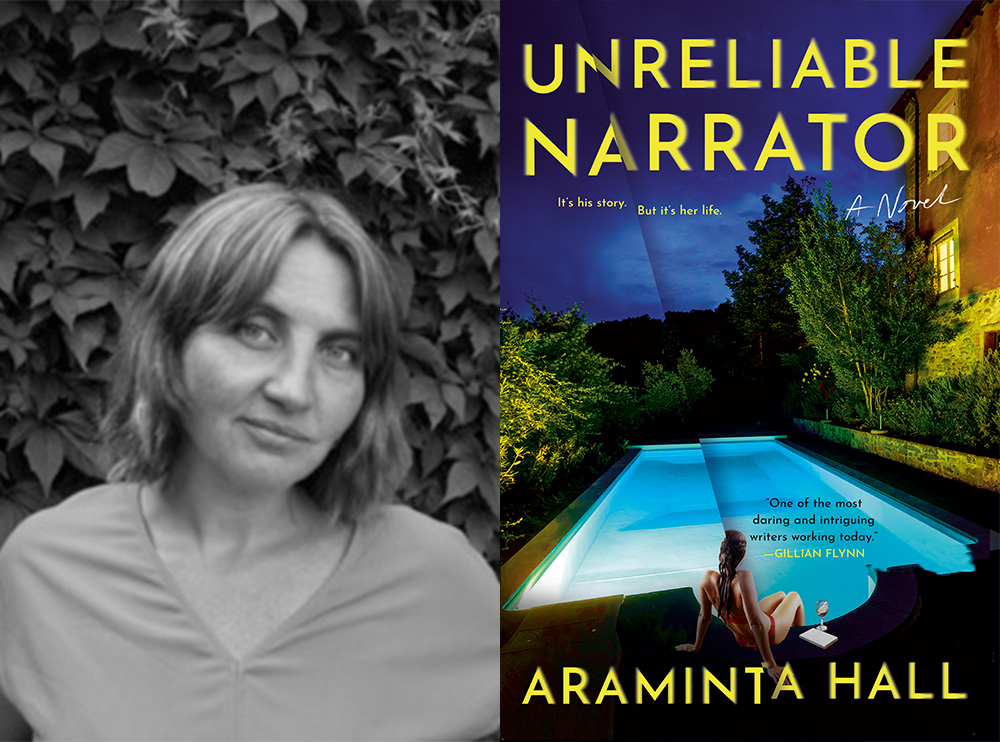
We chat with author Araminta Hall about Unreliable Narrator, which explores revenge, obsession, and the dangerous stories we tell to survive.
Hi, Araminta! In your own words, tell us what Unreliable Narrator is about?
Unreliable Narrator begins with a young woman, Hope, discovering that the worst thing she’s ever done has been turned into a best-selling novel by the celebrated novelist Ambrose Glencourt. Ten years before Hope worked as Ambrose’s assistant, living at his glamorous ancestral home, Shadowlands in the middle of the British countryside. Wanting to be a novelist herself, Hope documented all the events of that hot, heady summer in a journal. It is clearly the work of a young woman seduced by this world of bohemian privilege, ambitious for herself and her life. Ambrose begged her not to tell anyone what happened to end her time with him, except now he’s turned her life into a work of fiction and his account is very different to hers. As Hope tries to work out what actually happened, she has to confront the fallibility of her memory, the strength of her desires and her relationship with the truth. Unreliable Narrator asks us to consider the very idea of story-telling, who do they belong to and why do they matter? Is there ever one truth to be arrived at and why do certain people get to tell their stories, whilst others are silenced? It asks how far any of us would go to hang onto our personal narrative.
The first half of the novel is set in the past and told through Hope’s journal entries, creating an epistolary narrative, while the second half shifts to the present with a dual POV from Hope and Detective Natalie. Why did you choose this structure, and what did you hope it would add to the story?
Because a large part of this book is about story-telling I had always planned for the first and second half of the novel to be written in different ways. The first more like a fever dream as Hope experienced her time at Shadowlands and the second more like a traditional novel. I hadn’t planned on writing the first section as a diary, but the more I got into it, the more I wanted to totally occupy Hope’s voice. A diary is also such a unique form of writing, a place where we can be as honest or dishonest as we like, as it’s not usually meant for public consumption. The second half can almost be read as a novel within a novel, in fact I started to think of it as Hope’s novel. The diary is where she expresses herself with abandon and the second half is where she learns the power of omission and fiction. And I think this highlights the way truth and fiction can merge.
The Glencourt’s sprawling, opulent estate, Shadowlands, is more than just a setting—it feels like its own character in the novel. How did you go about building the world of Shadowlands? Were you inspired by a real-life location?
In the UK we have a long history with privilege and the grand country houses that litter our land are a brilliant manifestation of this. Men like Ambrose Glencourt, from this ruling class for want of a better word, have always sat atop of the pile. They have made our laws and influenced our lives, written our stories and dodged the law. The places that they live are so fascinating because they are smothered in impenetrable rules and manners which you could only know if you were brought up within them. All the descriptions of Shadowlands being slightly broken and dilapidated are so true to real life. These people live with such privilege they adopt a bohemian aesthetic in which trying too hard becomes deeply naff. Hope doesn’t come from this world and I wanted to see it through her eyes, almost as if it’s a character trying to thwart her.
Everyone in the novel is an unreliable narrator, from Hope’s fractured memory to Rosie’s manipulation of events to Delia’s reinforcement of his false narrative. Was this all-consuming theme of unreliability the inspiration for the title of the novel?
Absolutely. I have long been fascinated by the idea of unreliable narration as I think we all are to some extent. Most of my novels see the same events from different perspectives because I don’t believe there is ever one fully true version of events. It’s like that old adage that you never know the truth about a relationship until you’ve heard both sides. All the characters in this novel are unreliable by default, as we all are. However, some of them also tip into being unreliable by design, which is when perspective becomes a lie. One of the threads in this book is to sift through the unreliability to work out the truth.
The most traumatic event of Hope’s life is stolen and repackaged as a bestselling novel by Rosie without her consent. What drew you to explore the idea of people (particularly men) profiting from others’ trauma and society’s willingness to accept it without consequence? Do you think there’s a quiet fascination in consuming someone else’s suffering, especially in mass media?
Oh yes, and I think the true crime phenomenon shows this. Everything in our culture has been turned into entertainment, even politics, maybe especially politics. We have dumbed ourselves down and that is so dangerous because it means we stop taking things seriously. Violence against women is at epidemic levels and yet we approach real life news stories as if they are pieces of entertainment. I think one of the things that novels and dramas can do is show the emotional complexity behind these crimes, which is so important when our media is saturated by sensationalism. And when we sensationalise anything it is always for profit. I am sick of men like Rosie believing that everything belongs to them and disregarding consequences. Nothing is going to change in society until we fully explore the idea of what equality really means.
In both the novel and real life, society often celebrates artists like Rosie (white, wealthy, cisgender men) despite their abusive and manipulative behavior. Do you think it’s possible—or even ethical—to separate art from the artist?
No, I feel very strongly that we can’t separate the art from the artist. All artists of every kind can’t help but be influenced by themselves – how they feel, what they believe in, their experiences. Even when writing a complete work of fiction this is true. Because of this I don’t want to read or listen to or look at anything created by manipulators or abusers or worse. As Hope says at the end of the novel, if that discounts a lot of work by so-called great men, then so be it. Give others a chance to make art and we might find lots more even greater works will emerge.
Unreliable Narrator explores themes of sexual assault through Rosie’s relationships with his younger female assistants. How did you ensure their experiences were portrayed authentically and without sensationalism, especially within a psychological thriller context where readers often expect heightened tension and dramatic twists?
Mainly by not showing the assaults and only hearing about them through the women. Rosie wouldn’t even think he’d assaulted them and so he would dismiss them. Even the women themselves are unsure if they’ve been assaulted because we have such a strange relationship with the idea of consent in our society. Unfortunately I don’t think it can ever be sensationalism to write about this as I am confident in saying every woman you know will have a story. It might be small and feel inconsequential, but she will have been made to feel uncomfortable and unsafe at some, probably many, points by a man who has exploited his power, be that physical, social or economic.

The novel ends with a major twist that readers won’t see coming. How did you approach crafting the final moment of Unreliable Narrator? What would you say makes a truly great ending?
For me great endings are unexpected but satisfying. They shouldn’t come out of the blue and they shouldn’t twist on a lie or something withheld from the reader. I can’t really talk about the ending without giving it away, but I will say that I always knew how the book was going to end. The mechanics changed over various re-writes, but the last paragraph is one that I wrote almost in my first draft. The end for me is all about truth and how we can use it and even bend it to create a fairer world.
Many, if not all, of your books have been optioned for film or television. If Unreliable Narrator were adapted into a film or limited series, who would you dream-cast as Hope, Tom, the Glencourts, and Detective Natalie? Why?
For someone whose books are all optioned you would think that I would have an answer to this question. However, I don’t fully see my characters when I write them. Of course I have a vague sense of what they look like, but for me they almost become essences. A bit like anyone very close to you, who you think of more in terms of feelings than physically. That said, my immediate response to who Delia is, would be Cate Blanchett. The others are less clear to me, although Rosie would be one of those foppish British actors like Henry Cavill or Dominic West. Hope I see as someone like Chase Infiniti Payne and Tom maybe Nicholas Hoult. And Natalie perhaps Jodie Comer or Naomi Ackie. One thing to consider is, apart from Natalie, all the characters age a decade between parts one and two!
What are you working on next?
I’m still thinking about ideas of privilege in my next novel. Metoo did so much at raising women’s voices, but I still think our conversations are dominated by the same people who have always been listened to. And I’m also working on a couple of TV projects, that I can’t really say anything about!