


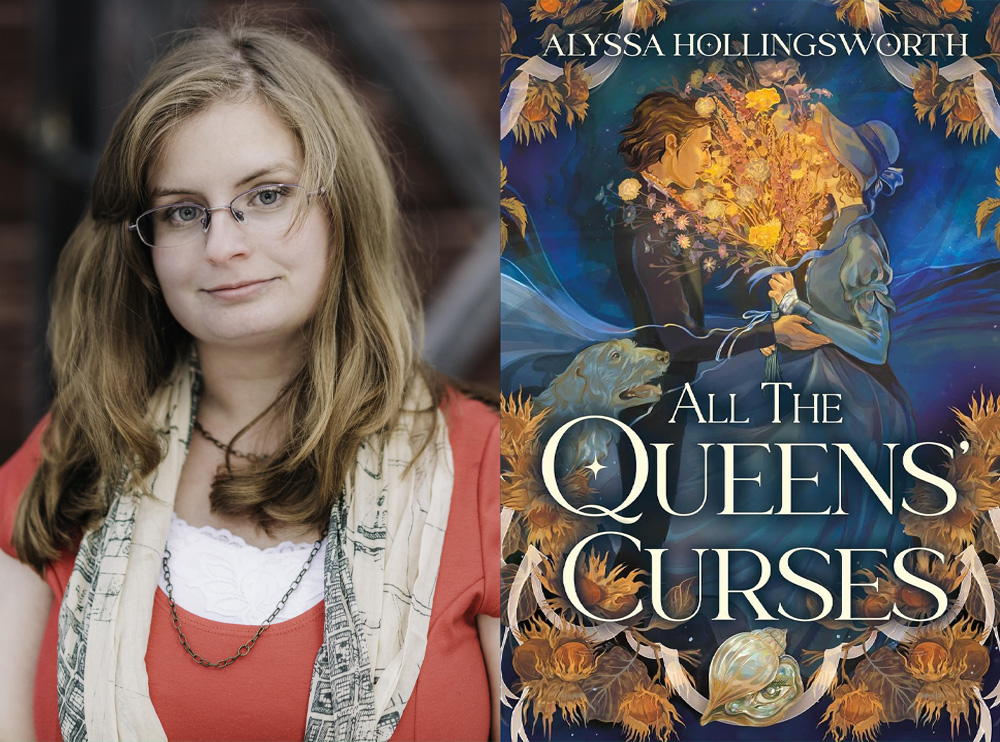
Guest post written by All The Queens’ Curses author Alyssa Hollingsworth
Alyssa was born in small-town Milton, Florida, but life as a roving military kid soon mellowed her (unintelligibly strong) Southern accent. Wanderlust is in her blood, and she’s always waiting for the wind to change. Stories remain her constant. Alyssa received her BA in English with an emphasis in Creative Writing from Berry College. From Bath Spa University, she received her MA with honors in Writing for Young People and her Ph.D in Creative Writing with her thesis Breaking the Curse: Retelling a Folk Fairy Tale to Explore Trauma and Healing in Novels for Young People. She is represented by Amber Caraveo at Skylark Literary. Her award-winning debut The Eleventh Trade and her second book The Invisible Boy were published by Roaring Brook/Macmillan (U.S.) and Piccadilly Press (U.K.). Alyssa loves crafting, cozy video games, and going on adventures with her nerdy husband and mischievous dog.
About All The Queens’ Curses: From a debut voice comes a gripping, atmospheric retelling of a Scottish Isles fairytale featuring body swapping magic, a complicated romance, sisterhood, royal curses, morally ambiguous fae, and a high-stakes escape from an abusive king. Released August 27th 2026.
The very first time I read ‘Kate Crackernuts,’ I felt it was perfect for a retelling. Magic, romance, a clever heroine—this story had it all!
As I spent time with the fairytale over the course of drafting my novel All the Queens’ Curses, I just fell more and more in love. Here are five reasons I’m obsessed with this little-known Scottish fairytale.
-
The love between the stepsisters
‘Kate Crackernuts’ features a deep bond between two stepsisters (in my novel, Kit and Catharine). In the original, Kit’s mother curses Catharine so that Catharine’s bonny face is replaced by a sheep’s (it’s a little different in my retelling!) But when Catharine is left alienated and reeling, Kit sides with her stepsister.
One of my favorite lines in the original tale is: “[Kit] took a fine linen cloth and wrapped it round her sister [Catharine]’s head and took her by the hand and they both went out to seek their fortune.”
There’s so much tenderness in those lines. These sisters have each other’s backs. I love it.
-
The trauma undertones
One little detail in the original fairytale is that the queen’s curse is only effective when Catharine has not eaten. It’s an easily missed story beat, but important.
Care and love (including being fed) form resilience and resilience makes us better able to recover from traumatic events. A lack of care and love makes us vulnerable.
In ‘Kate Crackernuts,’ the hedgewitch warns the queen that the spell will not work if Catharine has breakfast. The first day, Catharine sneaks some food from the kitchen (taking care of herself). The next day, field laborers give her some food (community takes care of her). The last day, the queen escorts Catharine herself, thereby ensuring she has no access to any resources. And so Catharine is cursed.
My retelling has a focus on themes around trauma and healing, and it was fascinating to find the kernels already there in the tale.
-
The missing reason for the prince’s curse
About halfway through ‘Kate Crackernuts’, our girls come across a castle where a cursed prince is wasting away with a mysterious illness. Everyone who stays the night with him ends up missing… until Kit.
Kit discovers that the prince is being danced to death by faeries. But in the original, we never find out why. He’s just cursed.
Gaps like this are gold for a retelling. In All the Queens’ Curses, because I wanted to explore themes of trauma, I decided to use the prince to explore intergenerational trauma. He takes on a curse that his ancestor started.
-
The clever bravery of the protagonist
Kit escapes alive because she is clever (in some versions, she’s even called Clever Kate). When the way to the faerie realm opens conditionally (“let the young prince in with his horse and his hound”) Kit quickly adds an amendment (“and his lady him behind”). When the faeries show their hand with curse-breaking items, Kit uses nuts she’s foraged to make a trade. When she negotiates her fees for helping, she escalates all the way to asking for the prince’s hand in marriage.

She is an active force in the original, which of course made her a delight to write in my retelling!
-
The setting
‘Kate Crackernuts’ was collected in the Orkney Islands by a rural lawyer in the late 1800s. He passed the tale on to Andrew Lang (famous writer of the Blue Fairy Book and other collections). One of the odd things, though, is that ‘Kate Crackernuts’ features characters riding through a forest… and there are very, very few trees at all on the islands.
During my writing process, I interviewed local folklorist Tom Muir. His theory is that the woman who told the lawyer the story was a ‘traveler’ from the Scottish Highlands.
One of the great joys of writing my retelling was bringing the setting more to the forefront of the tale. I’ve placed Catharine and Kit in a highland setting and my cursed prince on an island kingdom. Instead of riding through the forest, he sails through treacherous waters. In this way, I’ve been able to capture both the spirit of where the tale may have originated and the place where it was told.
Want to read ‘Kate Crackernuts’? You can find an annotated version on my website.
Want to read All the Queens’ Curses? You can order it now!