

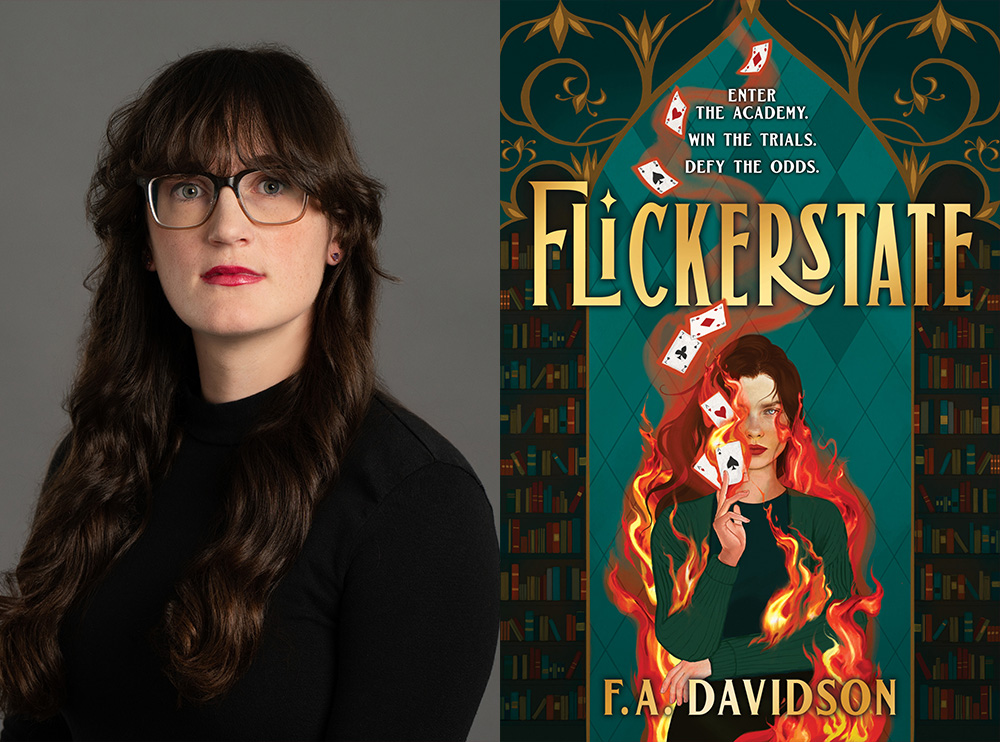
We chat with author F.A. Davidson about Flickerstate, which is a debut YA fantasy filled with lush world-building, heart stopping romance, and high-stakes competition that could be the key to everything.
Hi, F.A.! Can you tell our readers a bit about yourself?
Hello! I’m a freelance writer who grew up in the wintry wilds of northern New England and spent a decade in the Midwest. I now live in North Carolina. In my non-writing time, I run marathons and read books across genres. I also explore the NC Research Triangle’s food scene and avoid RPG video games (once I start playing, I have trouble stopping).
When did you first discover your love for writing and stories?
When I was in first grade or so, my dad gave me Tamora Pierce’s Alanna: The First Adventure, a fantasy novel about a girl who impersonates her twin brother to train as a squire. For years after that, I told well-meaning adults that when I grew up, I was going to be a knight errant. The conversations went like this:
Well-Meaning Adult: A knight. Like . . . an OBE? Like Sir Elton John?
Me: Does Sir Elton John joust?
Well-Meaning Adult: No?
Me: Then no.
Eventually, I realized that I was more interested in writing than in jousting, and I started to tell well-meaning adults I was going to be an author.
Quick lightning round! Tell us:
- The first book you ever remember reading: A board book about geometric shapes
- The one that made you want to become an author: Tamora Pierce’s Alanna: The First Adventure
- The one that you can’t stop thinking about: Svetlana Alexievich, Voices from Chernobyl
Your latest novel, Flickerstate, is out now! If you could only describe it in five words, what would they be?
Probability magic! Cursed wounds! Academia!
What can readers expect?
Flickerstate contains some much-loved tropes. It’s a YA novel set at a magical boarding school, after all. With dangerous trials! But Flickerstate puts its own spin on this set-up.
For one thing, Flickerstate’s magic system is STEM-flavored: the magician characters, called “navigators,” have the power to manipulate probability by entering a metaphysical space called, yep, flickerstate. In flickerstate, navigators can perceive possible futures and change which future is most likely to occur. (Flickerstate will not require you to know statistics, gentle readers. But if you like that sort of thing, feel free to mathematically model a navigation or two.)
Also, Flickerstate’s magical boarding school isn’t located in a pure fantasy world or even an unnamed, quaintly rural county in England. It’s set in an alternate-history U.S. where interdimensional predators called flickerbeasts started manifesting in our world right after the Trinity Test, the detonation of the first atomic bomb in 1945. Flickerbeast bites increase risk of death by any cause. That is, their bites make all the ways you might die—from gruesome accident to freak weather event—much more likely. And there’s no known cure for their bites.
Navigators can use their probability magic to reverse flickerbeast manifestations. But because navigation is a rare ability, the demand for navigator bodyguards among politicians, business moguls, celebrities, and other ultrawealthy elites has drained the public sector of emergency responders who can navigate. So when our protagonist, cranky St. Louis native Norah Sullivan, realizes she’s a navigator and (on the same rollercoaster day) stumbles into a flickerbeast swarm in her front yard, she and her father are bitten before the overworked, underfunded emergency response team arrives at the scene.
Norah has heard rumors that a secret cure for flickerbeast bites lies hidden in an archive at the Academy of Navigation, the oldest probability-magic school in the world. So she transfers to the Academy hoping to find the cure. On campus, she learns that only senior archive assistants are allowed inside the Academy’s archives, and to become a senior archive assistant, she needs to win a series of navigation trials as part of a three-person team.
Norah, not a team player, needs to learn and grow and change and mature—or die.
Where did the inspiration for Flickerstate come from?
I knew I wanted to write a novel about creepy interdimensional beasts and an ominous boarding school, and I knew that a cranky, precariously middle-class transfer student named Norah was my protagonist. But during my zero draft, I had no real idea how those elements were related. I meandered through 30,000 words before shelving the project for a long, long time.
Then, one fateful day, I was reading a medical research article analyzing all-cause mortality data, which included tables of the most common causes of death for different age groups. I realized that the creepy interdimensional beasts could kill people indirectly, by increasing their baseline risk of death by any cause. After that, I decided pretty fast that Norah should have magical powers related to probability, and “navigation” was born.
Were there any moments or characters you really enjoyed writing or exploring?
I really enjoyed writing dialogue between Norah Sullivan and her classmate Candace Yang. In some ways, Norah and Candace are polar opposites. In others, they are, as the internet says, the same person in different fonts. That unstable combination of similarity and difference made for a fun dynamic.
Did you face any challenges whilst writing? How did you overcome them?
Shortly after I turned in developmental edits for Flickerstate, I learned that I’d had raging undiagnosed celiac disease for at least seven years—a belated explanation for my iron deficiency, chronic exhaustion, weird joint and muscle pain, and ambivalent attitude toward pasta. When I received the results for the blood test that measures antibody response to gluten, mine was above the detectable range, and after the endoscopy that confirmed my diagnosis, the GI doctor told me that the autoimmune damage to my small intestine had been visible to the naked eye on the endoscopy camera. (I found this detail gross but deeply validating.)

Although I wrote draft after draft of Flickerstate with an undiagnosed autoimmune disease attacking my insides, I’m not really the one who overcame the challenge. I mostly held on for dear life while my family and friends supported me, doing necessary chores I was too depleted to finish and encouraging me not to give up on a medical explanation to my symptoms, until one doctor thought hard about the trajectory of my iron deficiency, realized it was weird, and ordered the blood test for celiac disease. I’m very much in debt to my support network and to that doctor.
What’s next for you?
I’m deep into drafting another book! Like Flickerstate, it’s YA fantasy. Unlike Flickerstate, it takes place in a imagined world I’m designing from the ground up.
Lastly, what books are you looking forward to picking up? Any you’ve read so far this year that you’ve enjoyed?
My TBR pile has grown so tall it’s started to menace me. If it topples on me in the night, I will sustain at least minor injuries.
I recently got my mitts on an advance copy of Jo Salazar’s If We Survive the Night, a YA zombie novel coming out at the end of August. It’s about Quinn, a teenage girl with antisocial personality disorder who realizes she might thrive under apocalyptic conditions. I’m excited to start it soon. And I’m very enthused about Sophia Veltfort’s This Vital Absence, which comes out in November. It’s literary fiction about Sylvia, a young woman born via artificial insemination to two affectionate, well-adjusted moms, who befriends Molly, another young woman who’s just learned a surprising secret about her family. Beset by a shared compulsion to know, Sylvia and Molly strike a fateful bargain to investigate each other’s biological relatives.
I’ve enjoyed a lot of books this year, including some that aren’t published yet: M.J. Hastings’s New Adult dystopian romantasy Firstborn, which I predict romance readers who want detailed fantasy worldbuilding are going to love; Tanaz Bhathena’s Persian epic-inspired historical fantasy Witch Daughter; and Julie Lew’s YA dark historical fantasy Death in Verse. All three are out in September!
Of the fortyish books I’ve read so far this year, eleven have been novels by other authors debuting in 2026, which has to be a record for me. As I mentioned, my TBR pile is massive and frightening, so I don’t usually get around to books the year they’re published. (Don’t be like past-me, Nerd Daily readers. Support debut authors!). I do read across genres, but my 2026 debut reading has been concentrated in fantasy and horror. The currently available ones are Shen Tao’s epic fantasy The Poet Empress; Maria Turead’s Irish historical horror This House Will Feed; Christina Ferko’s YA supernatural horror The Darkness Greeted Her; Cameron Sullivan’s French historical fantasy The Red Winter; Laura Cranehill’s mycological SF/horror Wife Shaped Bodies; Loretta Chefchaouni’s YA Moroccan fairytale-inspired fantasy The Lustrous Dark; Julia Bianco’s urban fantasy Witch Season; and Bori Cser’s YA Renaissance Venice-inspired court fantasy Mirrorwoven.
Finally, this past week, I finished Angela Velez’s Tangled Roots and Wild Dreams, a cleverly constructed contemporary YA about a girl who discovers that her deceased father, who was a successful biology professor, wanted to quit academia and found a community garden. I also finished John Keegan’s one-volume history The First World War.