

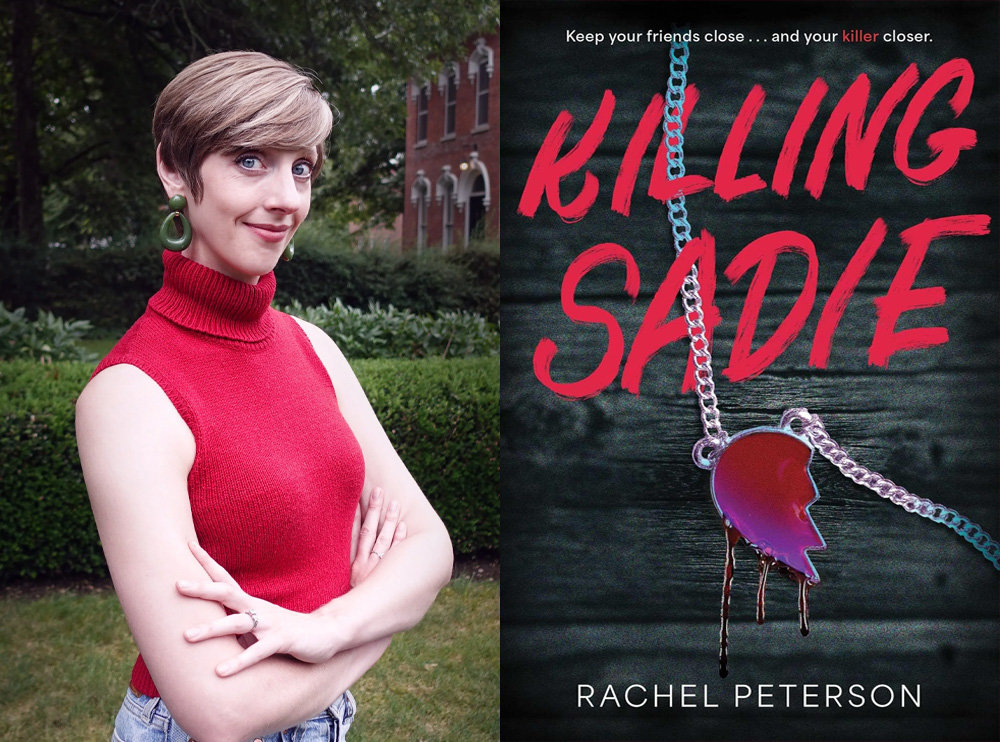
Killing Sadie by Rachel Peterson is a young adult thriller that unspools the truth behind a tragic murder through multiple unreliable narrators who all have secrets to keep. Peterson’s book is perfect for fans of How to Survive Your Murder and Dead Girls Can’t Tell Secrets.
Here’s what we do know: there was another infamous barn party at the McClain family farm last night, and things went horribly wrong. By the end of the night, there were two dead bodies in the old barn: seventeen-year-old Sadie Cooper and her killer, Mason Vreeland. The murder was heartbreakingly witnessed by Sadie’s twin sister, Jayne, and Sadie died in her arms. Mason was killed by Sadie’s boyfriend, Ben, in an attempt to save Sadie.
Aside from figuring out Mason’s motive, it should be an open-and-shut case. But it’s not.
The story unfolds just after the murders, and Jayne, Ben, and Sadie’s best friend, Liz, are telling the cops what transpired at the party and the events leading up to it. But little details don’t match. And those little details start to add up to big discrepancies. But who’s lying, and why?
The shocking truth is revealed in the third act, when the POV shifts to victim Sadie herself, in the days leading up to the party. Witness exactly what happened—and see if you can piece it all together. Because poor Sadie totally missed what was right in front of her.
Rachel Peterson graduated from Miami University of Ohio with a degree in English and creative writing. Born and raised in Ohio, she started her career in advertising before spending nearly a decade in New York City as a marketing executive for technology companies. An avid traveler, Rachel now splits her time between Manhattan and the Midwest, where she lives with her husband, Ken; their dog, Olive; and horse, Hope.
We asked Peterson about how Killing Sadie changed her writing life personally, the appeal of summer books with crime elements, and more.
Before becoming a writer, you started your career in advertising and then spent a decade in marketing as an executive for tech companies. How do you think your experience in both professions has entangled in your identity as an author? How has it contributed to Killing Sadie, if it has at all?
This question has me feeling nostalgic! My careers in advertising and marketing have been such a wonderful benefit to my author toolkit – not being too precious about the work, taking feedback with stride, and working against wild deadlines. But more than anything, those two worlds were super pressurized, which forced me to trust my team and my intuition, especially when the outcome was uncertain! Building those trust and collaboration muscles has had a much bigger impact on my author adventure than I could have ever imagined.
Being a debut author, getting Killing Sadie out into the world means wearing different hats (some familiar and some brand new) by the minute, which is mildly terrifying at times, but also a dream come true! Switching between author mode, speaker mode, social media mode and a hundred others has definitely been made easier by my past work life.
Despite the many POVs, you write a very authentic and consistent narrator voice. What preparation did you do to accomplish this? What is some wisdom you’d offer to young writers hoping to accomplish this?
When it comes to a consistent narration voice for these teens, full credit goes to my teenage self, who journaled extensively and was obsessed with Y2K-era blogging sites! She was a rebellious, creative theater kid through and through who loved to imagine the inner lives of other people. And happily, I still have access to a lot of that old writing (and the grainy film photos that prove my 2000s style was mostly on-point haha).
My advice to young writers is to reframe what you might consider a disadvantage into your storytelling edge – there really is magic in the mundane, especially if you push normal situations and characters to the absolute limits. Another piece of advice I always give young writers is to build a writing practice that exists regardless of the creative spark, which can be annoyingly unreliable! I truly treat writing as a daily routine rather than a lightning strike moment, and some of my best pages have come from days when I felt totally uninspired but opened my laptop anyway. True story: Some pages of Killing Sadie were written on my phone notes app in Newark Airport during a delay!
What was it like writing in the present moment with the police uncovering what happened that night and then reliving what the narrator experienced in italics?
The structure was a perfect match for my writing style, which as my wonderful editor knows well, is very much stream of consciousness. My characters tend to surprise me during most writing sessions! I think the pacing of the story plus the unreliable narrators (no spoilers: your favorite Killing Sadie characters are lying to you!) led to pages that feel frenetic, urgent and unhinged.

The italicized sections give readers a quick break from the intensity of police questioning, plus a deeper understanding of our characters and their histories before jumping dramatically back into present day. Personally, I just adore the drama it creates when we finally switch to Act Three: Dead Girl Talking. This page turn always makes my heart skip a beat!
What do you think is the appeal of stories set in the summer with murder or other crime elements that makes this niche genre so popular? What inspired you to write this book?
Twisty thrillers have a certain unstoppable energy, which is totally compatible with the summer mood! While we slow down in some ways (beach vacation with book in hand), tension and escapism is part of that experience! Summer offers up the promise of freedom, especially for teens, and the opportunity to step out of the structured school year and into the unknown. As a teen, I was reinventing myself practically every summer. You can be someone else and jump into a different world … all the elements that make for a brilliant thriller setup!
The inspiration for Killing Sadie came from taking a regular town and teenage life, and dialing the volume way up. It turns out that a sleepy Midwestern town like the one where I grew up can make your mind wander, thinking: Can you ever really know someone? What is truth? What if there was a murder at this weekend’s barn party? You know, the universal questions all teens ask …
You opened the story with a quote from Shakespeare and Fitzgerald. Out of all the authors, what enticed you about including quotes from them, and what does each author mean to you when it comes to Killing Sadie?
Oh, this question makes my English major heart sing! Pairing two unexpected authors together – in this case, authors separated by hundreds of years – is sort of like discovering a surprising pairing of ice cream flavors. Once you taste it, the combination makes perfect sense. The very first Shakespeare quote included in Killing Sadie, from Romeo and Juliet, jumped into my mind instantly alongside the plot itself. There are definitely Shakespearean elements to the book and Sadie’s fate, and I have always loved the idea of pairing the classics with modern stories.
Meanwhile, The Great Gatsby quotes actually came into play with a much later draft. One particular quote from Gatsby stuck with me after I reread the book and just felt so right for a certain character – readers will have to wait until the very end to figure out which character inspired it!
Turns out that modern teenage life has a lot more in common with feuding families, shocking secrets, personal reinvention and star-crossed lovers than we may think … at least in Sadie’s world.