


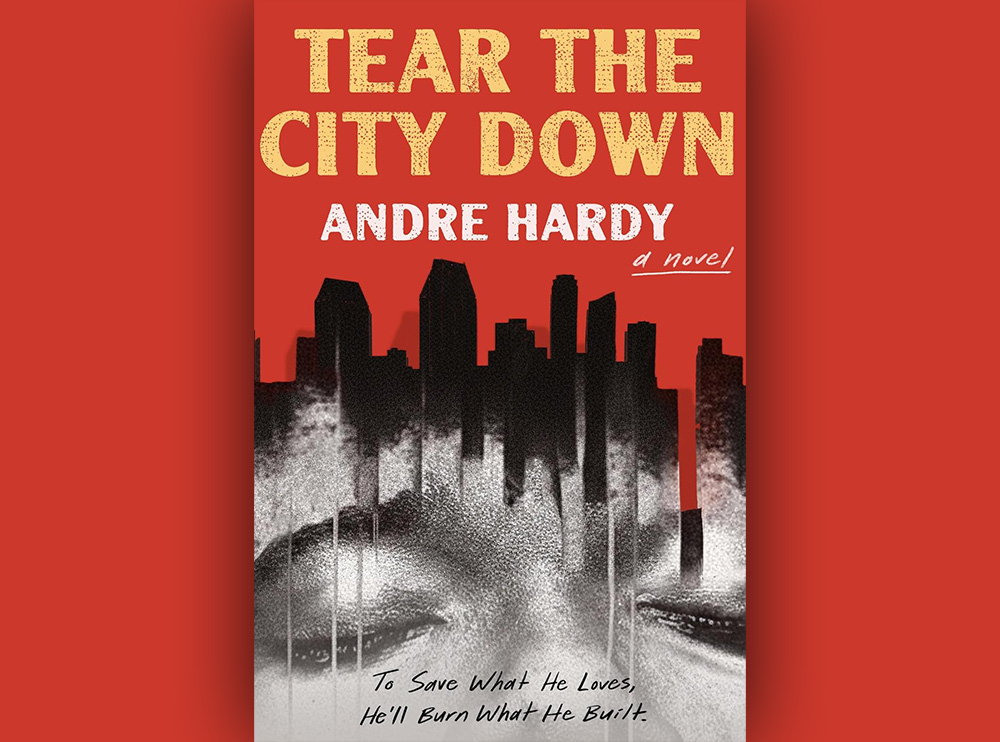
This debut novel from a former NFL player is a hard-hitting, heart wrenching crime novel that brilliantly blends elements of jazz, football, and a gritty portrait of a city divided—perfect for fans of S.A. Cosby and Walter Mosley.
Intrigued? Read on to discover the synopsis and an excerpt from Tear the City Down by Andre Hardy, which releases on September 1st 2026.
Coltrane Davis is at once a knight and a hustler. He has risen to wealth and success, graduating from San Diego’s back alleys to the halls of power through his partnership with Saul Sollman, a crooked kingmaker among the city’s elite. Running multimillion dollar scams with Saul, he has been Saul’s fixer, but now he wants out of the hustle so that he can focus on his teenage daughter’s burgeoning tennis career and finally be the dad he has always wanted to be.
But when the Los Angeles Chargers’ star running back vanishes one evening before a big game, Coltrane is drawn into an investigation of what happened by Saul and his protégé, the player’s agent; the stakes escalate with a gut-punch when the trail leads into San Diego’s underworld of drugs and prostitution and reveals clues to the disappearance of his daughter’s best friend, whose loss has haunted him.
Torn by the unreconcilable demands of the life he can’t seem to quit and the fierce desire he has to protect his own, Coltrane brings himself and his loved ones to the brink of destruction in his quest to free himself once and for all of Saul’s control—and focus on what really matters: family.
EXCERPT
Upward mobility needs a surgeon general’s warning label. Something to the effect of “Brothas, best beware: Social climbing is dangerous. Known to infect us with greed, leading to the adoption of the lifted class’s behaviors and prejudices, resulting in delusion, moral dilemmas, neglect, identity crises, self-hatred, and, in extreme cases, death.”
Reposed in Saul’s oxblood leather chair, I wasn’t thinking anything that eloquent. I’d fallen into a hustler’s lament. Running the tape back in my mind’s eye. Searching for the moment I should’ve recognized sooner—the signal I’d missed, buried under the sound of the cash register ringing.
I’d known better.
Hustlers supposed to get in. Stack some bread. Get ghost before it goes bad. Because it always does.
The library held its familiar golden hue, a brass lamp on Saul’s mahogany desk casting our shadows like ghouls on the floor-to-ceiling bookcases filled with Plato, Homer, Machiavelli, and Sun Tzu. I sipped my WhistlePig rye, then puffed an Arturo Fuente cigar, blowing smoke toward the artisan ceiling tiles. Turning my eyes toward the view out the tall arched windows whose red velvet drapes were tied to iron hooks, I gazed vacantly at the brewing storm.
Somewhere on the horizon, there was trouble with my name on it. Exactly what kind of trouble, I wasn’t sure. But I’d been feeling a sort of paranoid disenchantment as of late. There were a number of contributing factors, but all of them were tributaries of the same river: moral bankruptcy amplified by cognitive dissonance.
All I’d ever known was hustle. I’d graduated from nickel-and-dime plays on the concrete blocks of San Diego (hustlers say Daygo) to Churchill chairs in Saul’s La Jolla Farms estate. And while I might have seemed out of place in his underworld of hedgefund maneuvering, bribery, kick-backs, and good ol’ fashioned usury, Saul understood something: White men don’t see brothas. And that’s not some metaphorical aside. Unless I get close, like in an elevator, or I catch the eye of one of their women, white men don’t see me. And I’m built like a reason to cross the street: cast-iron black, six foot three, 235 pounds of mostly muscle. Their miss goes back to colonization, African adventure stories, Jim Crow, and shit I’ll leave right here. The point is, I’d hustled my way out the mud. But now there were strong reasons to change.
My daughter played in her first International Tennis Federation tournament in Boca Raton three months ago. She didn’t win, but goddamn, she hit some incredible shots. I grinned as the crowd side-eyed each other in amazement. There is pride, which I know well, but this thing in Florida hit different. Something warm swelled in my chest—and suddenly I saw my daughter in a new way. If my feet touched the ground after that, I don’t remember.
We spent three extra days in Florida, touring tennis academies and boarding schools, meeting with private coaches. As I walked the grounds of IMG Academy, it landed profoundly: Naima is a pro. This tennis thing is real.
Putting my hustle down went from someday to now. It felt right. And I’d been thinking about it for a while.
Which was why I wasn’t keen on being here.
The ritual of jazz, cigars, and fingers of high-end whiskey, which I took neat, was foreplay. Lubrication before Saul and I drew up new plays, reviewed those in progress, and graded those that had borne fruit. Occasionally, like now, the ritual was about finesse. Saul easing into an ask I wasn’t gonna like.
“Your bankruptcy attorney better be good,” Saul said. He was on the phone bullying my mark, Alexander Bradshaw. “Because if you don’t execute, the bid numbers are going to NASSCO,” he said, referencing the navy’s shipbuilding contractor. “I’m playing golf with their CEO on Tuesday.”
Man, I wished he would shut up so I could enjoy the music. I would have said something if he had not been on the verge of a mood.
Saul was a psychopath. I mean, honest-to-god, dropped-on-his-head-when-he-was-a-baby disturbed. When I first got on, I noticed his team of Ivy Leaguers—which I renamed The Weenies—tiptoeing around him, trying not to break the eggshell of Saul’s soul. Then came his over-the-top tantrums when deals didn’t go as planned. I’d look at him, thinking, Bro, relax. Let me do what I do. His behavior was a head-scratcher—until I plugged his superficial charm, grandiose sense of self-worth, con man fast-talk, and zero remorse into a Google questionnaire. There it was: He was fuckin’ crazy.

My hood was rife with brown-skinned people with damaged psyches. So his crazy wasn’t nothin’ to me. I was there for the money. It was coming fast in large chunks. And he reminded me of my Day One homeboy, Bobby.
Not physically, of course. Saul Sollman was pudgy, balding, five seven, tops, with skin a shade of white you get from living inside. Bobby was a classic ectomorph. And, I should add, was sort of like King Solomon, as street niggas go. Kind, benevolent, a deep thinker who would blow your candle out if the scales tip that way. Saul and Bobby’s match came in their brown eyes, which never stopped probing for leverage. It was the first thing I noticed about Saul. So it wasn’t unreasonable to expect he’d handle stress as well as Bobby.
But handling stress wasn’t happening that late Saturday night. Or early Sunday morning, if we’re being exact. Which was irritating because I craved silence. Coltrane was now playing “Naima.” My daughter’s name. And like her smile, the ballad’s dulcet melody had the power to chase my troubles away. If only he would shut up and let me listen.
Saul would finish his threats, then put between thirty and fifty racks of cash on the table for me to fix this emergency with Bradshaw. I don’t travel for less than thirty. The extra twenty thousand would be for getting me out of bed on date night.
Perhaps it’s better said: I’d left my woman in bed on date night because I can’t stop picking pennies off the ground.
No matter that I’d hustled more dough than I could ever spend; memories of hunger, cold, and mattress springs kept me answering Saul’s calls. It felt sacrilegious to turn down the bag. But that’s what I planned to do—which would be a first.
I closed my eyes as Wynton Kelly finished his piano solo, an ethereal meditation on its own. Now my namesake, Coltrane, was blowing those five declarative notes, which made me feel weightless as they climbed the scales into a crepuscular sky.
“I don’t give a shit what Coltrane said. He works for me!” Saul shouted. “If I were in your shoes, I’d be in Chicago tomorrow.”
Now it was clear why he’d insisted I leave my beautiful, naked woman. He wanted me in Chicago for the meeting. I shook my head with a tinge of sorrow. Saul was aware the coming days would be especially hard for Naima and me. To ask me to travel? It felt like, I don’t know, inhumane.
I wasn’t going anywhere but home.