


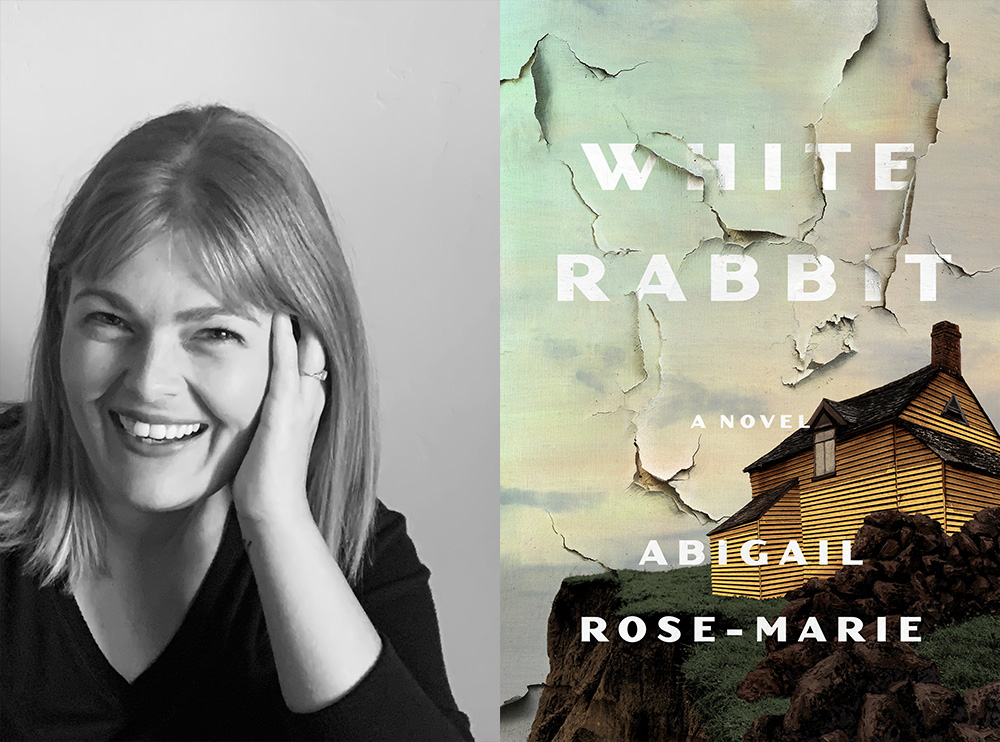
Guest post written by White Rabbit author Abigail Rose-Marie
Abigail Rose-Marie is a writer from Grand Rapids, Michigan. She holds a PhD in creative writing from Ohio University and an MFA from Bowling Green State University. She currently lives with her wife and their very spoiled pets in Utah. She is the author of The Moonflowers, and her novel, Night Work, in which two female scientists defy societal norms and risk everything to create the first life-saving whooping cough vaccine, is forthcoming from Lake Union.
About White Rabbit: A haunting novel in which a girl grapples with her father’s sudden departure and her new companion—the ghost of Sylvia Plath—in a crumbling seaside house that holds more secrets than memories. Releases July 14th 2026.
We know their names. We devour their works. We might know which city they wrote in, where they were born, where they died. Classical, canonical authors—Hemingway, Shakespeare, Dickinson, Fitzgerald—become like old friends when we first meet them in sticky high school classrooms and their words teach us something new about how we perceive the world.
I was fourteen years old when I began to read Plath’s poetry, sixteen the first time I picked up The Grapes of Wrath and fell in love with Steinbeck’s dusty roads. When I decided to write the ghost of Sylvia Plath as a character in White Rabbit, I often felt her presence sitting beside me in the shared spaces—libraries, coffeehouses, parks. I’m not the first to write a passed author into a work of fiction. In fact, numerous passed authors have appeared in media for decades, their legacy living on through new interpretations and representations.
Here are five works that include passed authors in some capacity. And they are all such a delight to encounter!

THE HOURS by Michael Cunningham
It’s hard for me to think of another novel that sat with me for as long as Michael Cunningham’s The Hours did. As a reader, I move from book to book like I’m in a bulk candy shop—taking a sample here and then a side-step later, reaching for another. But The Hours was a book I wanted to savor because the work—a reimagining of a day in the life of a modern-day Mrs. Dalloway, Mrs. Brown, and Virginia Woolf herself—is magnificent. Meeting Cunningham’s fictionalized version of Woolf is both like seeing an old friend in print and being first introduced to her genius at the same time. Though the book is hymn to Woolf and her work, the sections that feature Woolf as a character read like stream-of-consciousness. This not only mimics Woolf’s own writing style but also gives readers an in-depth insight into her mind, creating an intimate and detailed portrait of a prolific writer.

FINDING NEVERLAND
Okay, I’ll admit it: when this movie came out in the theaters in 2004, I went and saw it five times. I was fourteen years old and fascinated by the fictionalized portrayal of J.M. Barrie and his brilliant mind. There are scenes in this film that feel magical even without leaving real-life London in the early 1900s, scenes where we quite literally step into Barrie’s imagination to learn more about the power of storytelling. It is a film that made me want to be a writer, and one where I felt J.M. Barrie was taking my hand and showing me how.

MATRIX by Lauren Groff
Matrix by Lauren Groff is a masterpiece of character. The novel follows the life of 12th century poet Marie de France through beautiful and lyrical prose. What is fascinating about this novel is that so much is unknown about the life of Marie, leaving Groff to rely heavily on Marie’s own writings as the sole avenue for creating character. I really love this approach to fictionalizing a passed author. I, too, when writing the ghost of Sylvia Plath in White Rabbit, spent countless hours reading not only Plath’s poetry but also her letters and journals. Though the ghost of Sylvia Plath doesn’t speak, I had her voice constantly in my head as I recreated her on the page. In Matrix, Groff had a sketch of who Marie was and, from that, she created a woman who was a complex, fully realized and powerful female figure in literature.

MIDNIGHTS IN PARIS
Oh, to step into the shoes of Gil Pender, the protagonist of Woody Allen’s Midnights in Paris who, while walking the streets of Paris after midnight, stumbles upon the great writers of the past. Not only does Gil suddenly find himself in a historic restaurant with Ernest Hemingway and F. Scott Fitgerald, but he also goes on to meet Djuna Barnes and Gertrude Stein, the latter of whom reads Gil’s unpublished manuscript. While I love the film’s quirky charm, what I appreciate most is how place becomes a catalyst for the past and present to intersect. It is only in Paris, after midnight, when Gil, an aspiring writer from the early 2000s, is able to travel back to the streets of Paris in the 1920s and meet the cast of passed authors. Similarly, in White Rabbit, it is in the childhood home of Sylvia Plath where Penelope happens upon her ghost.

HAMNET by Maggie O’Farrell
What a massive undertaking to reinvent William Shakespeare, arguably the most well-known writer of all time, and create a fictionalized version that not only feels authentic but also reveals something new about the man to readers. Which is exactly what Maggie O’Farrell does in her novel Hamnet. Whether you’ve read the book or seen the film (both are fantastic!), meeting Shakespeare as a young man reveals a side of him that only O’Farrell could uncover. And perhaps that is why I’m so drawn to this story. We meet Shakespeare not as a writer, but as a young man: a lover, a husband, a father. From O’Farrell’s recreation, I found myself understanding the writer in new ways and reaching for that old, dog-eared copy of Hamlet, suddenly desperate to read it one more time.