


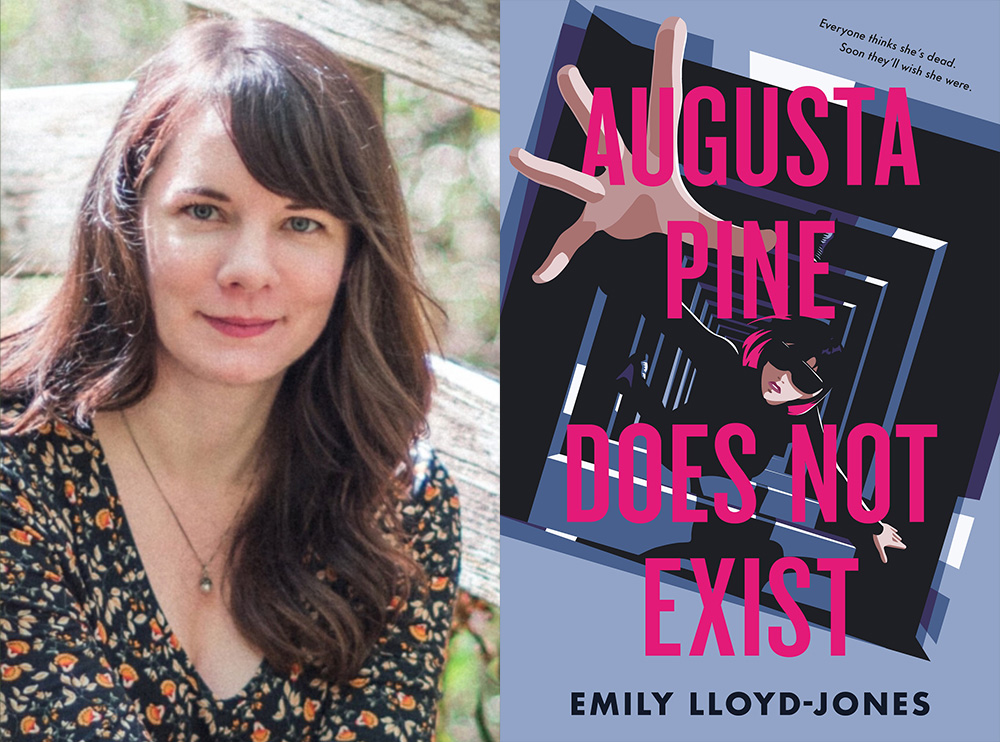
We chat with author Emily Lloyd-Jones about Augusta Pine Does Not Exist, which follows a teen criminal hacker turned secret operative who must outwit a band of cyberterrorists in this gripping novel from the acclaimed author of The Bone Houses.
Hi, Emily! Welcome back! How have you been the past two years since we last spoke for the release of The Wild Huntress?
I’ve been good! It’s so nice to be back!
Your latest novel, Augusta Pine Does Not Exist, is out now! If you could only describe it in five words, what would they be?
Vigilante hacker girl versus cyberterrorists.
What can readers expect?
A fast-paced, cyberpunk thriller with a chaotic protagonist, tired/grumpy mentor, and the funniest animal sidekick I’ve ever written.
Where did the inspiration for Augusta Pine Does Not Exist come from?
It was actually quite a long time ago, when I was working as a bookseller. I was helping a customer and when I scanned one of their books, the barcode scanner landed on my arm. The computer beeped and a bunch of random numbers came up. It was a very surreal moment because there was nothing on my arm! I joked to the customer, “Is this how I find out I’m secretly a robot?”
It never happened again. I still don’t know how it happened. But it started me thinking, what if I did have a barcode? What if we all had barcodes?
Were there any moments or characters you really enjoyed writing or exploring?
I loved every scene with Edgar – he is just a joy to write. I had a great time approaching his dialogue, since he sounds like a 1940s chipper radio host. It was a challenge to write a character with a wildly different voice than anyone else in the book. I spoke most of his lines aloud to make sure they sounded right.
I also loved writing the chapter with Augusta at the ISD offices. I have a fond spot for workplace comedies, so putting my chaotic little hacker in a situation where she has to rely on her coworkers during a crisis was really enjoyable.

Augusta Pine Does Not Exist is a step into a different genre for you! What was it like veering into spy fiction? Did your approach with writing change at all from your more fantasy based novels?
I’ve always loved action films, spy thrillers, and detective stories. I’m particularly nostalgic for that early 2000s age of action tv shows—and I wanted to recapture that same feeling in my own writing. This book has a very different structure than my Welsh fantasies, as a lot of it is told through case files and interviews. But the process of writing a book tends to remain the same for me no matter the genre. Once I have the initial idea, I’ll spend months working out the plot and worldbuilding. Then I settle in and get to writing!
Did you face any challenges whilst writing? How did you overcome them?
The fact that technology advanced faster than this book did! I started writing it a while ago, but my other books took precedence and this one was more of a side project for years. The problem is, our capitalistic cyberpunk dystopia happened faster in real life than I predicted! When I first started working on this book, I thought I was so clever for inventing smart rings. And then smart rings became an actual thing. Other aspects—like the sheer amount of surveillance we live with, AI trying to take over everything, etc—happened so quickly I had to keep changing the worldbuilding so that my cyberpunk could remain science fiction and not a contemporary book!
What’s next for you?
If Augusta Pine is my five-minutes-in-the-future thriller, my next book is my five-minutes-into-the-past thriller. And that’s all I’m saying. J
Lastly, what books are you looking forward to picking up? Any you’ve read so far this year that you’ve enjoyed?
I’ve recently read and loved SUCH A WITCH by Sarah Henning, 89 SECONDS TO MIDNIGHT by Crystal Seitz, and DOE by Rebecca Barrow!