
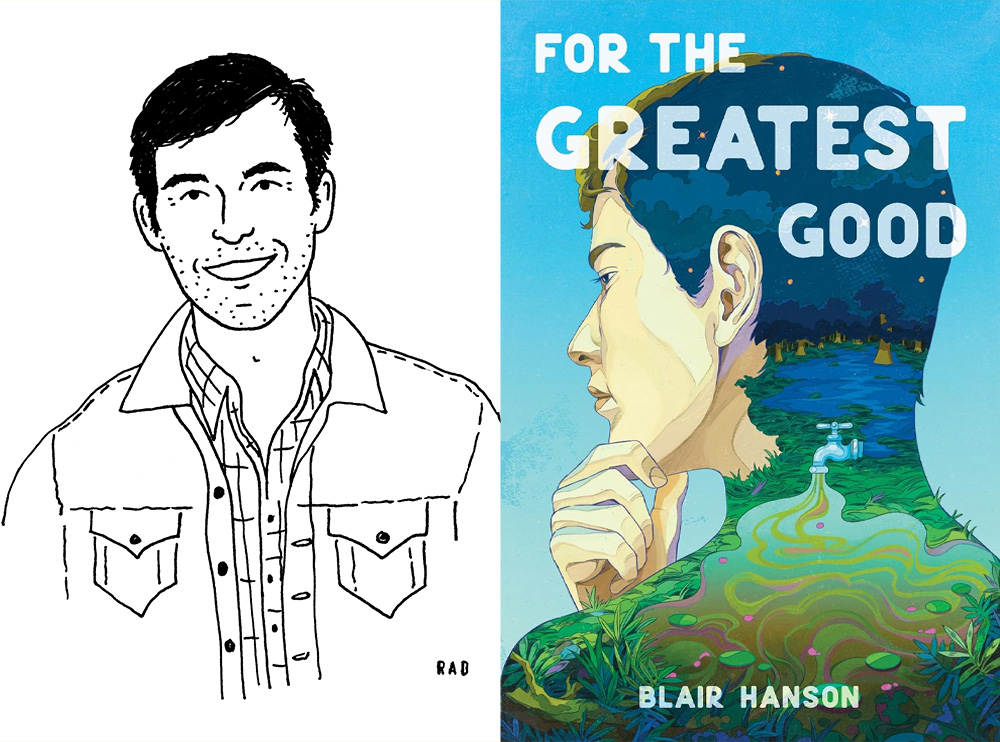
We chat with author Blair Hanson about For The Greatest Good, which follows two rural teens seeking water justice and must reckon with the dangers of privatization and learn what justice truly means.
Hi, Blair! Welcome back! What have you been up to since we spoke last year for the release of America’s Not-So-Sweetheart?
Hi! I wish I had a more interesting answer than “working a lot,” but unfortunately, that’s the truth. My partner and I have been trying to expand our horizons through cooking new dishes, to varying degrees of mediocrity. Other than that, it’s more of the same for me: binge-watching reality TV, going on long walks, annoying my friends by constantly sending them cute cat videos, etc.
Your latest novel, For the Greatest Good, is out now! If you could only describe it in five words, what would they be?
Messy teens + clean water advocacy
What can readers expect?
For the Greatest Good features seventeen-year-old Gavin, his best friend MacKenzie, and his younger sister Hailey as they try to obtain funding to improve their town’s water infrastructure. As a lifelong resident of Pondville, Arkansas, Gavin is well-acquainted with the quality issues of the town’s water supply. Aging infrastructure and inadequate treatment facilities have led to several problems with the tap water in town over the past decade, and Gavin’s worried that Pondville is one burst pipe or massive storm away from losing access to safe drinking water forever.
To help his town, Gavin makes the desperate decision to reconnect with his estranged father. After years of broken promises, Gavin had sworn he’d cut his dad out of his life forever, but his father—a member of a committee that awards grant money to local municipalities—has access to the funds Pondville needs.
The plan is simple: Gavin will reach out to his father, pretend to reconcile with him, and then subtly and expertly manipulate him into giving a grant to Pondville. As I’m sure you can guess, things don’t go exactly as planned…
Where did the inspiration for For the Greatest Good come from?
I try to keep up with current events and policies involving clean water access, and unfortunately, the news on that front has been pretty discouraging lately. I found myself becoming frustrated at the politicization of—or even backlash against—clean water initiatives. No one’s ever going to convince me that we should cut funding, research, or outreach programs related to clean water, especially because water quality issues are increasing due to climate change. Globally, billions of people don’t have access to a reliable source of safe drinking water, and research shows that members of marginalized communities are more likely to receive water that doesn’t meet state, federal, or national guidelines in terms of quality.
Naturally, I know my book won’t single-handedly resolve this huge, broad-scale issue, but I did feel compelled to do my part to raise awareness and help readers think about ways they could bring about change within their communities. Morally gray protagonists are my favorite brand of characters, and I think it’s so intriguing to explore environmental issues through this lens.
Were there any moments or characters you really enjoyed writing or exploring?
Gavin has a lot of interesting relationships (some good, some bad, most somewhere in between) with the people of Pondville, but the one I enjoyed writing the most was his dynamic with his best friend MacKenzie. The two certainly don’t have the “perfect” friendship, as they bicker a lot and are sometimes sloppy with each other’s feelings, but at the end of the day, they ultimately love and care for each other (and their town). I just think there’s something magical about a friendship where you’re roasting them to their face one moment and then doing absolutely anything to help them out the next.
While I didn’t necessarily set out to write the book this way, I’m also happy to have written a story in which the main character isn’t pursuing a relationship. I love exploring relationship drama in my writing, but I also think it’s good to have books out there that aren’t centered around relationships, as those are the stories I wanted to read when I was younger.
Did you face any challenges whilst writing? How did you overcome them?
Honestly, where do I even start with listing out the challenges I faced while drafting? I love a good midpoint plot twist, where the narrative shifts and the characters’ goals and beliefs are altered because of some huge event or revelation. I knew I wanted For the Greatest Good to have that as well, but I couldn’t decide exactly what that plot twist was going to be. The first half of the book stayed pretty consistent throughout drafts, but I think I tried writing at least ten different midpoint plot twists, only to scrap them and start again because they weren’t working. Ironically, the narrative shift I ended up choosing was the second one I’d tried, so I guess I should have trusted my gut. I would have saved myself a lot of time and stress!

The characterization of Gavin’s dad was also something I really struggled with. While I knew how I wanted Gavin’s relationship with his father to end up, I had a really hard time nailing Gavin’s dad’s personality. I had to rewrite the chapters involving Gavin’s dad several times until I found the sweet spot between caring father and irredeemable villain that the story deserved.
Were there any key lessons learned between working on your debut and For the Greatest Good?
When I sold For the Greatest Good, I had three sample chapters, an extremely rough synopsis, and a lot of wishful thinking. By comparison, when I sold my debut, I had extensively edited the full manuscript dozens of times before my editor ever laid eyes on it. Drafting on a contract is an entirely different experience, and for the most part, I think it was a positive one. I think it was really beneficial for me to be able to consult with my editor when I came across a tricky plot point or wasn’t sure whether a certain character should even exist. It was better to be able to talk through those big decisions in the moment, rather than getting 80,000+ words into the manuscript and realizing something major about the plot wasn’t going to work.
That said, if I could go back in time (if only!), I think I would have spent less time making pretty sentences in my first draft and more time getting my thoughts on the page and really immersing myself in the plot. A lot of the book changed during developmental edits, and I think that if I’m ever in this situation again, I will not spend as much time trying to make my writing super clean at the first draft stage. Writing on a contract also means a lot of tight deadlines for drafting, which I’d never really had to worry about when I was writing with the intent to query agents. I thought my time management skills were really good already, but working on this book made me have to reach a whole new level on that front.
What’s next for you?
I can’t say too much right now, but I’m working on a new project that is pretty different from either of my first two books. It will be a genre switch for me, which is a little daunting, as I’ve only ever written contemporary young adult, but I’m really enjoying it so far!
Lastly, what books are you looking forward to picking up? Any you’ve read so far this year that you’ve enjoyed?
I’ve had the opportunity to read early versions of Karen Myna Cantor’s Alex, by Proxy twice now, and I’m really looking forward to seeing the finished product when it comes out in July. Elias Cold’s Selkies & Skeptics is another book I’m happy to see coming out later in the year. I recently read Jessica Lewis’s Monstrous and loved the balance of horror, humor, and heart. I’m excited to get my hands on Britney Brouwer’s She’s A Knockout, H.D. Carver’s We Became Wild, Delali Adjoa’s The Free Verse Society, and Keala Kendall’s That Which Feeds Us.