


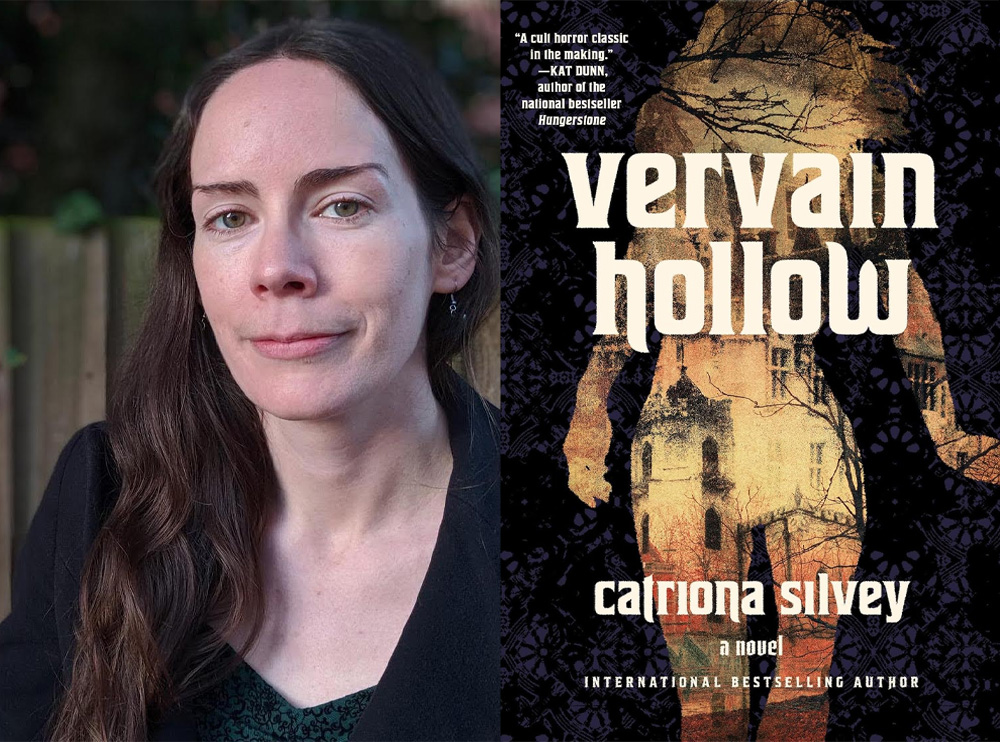
Guest post by Vervain Hollow author Catriona Silvey
Catriona Silvey is the author of the international bestseller Meet Me in Another Life and Love and Other Paradoxes. She was born in Glasgow and grew up in Scotland and England. After collecting an unreasonable number of degrees from the universities of Cambridge, Chicago, and Edinburgh, she settled in Edinburgh where she lives with her husband and children.
About Vervain Hollow: Two years ago, Laura was in a cult. But when the sprawling house in the hollow burned down with the cult’s magnetic leader trapped inside, Laura had nowhere to go but home. Brokenhearted, she finds herself longing for Vervain, their lost leader—despite the trauma of that strange and terrifying year, she knows the power he promised her was real. But when her estranged friend, Aliyah, calls to tell her that another acolyte has been lured back to the hollow by a message from Vervain, Laura only hears one thing: He’s still alive. As Laura and Aliyah venture back to the house of their nightmares to find the truth, Laura soon realizes that not everything she remembers can be trusted—and that the darkness will do anything to get her back. Releases June 16th 2026.
In the classic Gothic novel, the protagonist enters a shadowy world with its own rules, cut off from reality. They are unable to leave; they are gaslit, made to doubt their own sanity; often, they come under the influence of a mysterious, controlling figure, a source of both desire and fear.
In other words, it’s very much like joining a cult!
The thematic fit between the Gothic and cults is a driving force behind my novel Vervain Hollow. The protagonist Laura, naïve, passionate, and insecure, has all the characteristics of a Gothic heroine – characteristics that make her highly susceptible to cult recruitment. Meanwhile, Vervain, the antagonist, is both a prototypical Gothic villain – dark, brooding, linked to the supernatural – and a classic cult leader, whose initial seductive charisma quickly gives way to manipulation.
Here are five more Gothic novels about cults, where the aesthetic and thematic tropes of the Gothic marry perfectly with the authors’ explorations of brainwashing, groupthink, and coercive control.
Catherine House by Elisabeth Thomas

Fleeing a series of bad decisions made in her last summer of high school, Ines winds up in Catherine House: an elite college where tuition and board are free, on condition that students cut themselves off from the outside world for the duration of their three years’ study. Thomas’s dreamlike prose perfectly evokes the fugue state Ines drifts into during her time in Catherine, a mindset as Gothic as the house itself: a sprawling, interconnected mansion of decaying rooms and maze-like corridors.
While the novel invites multiple interpretations, it can be read as a surreal extrapolation of the experience of attending an elite institution. Ines feels the exhilaration of being chosen and the joy of belonging, but around every corner lurks the dissonance of her complicity in a dark legacy. Ultimately, her choice is between letting Catherine absorb and define her, or breaking away in search of an uncertain, terrifying freedom.
Our Share of Night by Mariana Enriquez

Part horror, part magic realism, Enriquez’s epic novel takes on the legacy of the Argentinian dictatorship through the story of a family entangled in a darkness-worshipping cult. Weaving back and forth through forty years, the story follows Juan and Rosario as they attempt to protect their son Gaspar from the machinations of the cult they are both deeply enmeshed in: Juan as the medium who can call the darkness into the human world, and Rosario as a privileged scion of the cult’s founding family.
What makes this novel Gothic is not just the surface elements – ghosts, family secrets, legacies of trauma – but the darkness within the characters: Juan and Rosario are trapped in the cult partly by their inability to let go of the power and prestige it offers. Meanwhile, the cult itself, and the colonial compound that serves as its stronghold, function as a clear allegory for the callousness of the rich and their complicity in the country’s suffering. Often deeply painful, the novel is also drenched in wonder and love of beauty, bringing an aching tenderness especially to the complicated father-son relationship between Juan and Gaspar.
Hagstone by Sinéad Gleeson

Part horror, part magic realism, Enriquez’s epic novel takes on the legacy of the Argentinian dictatorship through the story of a family entangled in a darkness-worshipping cult. Weaving back and forth through forty years, tOn a wind-battered island off the coast of Ireland, artist Nell ekes out a living, maintaining her freedom at the price of a deep loneliness. When she is offered a commission to create an artwork for the Iníons, an all-female group who live in an abandoned convent on the cliff, she is curious enough to accept. Working on her piece, Nell becomes enmeshed in the lives of the group and their leader, the mysterious Maman, whose motives she can’t quite figure out.
A masterpiece of sustained mood and gradually building tension, Hagstone eschews the obvious: there is no shocking revelation about the cult’s true nature, no climactic bloodbath. There is just the quiet unease of distance: between people, between events and their explanations, between the island and the rest of the world. An immersive, rewarding read for those who like their Gothics atmospheric and open-ended.
Bunny by Mona Awad

Part horror, part magic realism, Enriquez’s epic novel takes on the legacy Like Catherine House, Bunny takes an elite college as its setting. But the focus here, as in Bunny’s Gothic predecessor Frankenstein, is on the perilous allure of creation. When misfit MFA student Samantha discovers that the other women in her cohort, the creepily identical Bunnies, are transforming rabbits into uncanny simulacra of men, she gets sucked into their world and into their hive-mind. As Samantha gradually loses her identity, the Bunnies cannibalize her creativity, rooted in hardship, to lend some grit to their insipid creations.
Bunny is both an allegory about privilege and authenticity, and a very funny satire of critique workshop culture. It’s also extremely Gothic, from the aching isolation that pushes Samantha toward the Bunnies, to the eldritch, horrifying version of Providence, RI that she scurries through ‘like prey from some unknown but imminent beast’. Like a classical Gothic heroine reclaiming her agency, Samantha can only escape from the Bunnies’ control once she discovers the extent of her own creative power.
You Weren’t Meant to Be Human by Andrew Joseph White

Crane, a young trans man, flees his home after a suicide attempt and takes refuge with the Hive, a cult living under the sway of sentient parasitic insects. When cult member Levi gets Crane pregnant, the Hive demands that Crane carry the baby to term.
White’s novel is a harrowing, visceral read, at times darkly comic, at times intensely claustrophobic: Crane is trapped in his own changing body as much as he’s imprisoned by the Hive. The book is also Gothic to its core. Beneath the hallmarks of the genre – doppelgangers, possession, not trusting your own mind – lies the dysphoric meta-horror of Crane being forced into the narrative role of the Gothic heroine: a role he is determined to reject at all costs, even if it means committing monstrous acts. Like all the books on this list, You Weren’t Meant to Be Human uses the cult not just as a horror trope, but as an allegory for the way real-world structures seek to limit, control, and define us.