

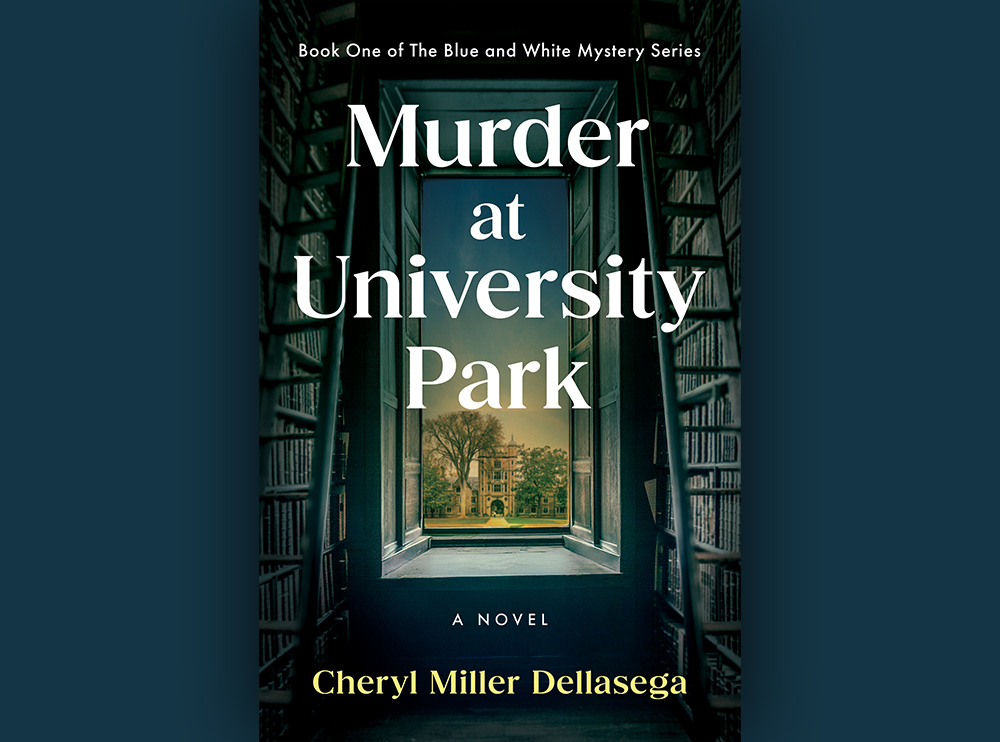
For fans of My Dark Vanessa and The Secret History, a gripping campus thriller about a determined young professor who challenges a corrupt academic system, confronts a predator in power, and refuses to stay silent—even when her quest turns deadly.
Intrigued? Read on to discover the synopsis and an excerpt from Murder at University Park by Cheryl Miller Dellasega, which releases on August 4th 2026.
A brilliant young professor. A powerful advisor with everything to lose. A university campus hiding deadly secrets.
It’s 1998, and Dr. Lacey Redd is on the verge of tenure—and under the thumb of her department chair, the arrogant and celebrated Dr. Geoffrey Hart. When Lacey begins to suspect Hart of falsifying his research, she quietly teams up with a tech-savvy colleague to uncover the truth. But before they can break the case, her partner turns up dead in the campus library.
As Lacey digs deeper, she uncovers something even darker: Hart has been preying on female graduate students for years. When he attacks her at a department party, Lacey fights back—leaving him injured and exposed. A new department head steps in, and with Hart out of the picture, it seems justice has finally been served.
But someone on campus is still watching. And they’ve decided Lacey knows too much.
EXCERPT
Although Dr. Hart was small in stature, he had strong, well-defined features: a thick mane of pure white hair, penetrating gray eyes, and a square jaw. When I’d received the letter offering me a tenure-track position, it was exciting to think about working with such an accomplished scientist. Then I started the job and quickly learned I was not one of the faculty he favored. Of course, he was always pleasant to me in public, but that facade vanished on the rare occasions when we were alone.
My legs stuck to the stiff leather of the office chair, but I sat obediently as he settled in and pursed his mouth in an expression that was different from his public-facing one, more sour than encouraging. “Well, Dr. Redd, how is everything?”
While I’d answered this question earnestly during our initial meetings, it was clear he didn’t really care how things were with me. (Florence was the one who listened to that stuff.) Thereafter, I gave the only possible response—a perky “Just fine!” and sat up straighter, forcing my hands to relax in my lap.
“You’re probably wondering why I called you in today, Dr. Redd. I thought it might be time for a little pep talk.” He picked up a folder marked with my name, and his expression changed from bland to disapproving. “When you first interviewed here, I hoped you would blaze a trail for other women to join us, but now, I’m quite concerned with your chances for tenure. You’ve had few credible publications, no pending funding from external sources, and only average teaching evaluations . . . and there was that trouble with Rick Stein.” His mouth puckered as if he had tasted something sour.
I shifted against the hard seat, unable to refrain from defending myself. “Dr. Hart, when I received the NIH postdoc grant two years ago, you told me it was a big plus.” His eyebrows arched up, but before he could respond, I added, “And the Academic Regulation Committee cleared me of any wrongdoing with Mr. Stein. In fact, they put a note in his file about his lack of integrity.”
Dr. Hart slid on a pair of rectangular wire-rimmed glasses, looking over the top of them, gray eyes steely. “Yes. You did get a preliminary small grant for your work on calcium channel blockers, but the National Institutes of Health like to see a second proposal before the first one runs out. That’s why I gave you permission to use my SIMS data for a new study of your own. I don’t do that for just anyone. How’s it going?”
I hesitated, not wanting to sound defensive again. “I’ve been working on the data, but when I agreed to help set up a minority scholars program this summer, it ended up as a full-time commitment. I’m hoping to get it done this semester.”
He cleared his throat in a way that reminded me it would always be a mistake to try to justify myself to him. Still, out of desperation, I smiled hopefully.
“Nonetheless, I must tell you that your accomplishments are weak at this point. Very weak.” He stared at me, then blinked. “Do you have any idea of how insipid you look when you smile like you are just now? We’re having a serious conversation.”
Over the years, under the guise of giving me advice about “professional development,” Dr. Hart had criticized my looks (“When one has curly hair, it’s best to pull it back so you don’t look like a sixth grader”), chuckled at one of my teaching evaluations (“I’m sorry, but this is priceless: ‘Dr. Redd is like a dumb blonde without the blonde and without the hot’”), and stifled a laugh over another that made remarks about my clothes (“Plaid is not her best look. All I can do is stare at her big rear whenever she wears it”).
The “insipid” comment was new territory, delivered by my chair in-person with a look that suggested a bad smell in the office. My face froze in shock.
Dr. Hart went on. “Here we are in 1998, and academe still isn’t a good fit for women, especially those with families. I’m guessing it’s hard for you to balance it all. Would you like me to remove you from the tenure track completely rather than have you be denied?”

I took a sharp breath, but he was busy paging through my file, frowning. If he had taken out a red pen and slashed a large F across my dossier, he couldn’t have made my failure to live up to his expectations clearer. Forcing myself not to look away, I hoped he couldn’t read the distress (and the beginning of tears) like beacons in my eyes, but it was too late. He reached into his desk drawer, took out a tissue box, and handed it to me.
Finally, he said, “I can suggest a special review.” He slapped the folder closed and dropped it on top of the memos he’d just reviewed. “Or you could ask to be taken off tenure track.”
I couldn’t put words to the different thoughts that pulsed through my mind just then: an image of our house with a For Sale sign in the front yard while Meg and Tyler cried; my apparently wasted years of schooling; grief for my dissertation research, which had seemed so potentially lifesaving; the crushing debt we would face on one income . . .
Dr. Hart looked away, pushing his glasses up on the bridge of his nose to focus on his computer screen.
“I’m sorry it’s come to this,” he said. “Why don’t you think it over? Maybe discuss it with Sam Miller. He knows the SIMS data, and he’s mentored other junior faculty successfully, but the clock is ticking for you. Going off tenure track and taking a pay cut may be your best option.”
I gathered my dossier and rose as gracefully as possible. He stood, crossed the room, and opened the door, reverting to a cheerful smile as I exited. “Thanks for coming in, Dr. Redd. Get back to me on my offer. Take your time, of course.”
I nodded, feeling as if I had swallowed a mouthful of glue. “I’ll think about what you suggested.”
All rights reserved. No part of this publication may be reproduced, stored in a retrieval system, or transmitted in any form or by any means, electronic, mechanical, photocopying, recording, or otherwise, except for brief quotations in reviews, educational works, or other uses permitted by copyright law.
Published in 2026 by She Writes Press, an imprint of The Stable Book Group