

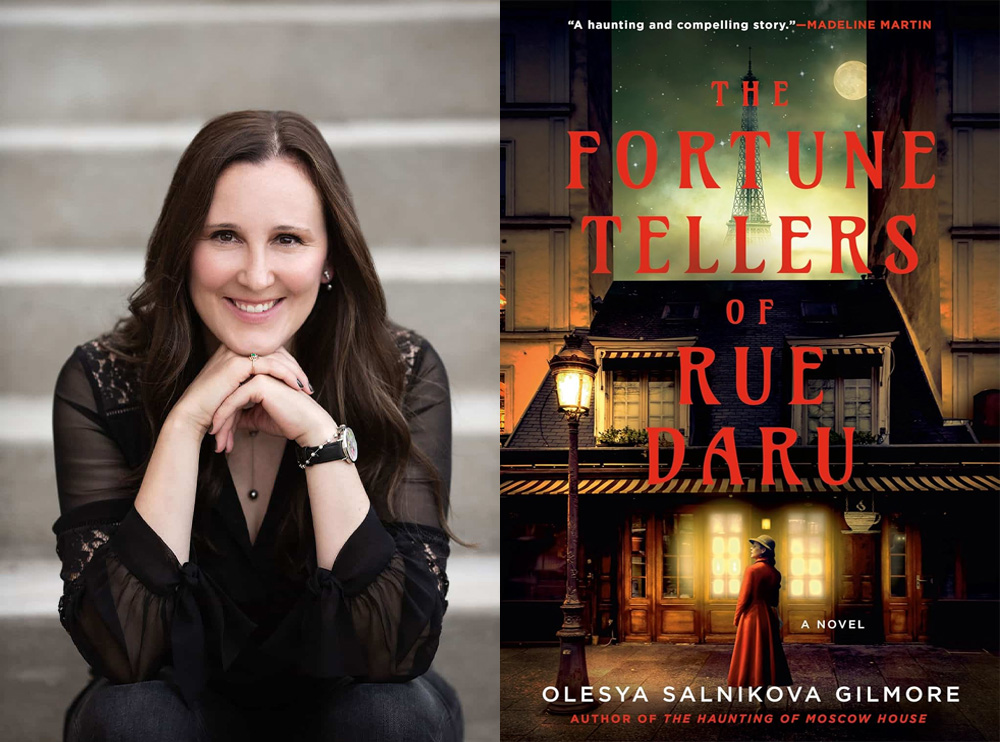
The Fortune Tellers of Rue Daru follows a fearless fortune teller in 1920s Paris who must use her powers to divine who she can trust when an exiled Romanov princess and her brother come to her seeking answers about a decades-old mystery.
Spirited Zina and her secretive grandmother, Baba Valya, own a tearoom on rue Daru in Paris, where they have lived quietly since Zina’s mother’s untimely death. By day, the women serve tea, mostly to members of the bustling Russian émigré community, but when dusk falls, they divine fortunes and perform séances for their loyal clientele.
Then the charming Princess Olga and her brother arrive, searching for knowledge about the disappearance of their father, the exiled Grand Duke, cousin of the last Tsar of Russia. Zina, eager to learn more about the spirit world and her powers, performs the séance. She is able to summon the Grand Duke, but to her horror, he starts to haunt the shop, and he seems to know something sinister about her mother’s death.
As Zina delves into her family’s hidden past, dark secrets are unearthed, threatening the home and tearoom Zina and her grandmother have worked so hard to build, not to mention their very lives.
Olesya Salnikova Gilmore is the author of The Witch and the Tsar and The Haunting of Moscow House. Originally from Moscow, she was raised in the US and graduated from Pepperdine University with a BA in English/political science, and from Northwestern School of Law with a JD. She practiced litigation at a large law firm in Chicago for several years before pursuing her dream of becoming an author. She writes speculative gothic suspense and other dark fiction. She also loves exploring Eastern European history and folklore. Her work has appeared in LitHub, Tor.com, CrimeReads, Writer’s Digest, and Washington Independent Review of Books, among others. She lives in a wooded, lakeside suburb of Chicago with her husband and two daughters.
We asked Gilmore about drawing parallels between her world of characters in the 1920s and today’s world, as well as her research into family history, immigration, and more.
You said you moved to the U.S. when you were seven and wanted to write about immigrants in a different time and place. What made you pick 1920s Paris over other time periods and places? What about it appealed to you most?
Part of it was research-driven. I was working on my previous novel, The Haunting of Moscow House, and learning about the people who stayed in Russia after the 1917 Revolution. Together came the research on the people who fled the new regime. These would-be émigrés settled all over the world, but there is one place they kept coming back to: Paris. Paris was familiar to Russian people; many knew French, had visited or lived in France before. And many of the Romanovs who survived ended up there, which made for plenty of drama.
I also wanted to continue working in the 1920s after Moscow House—it is such a time of change, of modernization, of hope, while still being haunted by the Great War, all the revolutions and turmoil.
Lastly, I loved the idea of “time-traveling” to Paris, one of my favorite cities, to the 1920s, one of the most legendary time periods in Paris, and discovering the many strong, time period-defying women that upheld the Russian émigré community there. These women held jobs, were their family’s breadwinners, supported their kids, parents, and sometimes husbands, in immigration and in other difficult times. They are the heroes unsung in our history books, and I wanted to give them a voice.
What affinity would you want to have and why?
I am an absolute coffee addict, so I would choose Baba Valya’s affinity for coffee reading (either through beans or grounds).
It would be fun to tell the future just by looking into a coffee cup. I also think it is a “safer” method of divination as compared to, for example, Zina’s aura reading and eventual work as a medium/spiritualist. Since I am an extremely risk-averse person, I would likely not be able to take the risks with the dead and the living that Zina does. Instead, I’d prefer to safely ensconce myself in my very much non-haunted place of business, be it a tearoom or coffeeshop, and brew coffee and tea by day, and tell fortunes by night.
Were there any characters who you took inspiration from in your real life?
All my characters have aspects of me and the people in my life—family, friends, people I’ve come across, and historical people I’ve learned about through the history books. In this novel, though, Baba Valya is the character most heavily inspired by my family, particularly my grandmothers.
I knew my mom’s mom, Irina, the most, as she only recently passed away. We had a very strong, very special bond, though she lived half a world away. She was also unbelievably bold, beautiful, and brilliant. A spitfire in every way possible. Having said that, both her and my grandfathers had secrets they kept from me and my parents until the very end of their lives. Part of it is due to the secretive nature of the Russian culture, beginning with the conservative society of Imperial Russia that then transformed into a secrets-is-currency mindset of the Soviet period. The other part is the differing mores and societal expectations in many grandparent/grandchild relationships, and certainly between Baba Valya and Zina.
Valya is named after my dad’s mom, who unfortunately died when I was a baby. But by all accounts, and family history, she might have been even more of a spitfire than my mom’s mom. This speaks volumes.
But all the women in this novel are inspired by somebody I knew in immigration. They are or were forceful, determined, independent women who upheld our Slavic community here in the US, who worked hard, had a lot of passion for life, took care of their families and friends, and were a pillar of strength and wisdom for us all. They inspired me to write this book and continue to inspire me as a person and woman, and breathe soul into my writing.
One of your lines really stuck out to me: “I had come to believe ghosts live in memories and nightmares.” How does this line apply to your familial memories when it came to researching and writing The Fortune Tellers of Rue Daru?
This question is very astute, as with that line, I was specifically thinking of my departed family. All of them live on in my memories, yes, but they are also a source of inexplicable fear. My memory of them, living or dead, the way I remember them or as some kind of spiritual manifestation of their current state, come back to me in my darkest moments of insecurity, of nightmare—like when I need to spend the night alone in my house! Quite simply, they haunt me.

I explored this return of dead family members, and the question of what would happen if the spirits of departed family started to literally haunt us, in Moscow House. But I continue to grapple with this personally and in my writing, including Fortune Tellers. These questions are born not only of my fear of ghosts and hauntings, but of my fear of loss, of death, of what happens to us in the great beyond. What has happened to those we know who have passed on there. Who are gone from our lives, who are lost to us.
In this novel, I also explored the darker, more nightmarish aspects of family history, trauma, and hidden secrets, as revealed through the ghosts of our past (indeed, our past being a kind of ghost in itself), through memory and nightmare, and often threatening the new lives we’ve built for ourselves and our loved ones. I explored in my family history and memory my own “ghosts”—my grandmothers and grandparents generally and the secrets they kept; my immigration experience; what my parents’ decision to move my sister and me to the States meant for my life and me as a person, not to mention my fate, my own traumas, and the trajectory and tapestry of my family as a whole; and the superstitions and fortune telling traditions the women of my family engaged in and passed down to me, even if in their imperfect, almost hesitant way.
These and many other questions drove my research, were at the very heart of my conception of this story and its characters, and eventually, played a big part thematically and personally in the writing of what became The Fortune Tellers of Rue Daru.
In writing this book, what have you learned about yourself? Is there anything you wish to say to your seven-year-old self who was just moving to the States?
Mirroring Zina’s experience of being born French but raised Russian, and her coming of age journey of self-discovery, including cultural self-discovery, I learned that an immigrant doesn’t necessarily need to choose between their birth and adoptive cultures. I would tell my seven-year-old self that both can be a part of you and your experience. And that you’ll be more comfortable in your skin if you just acknowledge both and make peace with it and who you are.
How do you think this novel, even though set in a different era, can be paralleled to today’s world? What can readers take from The Fortune Tellers of Rue Daru? What do you want them to take from it?
The strength and perseverance of women and our community are a light in dark times, whether in immigration or not, and should be considered our metaphorical home. Our touchstone. Our unique source of feminine magic. It is the source of sisterhood, found family, and true friendship. It is the tapestry of survival across generations. It is also the vehicle through which family history, lore, talents, and magic are passed—maybe real magic, but mostly, the love that runs like a current through each and every one of us.
And while women might not be the focus of traditional history books, strong, determined, powerful women and their stories have always played a key role in shaping that history and the society we know today.
Trust in your women, hold them close, raise them strong. They are the true leaders at the heart not only of our societies and our families, but of our very lives.