

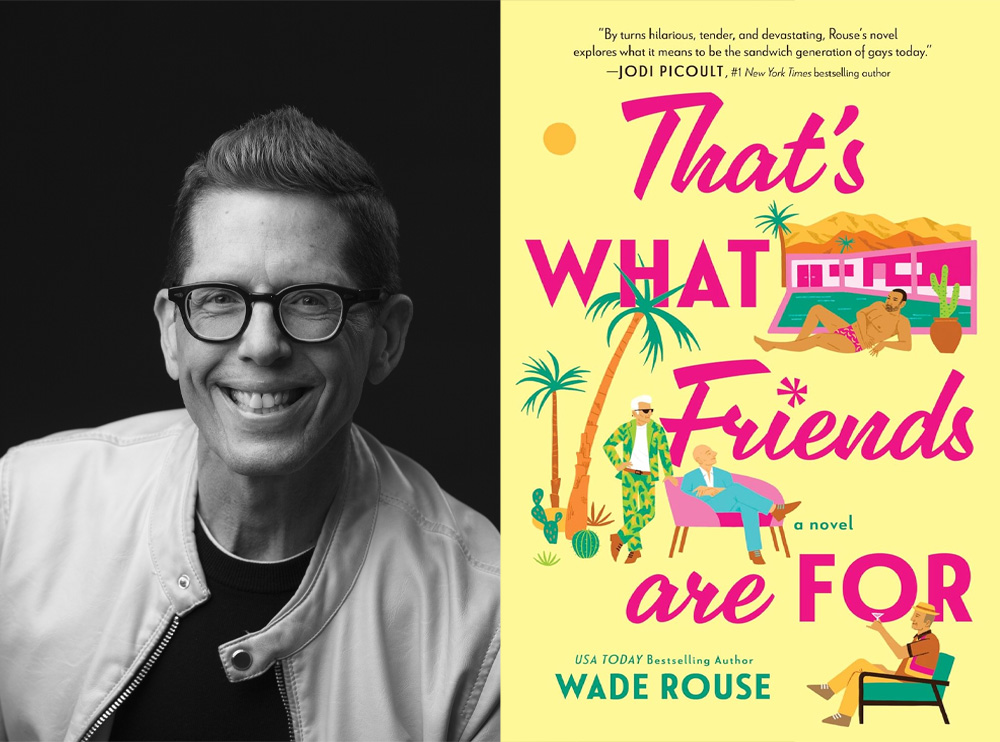
In this poignant and hilarious story inspired by TV’s beloved The Golden Girls, bestselling author Wade Rouse celebrates love, aging, finding your people, and the art of impeccably timed one-liners. That’s What Friends Are For proves that while family may be the tie that binds, it’s the chosen family that truly keeps us together.
Wade Rouse is the USA TODAY, Publishers Weekly, and #1 internationally bestselling author of 21 books, including five memoirs, 13 novels, and three holiday novellas. Wade’s books have been translated into nearly 30 languages and have been bestsellers across the world. That’s What Friends Are For marks the first novel under Wade’s own name.
We asked Rouse what it was like revisiting the iconic Golden Girls, what it was like to revisit the show since watching it in college, and what That’s What Friends Are For means to Rouse.
You craft such witty comedic conversations between the four friends that really feel like you’re watching a sitcom. What was it like to write these four characters and blend them all together?
Thank you! One of the biggest compliments I’ve received was from the Emmy-nominated casting director of Shrinking and Scrubs, who said the novel had the comedic timing of the best scripts he’s ever read. I really wanted the novel to have the humor and pacing of the classic sitcom. However, the humor had to fit each character, each moment, each situation. The humor is all my own, and the conversations these friends have is pretty much how my best friends and I talk to each other: One-liners, biting sarcasm, jokes that often cut a little too close but tell the truth because we know – and love – one another more than anyone else in this world.
Each of the characters in the book are not only inspired by Dorothy, Rose, Blanche, and Sophia but also my dear friends. I worked very hard to transfer the internal traits that made Dorothy, Blanche, Rose, and Sophia so unique into the bodies of four very different men whose lives have been completely different in order to give this a very modern twist and a new-age twist on friendship, found family, aging with grace and grit, being overlooked in society and battling the inhumanity in the world. So, Teddy’s humor (like Dorothy’s) is his armor, but it springs from a place of hurt and abandonment. Ron’s sunny optimism (like that of Rose) remains because it’s all that’s kept him going after a life of familial abuse and estrangement … he’s built a home for himself and his friends by believing tomorrow will be better; Barry is Blanche, who runs through younger men as a way to deal with the loss of his career and to feel youthful, powerful and sexy in a world that looks his way less and less (Barry is based on Coco, a real character from The Golden Girls – the women’s openly gay cook and housekeeper – who was cut after the pilot was tested to audiences); and Sid (Sophia) is an 81-year-old, formerly married Jewish man who comes out late in life, often says the wrong thing, and – toward the end of his life – is finally learning to love himself and understand his own beauty and strength. His late in life love story is one of the most beautiful storylines I’ve ever written.
In your Author’s Note, you said you watched Golden Girls when you were in college. Now, here you are with your own book about the show and honoring the legacy it left behind. What were some challenges you found when drafting?
There were many challenges (and pressures) when writing this novel. First, I didn’t want my main characters to be caricatures of The Golden Girls because almost everyone already knows and loves those women so much. Moreover, humor is much harder to write than drama. It’s more difficult to make someone laugh than it is to cry. I can write about the last days of my beloved dog’s life and have you weeping instantly. But if I tell a joke to a hundred people, fifty will think I’m a genius, and the other half will think I’m an idiot. Humor writing has a style, pace, and rhythm much like a great sitcom or memorable standup act, and I had to pare away what didn’t work or what wasn’t in the soul of each character. I call it the “3 H’s”: Humor + heartbreak = honesty. The best humor springs from an internal well of hurt. I left a lot of funny on the cutting room floor because – although I loved it – some of the jokes didn’t move the characters or story forward in any meaningful way, or they slowed the pacing. I also felt a great deal of pressure to get these characters’ lives and histories right: My life – and the lives of my friends and history of the gay community – are reflected in each character, and it was my honor and privilege to bring those to life.
Which Golden Girl character are you? And which Golden Gays character are you?
I’m a total Dorothy from the show and Teddy in the book (with a touch of Barry). Like Bea Arthur in the show and Teddy in the novel, I’ve used humor my whole life as a way to make friends and also keep people at a safe distance. And I can give someone a wicked side eye. Humor can unite, and yet it can also protect you from getting hurt, which it did for me growing up gay in the Missouri Ozarks. Dorothy, Teddy, and I have that in common, and yet our wit, sarcasm, and good-natured needling are also our deeply personal ways to show love. My connection to Barry is that being an actor or author is all-consuming. It’s a calling, and each and every day our talent and our souls are tested and judged. Being a fulltime author is a magnificent yet maddening career filled with daily rejection. I connect with Barry’s desire to never give up – no matter what life throws at you – and his desire to create and succeed. PS: My husband, Gary, is a former Blanche, who turned into a Rose, who is quickly becoming a Sophia.
One of the main aspects not many people remember is Coco, the gay housekeeper and cook, who was written out after one appearance on The Golden Girls. What was it like to do research for this book? What did you learn as a viewer and as an author?
One of the main reasons I wrote this novel was my fascination with the character of Coco in The Golden Girls. Never heard of him? You’re not alone. I truly didn’t remember him either until – tired of baking break and buying Air Fryers during Covid – I began to rewatch The Golden Girls, like so many in America (it ended up being one of the most-streamed series at that time). That’s when I rediscovered that in the original episode of The Golden Girls, there was a lead character named Coco, who was removed from the show to make room for Sophia after the pilot was shown to test audiences. Sophia, meant to be a recurring character at the time, got the full-time role, and Coco got cut. Some involved with the show blamed the kitchen: It was too small to have five people constantly featured in it, but I ask in the novel: Were audiences ready for a character like Coco? So I fictionalize the life of this actor and bring him to life as Barry, who had the role of a lifetime ripped away from him and share the struggle of a man trying to get that fame back his entire career. What must it have been like to be an out, gay actor in a time when Hollywood was still so closeted? What was it like to break the gay ceiling in Hollywood in the 1980s and then be broken by having it all taken away? I’m a former writer for People.com, and I began to read a lot of articles about the show, especially as it approached its fortieth anniversary. Many writers involved with the show actually stated Coco’s removal inspired them to make the show tackle weighty, important, timely, difficult issues, which is also what I tried to do in the novel. I’ve never been prouder of bringing a character to life on the page and also bringing recognition back to a forgotten character.
To those who haven’t watched Golden Girls, what would you say to them? What words of wisdom would you give to those who are also torn about reading That’s What Friends Are For especially if they haven’t watched the show?
Oh, my gosh, you don’t need to have watched The Golden Girls to read That’s What Friends Are For, like you don’t have to be a letter writer to love The Correspondents, an artist to love Theo of Golden, or met a dragon to read The Fourth Wing. This is a novel about deeply universal themes, such as finding chosen family who are as important as blood relatives, the joy of finding friends in your life who love you unconditionally, accept your flaws, and will help you navigate all of life’s ups and downs with laughter. This is a story of finally learning to love and accept yourself, no matter your age. And I guarantee you will laugh your ass off on page one (and cry by page two). As I write in the novel, which sums up why people should read this story: “Life is pretty damn simple when you get down to it: We need friends who not only love and accept us but love and accept us just as we are. We need friends who allow us to shine brightly in the world so our light can be seen. When it does, we can be our true selves. We can show our faces without shame, without bruises, without masks.” And, if you need more convincing, the novel was a Today Show Must-Read (Kwame Alexander named my new novel “The Best Feel Good Read of the Month” and said, “This book not only made me laugh out loud, it made me call all my best friends and tell them how much I loved them!”). Jodi Picoult raved about the novel, it was named one of BookBub’s Best New Fiction releases, A Most Anticipated Book of 2026 by Zibby Media, an US Weekly Best Romance, and it was featured in People, Newsweek, and CBS-New York’s Club Calvi Book Club.
What about Golden Girls makes you feel like it’s still relevant, maybe even a bit iconic, to this day? What about it do you think makes it a comfort show?
We tend to remember the four women and the laughter, but The Golden Girls tackled HUGE issues during its time on air: Aging, family dynamics, friendships, LGBTQ+ issues, coming out, women over sixty having sex, the search for meaning after marriage and children, mortality, fidelity, racism, depression, the HIV-AIDS crisis, and it did it all with humor. It’s what I’ve done my entire existence in life and writing: Lessen the pain with laughter. Teach and break down walls with humor. You don’t change people by preaching at them; you have to connect, have them walk in your shoes, and see the world through your eyes. The Golden Girls is still considered one of the most progressive shows ever to air on television, even some forty years later, and it enjoyed an epic rebound – ironically – during COVID, when so many younger people discovered the show as a way to understand what their isolated elders – many of whom would sadly die – were going through. They watched it together, as I did some forty years earlier with my mom and grandma. I actually structure the novel like a sitcom.
What does The Golden Girls mean to you? Most importantly, what does That’s What Friends Are For mean to you?
Both are deeply, deeply personal. The novel was inspired by watching The Golden Girls as a closeted college fraternity boy with my mom and grandma long-distance. That show was not meant for a 19-year-old frat boy. I mean, four old women living together in a pink house in Florida? C’mon. I was in college in 1985, and I was – on the surface – your stereotypical ’80s frat boy: I could chug a keg beer with the best of them, I pulled all-nighters, I timed Domino’s Pizza drivers with a stopwatch … if they were one second late, I got my free pizza. But I was also hiding a big secret: I was gay. And I hated myself for that. So much so that I adopted a new persona in college that made me the life of the party. I buried my secret, much like I had buried my older brother, Todd, who had died a few years earlier in a tragic accident. I believed God had made a mistake and should have taken my life.

I believed my brother – a true country boy – would have given my parents what I believed they wanted: A family, a daughter-in-law, grandchildren. I believed the rest of my life should be dedicated to not creating another moment of pain for my parents. They did not deserve that. And so I lived a lie to make others happy. And I died a little every single day until I nearly ended my life. I had not wanted to go to college and leave my mother and grandmother alone. I was their best friend, and they were mine, but they both pushed me out of the nest and our small town, telling me a bigger world was waiting for me and my gifts. My mother and grandmother used to write me letters (remember those?) every month. I would talk to them every Sunday after dinner on the pay phone (remember those?) at the end of the dorm hallway. One of the ways I also bonded with my mother and grandmother in college was by, as I write about in the novel, watching The Golden Girls long-distance with them. I remember some sorority friends talking about the show, and one Sunday, I asked my mother and grandmother if they were watching it. They were. Of course. So, on Saturday evenings before the fraternity parties started, I’d stretch that cord of the rotary phone (remember those?) on the wall in the fraternity house until it snaked into my room and watch the show with the two women I loved most in the world, our laughter crossing the miles. That show also – I didn’t realize at the time – bridged a cavernous divide between generations. It allowed me to see my mother and grandmother in a new light. It allowed them – eventually – to understand and accept me because the show discussed topics (like coming out) that were rarely broached on network TV. What was it about The Golden Girls? I mean, what could four older women say that would resonate with a 19-year-old boy struggling to find his place in the world? Plenty, it turns out. Because we were the same in so many ways. Ostracized and overlooked. Diminished by society. Our voices and worth dismissed. Unlovable … due to age, shame, sexuality. And yet, somehow, we found our friends and community, we bonded together, and our individual strengths made each other stronger. Old women and the gay community, it turned out, were exactly the same.
I think this is one of the best books I’ve ever written. It is – after 20 books – including five memoirs under my own name and fifteen novels under Viola Shipman, the pen name I use to honor my working poor Ozarks grandmother whose sacrifices changed my life and inspire my fiction – the first novel under my own name, and the wait was worth it. I’ve never been prouder of a novel in my life.