


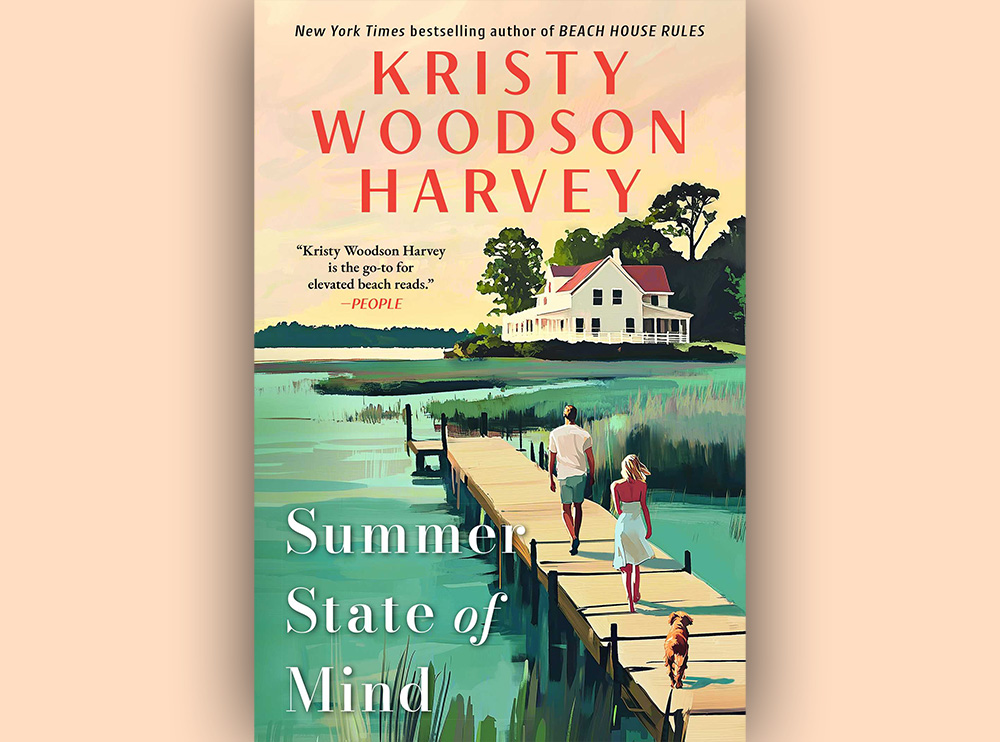
“Queen of the beach read,” (Cosmopolitan) New York Times bestselling author Kristy Woodson Harvey returns with a heartfelt escape to coastal Carolina.
Intrigued? Read on to discover the synopsis and an excerpt from Summer State of Mind by Kristy Woodson Harvey, which releases on May 5th 2026.
After the worst day in her professional life, burnt-out NICU nurse Daisy Stevens runs to Cape Carolina, North Carolina, looking for a new life—and possibly new romance. On her first day at her “simpler” job, high school baseball coach Mason Thaysden discovers an abandoned baby, sending ripples through the entire tight-knit town of Cape Carolina.
Mason is still struggling to reconcile the scars of the injury that kept him out of the big leagues, stuck in his hometown, and searching for a way out. This newcomer and the child they’ve saved together might be just the motivation he needs to stay put. Sparks fly as Mason acquaints Daisy with Cape Carolina, introducing her to his friends and family, including his batty Aunt Tilley, who is looking for relief from long-buried family secrets and her own fresh start.
But as Daisy becomes increasingly attached to this abandoned child, and begins facing her own demons in the process, a startling discovery is made that threatens to rip the entire town of Cape Carolina apart, placing Daisy, Mason, and Tilley in the center of the storm. In a novel that proves that “Kristy Woodson Harvey is (the) go-to for elevated beach reads” (People), they will each learn that with love, understanding—and a community theater production of Hello, Dolly!—sometimes life conspires to bring us just exactly where we belong.
EXCERPT
TILLEY – A FEELING
Growing up, Tilley believed that Dogwood would always keep her safe. She had been brought home from the hospital to this stretch of land, the peninsula surrounded by the sea on one side, the Intracoastal Waterway on the other, with marsh in the middle, laid to sleep her first night in the same crib, in the same nursery as her father, her grandfather, and great-grandfather. Her family took pride in maintaining the sanctity of their “homeplace,” a word she and her sister Elizabeth once found terribly old-fashioned and even a little embarrassing. They were children of the ’60s, teenagers of the ’70s. There was nothing old-fashioned about them back then.
Except, well, the fact that neither of them could bear to leave the acres on which they grew up, the sprawling historic home with the screened doors that creaked and slammed with summer freedom, the widow’s walk that had views all the way to the Cape Lookout lighthouse and, during the sunrise, seemed to reach all the way to heaven. She used to imagine herself as one of the barnacles on the pilings of the dock, the ones that grew coarse and that her daddy and uncles tried to pry off with shovels to attract the sheepshead while fishing.
Her sister Elizabeth married a farmer who wanted to stay right there on that land. But Robert, the man that Tilley loved, had loved since high school, had his own family land, his own vast acreage of cotton that ran as deep and thick in his veins as the saltwater outside Tilley’s door, the oysters she could harvest from her own shoreline.
Sometimes, in moments like now, all these years later when Tilley, nearly sixty years old and still inhabiting the east wing of Dogwood, haunting it like a ghost even though she was very much alive, she wonders if Robert’s death was her fault. Not in a physical way, of course. No, Tilley did not have the power to stop a cotton baler. But in a metaphysical way, did the wild incantations of her heart, the powerful wantings of things that marriage to him could never give her, kill him?
Sipping her tea, looking out over this same stretch of marsh she had seen her entire life, the sunrise growing orange and then pink and then, all at once, bursting into a sky of blue, Tilley whispered good morning to the love she lost. Tilley sat in the same family pew of the Episcopal church down the road every single Sunday morning. As such, she did not believe in past lives or reincarnation. Even still, there was this certain egret that stood every morning, watchful and waiting, staring at her as she, as it felt sometimes, called the morning into being. She would never say it out loud. No. Everyone would only believe it to be another of her nonsensical musings. A spell. A delusion. Poor crazy Tilley believes the man who has been dead for decades is a bird.
She was delusional sometimes. She was well aware of that. She was finally, after all these years, trying to take control of that, to stay in the here and now. But as she stared down at that regal and elegant bird, as he lifted one leg and peered at her, his feathers fluttering in the soft breeze, his long beak pointing up toward the balcony where she stood, she could swear, as she did every morning, that it was him. Her Robert.
Her three-year-old twin great-nephew and -niece, George and Greer, whom she lived with, raced out onto her balcony, calling, “Aunt Tilley! Aunt Tilley!” The brightness of the two of them was transforming her, little by little. She held out her arms and kissed two sandy-blond heads as she embraced them.
Her niece, Amelia, George and Greer’s mother, appeared on the balcony too. “Guys, let’s let Aunt Tilley have a little peace and quiet to start her day, please.”
Tilley shook her head. “No, no. I don’t need peace and quiet.”
She looked back toward the bird. He was gone. Her past had flown away; her present had sprinted in. Maybe this was the way it should be. “Can you take us to school, Aunt Tilley?” George asked, peering up at her.
“Please! Please!” Greer interjected, her tutu bouncing as she jumped up and down.
She took one of their hands in each of hers. “I can’t think of anything I’d like so much.”

The affection and attention of children was earned, and it flattered Tilley that George and Greer wanted to be with her.
Amelia winked at her. “Aunt Tilley, those blueberry muffins were delicious,” she said.
“Aunt Tilley!” Greer said breathlessly. “A bird ran into the window while we were eating, and Daddy had to go out and check on it! But it got up and flew away.”
Not to be outdone, George said, “And, Aunt Tilley, there was a spider on the porch yesterday, and it made a big web.”
“Quite a time for wildlife on the peninsula,” Tilley said, searching for her egret, her Robert. A feeling washed over her, a good one, one she hadn’t had in quite a while. Tilley couldn’t say how. Not just yet. But today was going to be a magnificent day. Today, she felt in the marrow of her bones, was going to change everything.
Excerpted from SUMMER STATE OF MIND by Kristy Woodson Harvey. Copyright © 2026 Reprinted by permission of Gallery Books, an imprint of Simon & Schuster, LCC.