

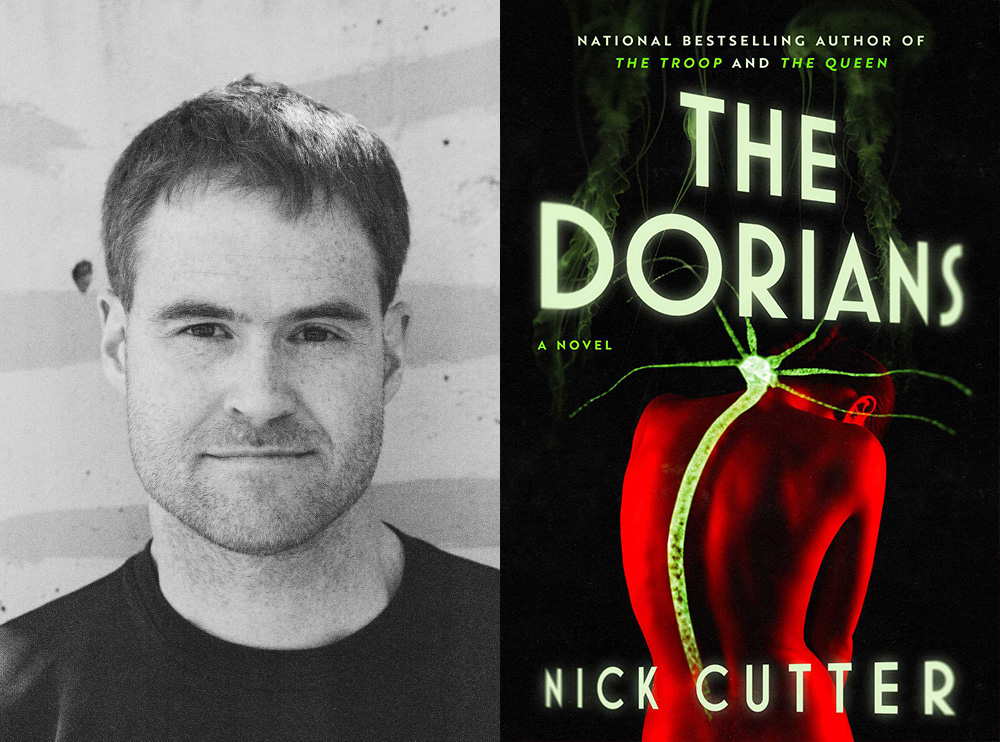
Guest post written by The Dorians author Nick Cutter
Nick Cutter is the author of the critically acclaimed national bestseller The Troop (which is currently being developed for film with producer James Wan), The Deep, Little Heaven, The Queen, and The Handyman Method, cowritten with Andrew F. Sullivan. Nick Cutter is the pseudonym for Craig Davidson, whose much-lauded literary fiction includes Rust and Bone, The Saturday Night Ghost Club, and, most recently, the short story collection Cascade. His story “Medium Tough” was selected by author Jennifer Egan for The Best American Short Stories 2014. He lives in Toronto, Canada.
About The Dorians: Five elderly volunteers on a remote island undergo a high-tech experiment that harnesses an ancient biological agent, pushing the limits of science, human ambition, and sanity. Out May 19th 2026.
Years ago, I did a steroids cycle. I was young(ish), dumb, and obsessive. Not about weightlifting. About writing. And obsession has a way of merrily tripping into masochistic self-abuse if left to run unchecked, as it did in my case: I was in my late-twenties away from home, socially isolated (of my own free choice) with no partner or close friends nearby to say: Hey, Craig, you think you might consider not being a total idiot?
I was working on a novel that would go on to be the first I published under my own name: The Fighter. It would come out years before the Mark Wahlberg film of the same name but would leave an exponentially smaller footprint. In the opinion of my agent at the time, the manuscript “wasn’t working.” This criticism, while correct, was nebulous enough to encourage a host of pathways that I could freely follow in search of a solution.
There were thoughtful, intelligent paths. There were also corrosive and stupid ones. I chose the latter.
If my main character seemed limp on the page, how could I fix that? Well, having him do steroids was certainly an idea. Not a bad one, given the nature of the book. No, the bad idea was to do them alongside my fictional character, casting myself as the George-Plimptonian or Hunter-S-Thompsonian experiential writer.
As I said, I was at that age where such notions seemed very writerly and committed, where at my present age they seem silly.
Let’s skip to the main bullet points, shall we? I did the steroids. They had the general effects that anabolics have on a human body, both good and bad. The novel was made no better from my experience. The book tanked. On went my life.
Yet I’d found the steroid odyssey so bizarre that I sat down and wrote a nonfiction piece about my experience. I sent it blindly to Men’s Health, Men’s Fitness, GQ, Details, probably The New Yorker (why?), The Atlantic, Harper’s, Esquire. This was in the olden days of paper submissions, mailed off in manilla envelopes. I’d tried these outlets before, mainly with short stories. It was an eye-of-the-needle moonshot.
Months later, I came home from a shift at the library to a message on my landline. An editor from Esquire had read my steroids piece. It had been plucked from the slush pile (I was given to believe this was a toppling heap of un-agented, unasked-for submissions stashed in some leaky closet in one of the magazine’s subfloors) by an intern. It had gotten passed around desk to desk until it landed on this particular editor’s blotter. He wanted to publish it. And as I needed the money and was clever enough to have taken a few snaps of me jabbing a needle into my ass during my steroids cycle for photographic proof of my idiocy, we agreed to terms.
Some months later the article (with photos of my pale, needle-skewered ass) were published in the hallowed pages of Esquire. The editor and I stayed in touch. I pitched a few ideas, similarly self-abusive (one was that I’d subject myself to humankind’s cardinal fears—arachnids, sharks, claustrophobic spaces, etc.—and report on my experience), but none were picked up. Still, we remained friendly.
A few years later that editor called out of the blue. The baseball player Barry Bonds was in the news. Barry’s trainer Greg Anderson may have slipped Bonds steroids—under the codenames The Cream and The Clear—without the slugger knowing. This led to a lot of side chatter about TRT or Testosterone Replacement Therapy. Seeing as TRT was legal and doctor-approved (well, by some doctors), and since it was basically the equivalent of a physician-monitored steroid cycle, the editor figured I’d be a natural fit to write an article.
Which I was happy to do. But because I have somewhat of a wandering mind, I strayed far afield from the basic pitch outline.
What I found most interesting about TRT wasn’t the steroid angle—that substances outlawed in the Olympics and professional sport had found a foothold amongst 40- and 50-something men who wanted to restore their youthful vigor and sex drive—but the human longevity angle that lurked at the heart of the issue.
The frequent question I asked the patients I interviewed was: What is the main goal of this therapy for you? The most common answer: To help me live a longer, healthier, more robust life. This was echoed by the doctors and researchers I spoke with.
TRT, no matter how effective, is no bulwark against the predations of human aging. Our bodies have a shelf life, as do all mortal things. Animals, fish, trees, everything that endures in some fashion or another on our planet. We come into existence, we grow, experiencing what it is to be alive in whichever ways nature affords our kind, and then, as surely as the sun sets, we all do die.
Yet there were people I spoke to in the course of writing that article who tendered a more extreme and nature-defying possibility.
Why should we have to die at all?
One of these people was a gerontologist by the name of Aubrey de Grey. At the time he was running the SENS Foundation, which was dedicated to life extension and (don’t quote me on this) the elimination of human death.
How? Well, it’s pretty scientifically dense. I’d make a hash trying to explain it. The one idea I recall de Grey extolling (I still have his interview notes; I hunted through my Gmail records to find them.) was that when an organ fails, we replace it with a new one. A lung goes kerflooey, we replace it with a fresh one. A heart, a kidney, a bunch of veins, a brain, etcetera.
We already do this, sort of, via organ transplant. But this is a scenario where we have bio-identically engineered organs—that is, organs grown in vats rather than those harvested from the recently deceased—so hypothetically, a steady supply and in some halcyon future when our organs fail, we get a quickie operation, bad one out good one in, and off we toddle. Our bodies are cars, and doctors are mechanics.
There are many prongs to the SENS Infinite Lifespan Agenda; organ replacement is but one. The overriding objective, however, is to advance the human species to a place where death, once inescapable, can be put off endlessly.

Almost fifteen years since writing that piece, I tried to recall my impression of de Grey. What came to me was: Dude was kind of a jerk. Now that may simply be a case of his blindered passion, his elevated mind, and the fact that he had to defend his work against the objections—scientific, moral, philosophical—of rival researchers and day-tripping so-called journalists such as myself. But in re-reading the transcript of our interview, that sense rebounded on me: Man, what a supercilious, derisive jerk. Perhaps, that’s how you need to be when pursuing work that flies in the face of Mother Nature. Or maybe it was just him.
What I really didn’t care for (and that’s what lurks beneath the Fountain of Youth theme of my new horror novel The Dorians) was the high-handed notion that humans were somehow entitled to eternal life. To me, it seemed wholly unnatural and weird. I did eventually re-read my piece, at least in parts, and came across this paragraph:
I envisioned myself as one of de Grey’s thousand-year-old model humans: My regenerative skin cladding bones drifted with desiccate marrow, second-hand eyes screwed into sockets like blown fuses — a shambling shipwreck straight out of our worst childhood nightmares. De Grey believes that were society to embrace his model, the birth rates could drop astronomically, which paints an even bleaker picture: a bunch of doddering, mothball-smelling millennium-year-olds tottering about in a world cleansed of children’s laughter.
That’s what got me: the selfishness. It’s so pitifully human, isn’t it? If I were to live endlessly—or 1000 or 2000 years—well, that’s me taking up the resources that should otherwise go to downstream generations. I’d be taking their food, water, money, opportunities. Unlike the generations following the Boomers, who (rightly in many cases) blame them for hoarding the homes, jobs, and resources, in this conception the Infinite Generation would prevent ensuing generations from even being born. Childbirth would end. There just wouldn’t be enough to go around if we started living neverendingly.
To hear this possibility tendered by someone like de Grey (himself childless) as the way humankind rightfully ought to exist … it hit me all wrong. It made me sad to realize that too often the selfishness of humankind predominates, and those who can weaponize it stand to profit mightily. The whole conversation (excuse the juvenile phrasing) grossed me out.
It also made me think that, on a philosophical level, an infinite lifespan hammers out so much of our shared human experience. If we exist on an infinite timeline, we lose the value of time itself. Experience becomes repetitive, cyclical, and thus loses consequence or meaning. If we live forever, we forfeit the signposts that signify human life: childhood, teenagehood, young adulthood, adulthood, middle age, old age … now a flat sinewave cleansed of the markers that we assign to those epochs in our lives.
What we may see as heaven—life never-ending—could be like that old episode of the Twilight Zone where the gambling addict arrives at a casino where he can never lose, he only ever wins. What he mistakes at first for heaven is in fact hell.
Would I like to live a healthier life? Surely. Would I wish to live eighty or ninety years in good health, mobile and independent and of sound mind—would I mind it if I was striding down the sidewalk one fine sunny day at ohhhh, let’s say eight-eight years old and fall on my face, stone dead in a heartbeat? I’d be fine with that. With all my affairs in order and most of what it means to have led an interesting human life accomplished. Great, sign me up.
There are researchers working on that objective, too … healthspan rather than lifespan. The goal is to live a normal (dare I say fair) allotment of years in good health. Seventy, eighty, ninety years, without the terminal fall which plagues so many of us toward the end: a dismal carrousel of hospital visits, mobility devices, canned oxygen and machine-assisted living.
If I could avoid that, sure, I would. But knowing those bad days could come provokes me to make the most out of the good and healthy days I have left. I’m aware of the sands slipping through the hourglass. Do I still squander my time sometimes? Sure, but I’m human.
But life everlasting? Nah, I’m not nearly so selfish or egotistical as to believe the world needs an infinitude of me.