


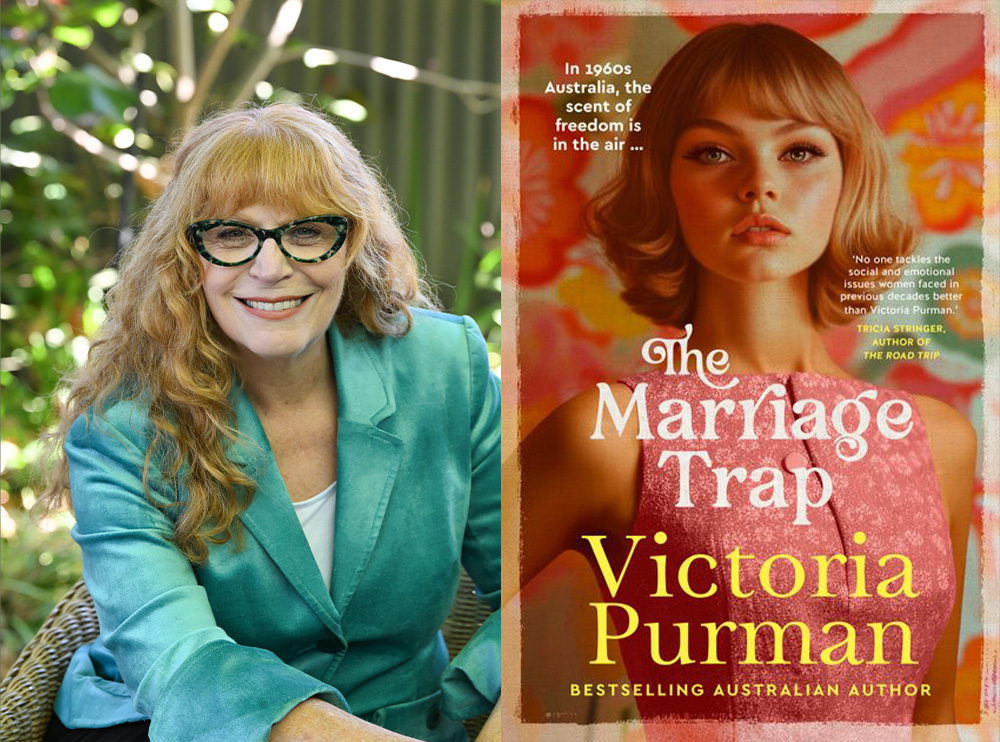
We chat with author Victoria Purman about The Marriage Trap, which is a charming but pointed look at the tumultuous extraordinary decade of the 1960s, and the effects of the pill, rebellion and new ideas on ordinary Australian women as alongside shorter skirts and the Beatles, they embrace freedom…
Hi Victoria! Tell us what The Marriage Plot is about?
It is 1960s Australia, where women were beginning to see a world in which they could make their own decisions, particularly when it came control over their bodies. It was a time when hemlines were rising up and women were too.
This story is told through the eyes of three women in one family in Adelaide; sixty-year old Olive and two of her daughters, twenty-year-old Cathy and ten-year-old Evelyn. Cathy has big dreams for her life that don’t involve being trapped at home like her mother was with five children. She wants to be the first in her family to go to university to become a teacher. She’s seen first-hand that women’s lives can be tough. Society and especially the church dictate how girls and women should behave, and when it comes to sex? Not until you’re married, thank you, and then as a woman it’s your role to help Australia “populate or perish”. Little Evelyn is too young to think about what being a woman might be like but as we watch her grow through the decade, we see her horizons expanding about the choices she will be able to make for her own body and her own life. As for their mother, Olive? She thinks she’s too old for social change but when the church reiterates its position on contraception in 1968, she finds herself at a crossroads.
What inspired you to write this novel?
I was inspired to write “The Marriage Trap” by renewed efforts around the world that continue to this day to ban contraception, even condoms in some countries. It made me reflect on the easy road I had in the 1980s when I went on the Pill to make sure I could control my body and decided if—and when—my partner (now husband) and I would have children and how many.
So I began research its history and I work on the theory that if I find a topic fascinating, my readers might too. What I found was a story of women taking control of their bodies and their lives in defiance of societal pressure, the all-powerful Catholic church and sometimes even the government.
In 1961, Australia became only the second country in the world to approve the use of Pill by Australian women, after the United States. But that didn’t mean it was widely available. It was only to be prescribed to married women for the purposes of ‘family planning’, it attracted a 27.5% luxury tax, and it was against the law for it to be advertised. Doctors with moral objections to its use simply wouldn’t prescribe it and some pharmacists wouldn’t fill the scripts. As a result, many women simply couldn’t afford or couldn’t get access to it even if they knew it existed.
But women began to talk amongst themselves about this miracle and by 1966, there were twenty-six different brands of the Pill on the Australian market with an estimated half a million women using it.
This is my love letter to women who grew up in the sixties (in Australia), women who – for the first time – could see a world in which they could make their own decisions about the size of their families. Or, indeed, whether to have a family at all.
As this book will be coming out for Mother’s Day, tell us more about the importance of motherhood as a choice.
I’m privileged to be the mother of three: one daughter and two sons. And I’m privileged to have started a family in a country that enabled my husband and I to have a family at a time of our choosing, when it suited us as a couple and in terms of our careers. I wasn’t forced to marry someone simply because I had fallen pregnant. I wasn’t forced to make the choice of being a single mother or putting a child up for adoption. And if I had fallen pregnant before I wanted to have a child, an abortion would have been available to me.
I went into motherhood with my eyes open (or as open as they can be before you actually have children!) and it was still hard at times. The lack of sleep, the loss of personal space, the breaks I had to have in my career. None of that is easy but I can’t imagine doing that when it wasn’t your choice to have a child in the first place.

And let’s not forget the women who don’t want to be mothers, whether they have a partner or not, and those who want to be mothers but don’t have partners. The most important thing is the CHOICE.
Do you feel the conversation about the Pill and contraception more broadly has changed even since you were young?
Definitely. When I’ve discussed the topic on my social media pages, the overwhelming reaction I’ve had so far from women who grew up in the 1960s and early 70s is an overwhelming, “Thank God things have changed.”
Sex and contraception are no longer taboo subjects. There are many, many different forms of contraception available to women these days (remembering that for a variety of reasons, not all women get on with taking oral contraception) and perhaps it had something to do with the terrible emergency of AIDS in the 1980s, but condoms are now widely available and discussed, too. Back in the 1960s, people would never have imagined that they would be available on supermarket shelves.
Lastly, what do you hope readers will take away from reading this book?
I hope older readers might be able to reminisce about the era in which they grew up and reflect on just how far we’ve come. And I hope younger readers might realise who difficult things were for women back in the 1960s and ‘70s and be inspired to be vigilant about any moves to curtail the rights we have as women to control our own bodies. We might think the rights we have are safe, but experiences from other parts of the world have shown us that sometimes hard fought for rights are being would back. We must never take them for granted.


Is anyone else ‘confused’ with when Olive was born? There are references to Olive being 14 in 1915, having had 3 children by the times she was 28, children born in 1935, 37, 39 and 1941, and then being 50 when her last child is born in 1950. I was constantly flipping back to find dates. I enjoyed the novel as I have with all of the previous books. My favourite being The Nurses War