


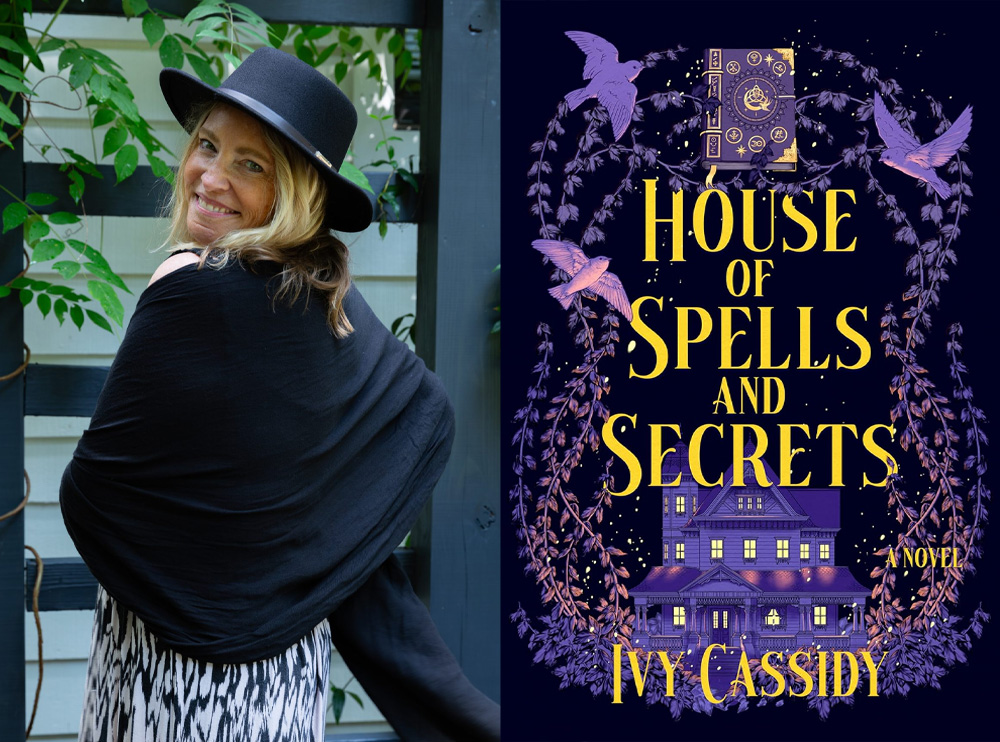
Guest post written by House of Spells and Secrets author Ivy Cassidy
Ivy Cassidy writes atmospheric women’s fiction woven with folklore, legacy, and the magic of memory. Her stories explore generational bonds, ancestral secrets, and the emotional landscapes of women rediscovering their strength. She is the author of House of Spells and Secrets and has written more than thirty-five novels across multiple pen names. Cassidy lives in North Carolina, where she is always listening for the next story waiting to be told.
About House of Spells and Secrets: When three sisters return to the house that holds their forgotten legacy, the walls whisper of magic, betrayal, and the secrets their mother never told them. A sweeping story of resilience, magic, and sisterhood, perfect for fans of Alice Hoffman, Heather Webber, and Sarah Addison Allen. Released March 24th 2026.
What makes someone a witch?
Most people think witchcraft is about spells or magic, but it was (and is) more about women who didn’t fit the social norms of their time. Maybe they were women who lived alone, or women who spoke their minds, or women who knew things others didn’t understand.
The question of what makes someone a witch has fascinated me for years. Who were these women, really? What did their days look like? And how did they carry on after being labeled something so dangerous and fraught with risk?
While researching folklore for a novel, I came across the story of a woman named Biddy Early. Like most research journeys, I began with a single question and continued to explore it until I uncovered something unexpectedly brilliant.
Biddy lived in rural Ireland in the nineteenth century. She was known as a healer and was someone families turned to when they suffered from illness or when livestock struggled through a brutal winter. People trusted her because she was an integral part of the community, and they’d seen her help people over and over.
Despite this, at some point, she became known as “a witch.” She was actually tried for witchcraft—the last woman tried in Ireland in the mid 1850s.
The word “witch” has traveled a long way through history. It has been about fear, respect, and often suspicion. But nearly always, misunderstanding has accompanied it.
The more I have read about women like Biddy Early, the more I have noticed that these weren’t mysterious figures hiding in the shadows. They were practical women who listened and watched, then they stepped in when neighbors needed help.
They were midwives, herbalists, and caregivers. They were the women people turned to in the middle of the night.
But to me, and maybe most importantly, they were what I call “memory keepers.”
They held onto knowledge when there was no formal record of it. They remembered what worked, what failed, and what to try next time. They passed those lessons forward. Without these women, much of what we call folklore would have disappeared a long time ago.
The Women and Their Communities
Before modern medicine, meaning before pharmacies stayed open late and before we could search symptoms on our phones, communities depended on women with practical knowledge. If you’ve read Outlander, you’ve seen this play out. Claire is accused of witchcraft, yet most of what she does is grounded in observation and care (and a little time-travel future knowledge). She studies herbs, she listens to people, and she pays attention.
She was labeled a witch, but what she practiced wasn’t magic. She used skills developed over time, grounded in reality.
In the past, women like Claire lived in nearly every community. They knew which roots eased pain, which teas settled a restless child, and which remedies helped during a difficult birth. They learned from the women before them and shared what they knew with the women who came next.
But knowledge made people uneasy when they couldn’t explain it. It still does! If a remedy worked, it felt miraculous. If it failed, it was suspicious. Fear tends to look for a target, doesn’t it? And women who stood apart from the norm were easy to blame.
This is clearly evident in the Salem Witch Trials. Innocent women were put to death. What about the practical loss communities experienced afterward? That’s rarely discussed. The healers’ communities depended on were gone. The caregivers disappeared. And maybe most importantly, the inherited knowledge vanished.
The Word “Witch” Now
Today, the word “witch” feels different. In many circles, it represents strength, independence, and intuition. It carries a sense of reclaiming something that used to shame or silence women.
Still, underneath all the symbolism, the word still points to something simple: it is knowledge used in the service of others.
When I think about this idea, I don’t picture historical figures first. I think about women in my own life. My grandmother, who knew how to cool a fever with a damp cloth. My great aunt, who could calm nerves with a cup of tea. My great-aunt Mae kept handwritten recipes that have been passed down like heirloom quilts (which they also made).
These women in my own family never called themselves healers, and they definitely never called themselves witches!
They carried and shared wisdom that is rarely seen in official records. You find it in family stories, in traditions repeated year after year, and in the small gestures people remember.
Stories as a Way of Remembering
As a writer, I always return to the idea of inheritance…knowledge passed from one generation to another.

Folklore is full of women who understood the land and the seasons, women who stepped in when neighbors struggled, and women who kept families steady through uncertainty.
Some were respected, some were feared, and many were both (depending on the day!).
Their stories matter because they remind us that wisdom doesn’t always come from institutions or titles. It comes from real life experience, from paying attention, and from showing up again and again when people need help.
Reclaiming the Stories of Wise Women
One of the reasons I’m drawn to fantasy and magical realism is that these genres make room for stories about wise women. They allow writers like me to revisit the past and see these women through a different lens, meaning not as threats but as protectors.
Through my stories, I hope readers recognize something familiar in my characters. I hope they recognize the reflections of their grandmothers and aunts, neighbors, and teachers. These are the women who have shaped our lives through their persistence, patience, and willingness to keep going when others step back.
Those qualities don’t attract attention, but they certainly sustain communities, then and now.
Carrying Legacy Forward
When I sit down to write, I often find myself thinking about the women who came before me. They weren’t trying to make history; they were simply trying to take care of the people around them. And yet their knowledge and resilience shaped the generations that followed…including mine.
That legacy hasn’t disappeared. You can still see it in family traditions and through stories told at reunions and holiday gatherings.
I love bringing that legacy into my fiction. In my novel House of Spells and Secrets, three sisters uncover a history of knowledge that had been hidden and misunderstood for years. Memory, community, and love are all at the heart of the story. Yes, my characters are witches, but not in the cauldron-stirring, eye-of-newt kind of way. They aren’t the Sanderson sisters in Hocus Pocus! Their magic is grounded and natural.
These Stories Still Matter
Remembering women like Biddy Early is about recognizing the memory keepers of the past. They inherited knowledge and carried it forward. Their stories are still worth telling…and I find my own power in telling them.