


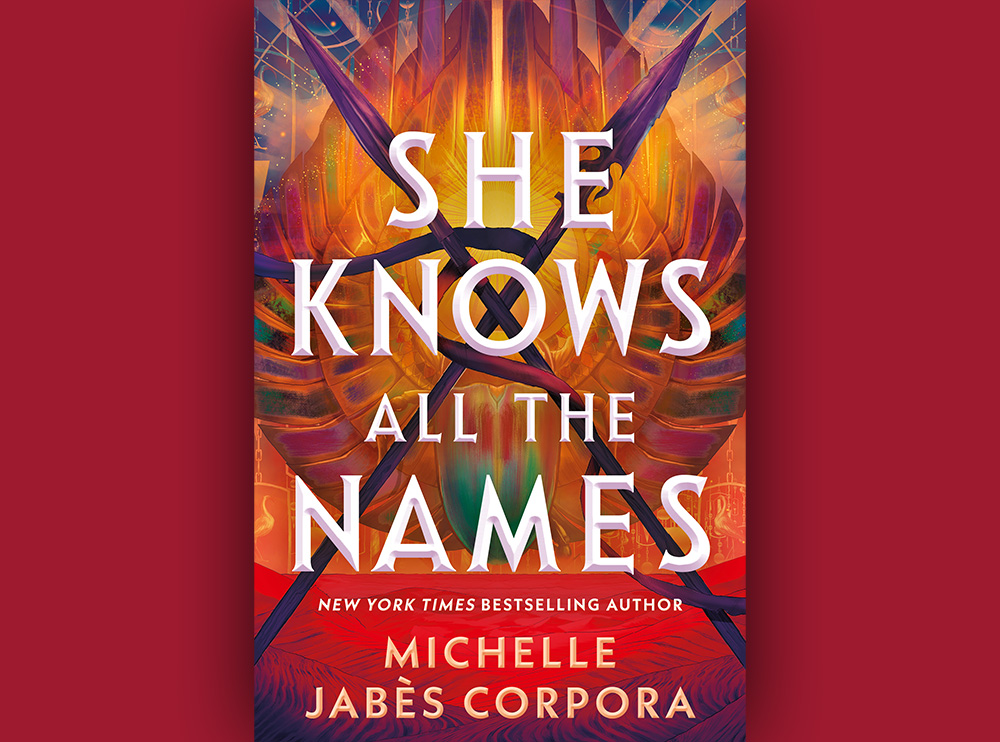
The sequel to the New York Times bestselling novel His Face In The Sun follows a simmering rebellion, an undead army, a dangerous king, and a fateful prophecy all set on a collision course to irrevocably alter the lives of a priestess, revolutionary, princess, and thief.
Intrigued? Read on to discover the synopsis and an excerpt from She Knows All the Names by Michelle Jabès Corpora, which releases on May 5th 2026.
Fresh to the throne, the cunning new pharaoh schemes to bring unprecedented power to the Kingdom of Khetara. He commands absolute allegiance, leaving bloodshed in his wake as he searches for the missing Princess Sitamun, and at his side, the young priestess Nefermaat serves as divine counsel. Having witnessed the king’s merciless acts, Neff furtively plots to free the kingdom from his grip, though she knows the heavy price of treason.
Meanwhile, the rebellion in Low Khetara grows, and Raetawy, a courageous farm girl, leads the resistance. Her quest is clear: infiltrate the capital and free the imprisoned rebels—including her beloved father. Yet in her desperation, Rae agrees to a plan that could destroy all she is fighting for….
In the Red Lands, the thief Karim grapples with the new life he’s been given. Is it a blessing or a curse? He fears what lurks within him, yet he and his unlikely companion, Princess Sita, grow ever closer as they search for a lost city believed to harbor the secret to saving Khetara from destruction.
The ancient oracle that once whispered to these four strangers now speaks with an urgency as powerful as the mighty Iteru. The current of destiny is strengthening, but will it bring redemption…or annihilation?
Prologue
WINGS
If only he’d been looking up at the world instead of down at his feet, he’d have seen it coming.
The ibis had been poking about in the dense papyrus thickets, dipping his needle-sharp beak into the river, quick-quick, hunting for fish. He was a disheveled bird, his moon-colored body and jumble of black tail feathers giving the impression that he cared very little about appearances.
But he did preen. Every morning…
They neither heard the rustle of men in the thicket nor felt the water tremble with the men’s approach.
Then: a splash. Close. Very close.
The ibis raised his head, his long, slender neck bending into a question. He murmured, low and wondering, before another splash turned his wonder to alarm.
Fly away! Fly away! the ibis opened his beak to cry.
Too late. A guttural call broke the silence, and as the flock opened its wings in unison to take flight, a net fell upon them, dragging them back down.
Panicked, the ibis flapped and struggled as the net drew tighter and tighter still, until he found himself pressed up against the other birds in a writhing mass of flesh and feathers…
Over the frightened yelps of his brethren, the ibis heard a man speak.
“Did you hear what happened?” the man said. “One of the fishermen told me.”
The other man grunted and spit on the ground. “Better not to speak of it.”
The first man, ignoring his companion’s advice, continued. “He said he’d arrived from south of Bubas and saw something strange flowing downriver. Never would have believed it if he hadn’t seen it with his own eyes. What do you think it means?”
“That’s for the priests to decide. We have our work; they have theirs.”
“I think it means change is coming to Khetara,” the first man said, undeterred. “Just as the pharaoh said it would! Don’t you remember his speech? ‘The forgotten floodgates of power’? ‘The currents of war’?”
There was a pause. “Perhaps.”
The ibis was pressed against one of his flock mates, and felt his heart racing beneath wet plumage. A moment later, the net was set on hard, sandy ground.
“You don’t agree?” the first man asked.
“I agree that the sooner we process these birds, the sooner we can go home.”
With that, the net loosened. There was a cry and flapping of wings as a bird was pulled out, and then a sharp snap.
The ibis’s own heart quickened with horror.
“How can you be so cynical?” the first man asked as another bird was lifted from the net. “Everyone I know is excited about King Meryamun! He has great plans for the kingdom! All of Thonis is suffused with hope!”
“Hope and foolishness are neighbors, my friend,” the second man said. “It is all too easy to enter the wrong house.”
Snap.
Suddenly, the struggle to reach the opening of the net reversed, and the captured birds began fighting to get away from the men’s grasping hands. The ibis found himself being shoved to the top, until he could see the growing pile of limp feathered bodies on the ground nearby.
“Pah!” the first man scoffed, reaching for the bird directly above the ibis and pulling it free. “Our entire business is based on hope! Hope that our mummified ibises will cure our customers’ ills, grant their wishes, and bring Thoth’s favor upon them in the Duat. Without hope, people wouldn’t buy, and we would have nothing.”
“Perhaps the new king will rule as he claims,” the second man said. “Perhaps this omen is a good one. But hope is a poor replacement for preparation. Keep your eyes open, my friend. The gods help those who help themselves.” The ibis watched as the man snapped his flock mate’s neck with one swift motion and tossed its corpse onto the pile.
He felt the shadow of death fall over him.
Then a new scent met his nostrils, riding the wind. It was bitter and strange—and it gave the ibis courage.
The man reached back into the net, groping for a throat to squeeze.
Not today! the ibis crowed with a surge of ferocity. I will not die today!
He stabbed his beak into the flesh of the man’s palm—once, twice, quick-quick. Blood fountained from the wound, and the hand jerked away. The man loosed a string of curses, and before his companion could close the net, the ibis launched himself into the air.
The strange-smelling wind lifted him up, away from angry words and reaching hands, away from his doomed brethren. He wheeled south, the mouth of the river and the green sea at his back, flying past farms and villages until he reached a great white city.
The ordeal transformed the ibis’s hunger into near starvation, and he knew he wouldn’t be able to fly much longer without stopping for food. Below, he saw a lush walled garden with a pond at its center. The garden lay in the shadow of a massive structure, and although the ibis could see many people flowing in and out of it, the garden itself appeared to be deserted.
Even better, he could see the silvery flash of scales beneath the pond’s surface.
When he got closer, however, the ibis saw that he’d been mistaken. There was someone in the garden.
A girl and a cat were hidden among the rosebushes by the pond. The girl was reedy, hairless, and plumed in blue. Her bare feet were in the water, and she was muttering quietly to herself, over and over, like birdsong. Powerful energy emanated from her. Dangerous energy. It didn’t carry the lethal intent of the men who had captured the ibis’s flock, but it held dark portents. As if sensing the bird’s presence, the girl looked up. Surprisingly, her face was kind.
The striped cat looked up at him too, the pupils of her golden eyes widening. And although she looked old, the ibis could see the cat’s teeth were still as sharp as ever.
Death had nearly gotten him once already. It would be foolish to tempt fate a second time. The ibis clacked his beak in frustration and turned away.
He sailed past the garden and the buildings teeming with life and crossed to the other side of the river, the quiet side, where stone giants rose from an ocean of sand. The ibis had no strength left to hunt. He needed to eat and not become food for another. But where could he find an easy meal?
Movement attracted his attention. A single line of men, laden with goods, marched from a sailboat down into a valley inland from the river. The salty smell of fish wafted up from them, so the ibis decided to follow. With any luck, he could snatch up a bite or two without being noticed.

Sailing past the line of men, the ibis dipped down into the valley and alighted on a flat-topped acacia tree. From that vantage point, he could see many people at work, talking among themselves, piling food and all manner of strange things, and going in and out of a hole in the valley wall like ants. Strangest of all were the bald men huddling over a great many human corpses, efficiently disemboweling them one by one before filling them with white sand.
One of the men overseeing the gruesome work caught the ibis’s eye. He was birdlike himself, his nose beakish, his plumage as dingy and plain as the ibis’s own. Even his nest of black hair was reminiscent of the ibis’s tangle of tail feathers. The birdlike man walked to one of the bald-headed ones and said, “How much longer? We must get through the mummification rituals today, or these people will not be ready for the funeral. My father will be laid to rest in fewer than seventy days; his court must be prepared to join him in the tomb.”
The bald man wiped perspiration from his brow. “Apologies, Prince Bakenamun. We were not expecting these…” He paused. “These sacred dead. There are so many of them, and you know the rituals take time. We are going as quickly as we can.”
The birdlike man blinked, his irritation changing to remorse. “Of course, of course. It is I who should apologize. You and the other priests are doing your best; I should not have addressed you so sharply. We are all…adjusting to the new king’s doctrine.” He frowned. “But where is Montuhotep? Should he not be here supervising your work? I have been busy inside the tomb, directing the painters and engravers.”
The bald man cleared his throat. “The master says he is ill. He has taken to his bed, and I do not know when he will be well enough to attend to his duties here.”
The birdlike man ran a hand through his unruly hair, making it even messier. “For the love of Amun, must I do everything?” he muttered.
While they spoke, the ibis noted the other men had lain down their burdens and were returning to the boat, leaving the food unattended. This was his chance!
Fluttering down from his perch, the ibis landed before a delicious-smelling package tied with twine. He deftly untied the rope with his beak and pulled back a corner of the fabric to reveal a treasure trove of dried fish. He was about to grab as many as he could carry when he was startled by a voice behind him.
“Lost your flock, have you, Sacred One?” the birdlike man asked, having left the bald-headed men to their work.
The ibis froze on the brink of flight, his hunger battling with his fear. But the man didn’t lunge or try to kick him away. Instead, he said, “Go ahead. Take the fish.” A sad smile touched his lips. “I know it’s not easy being alone.”
Unable to believe his luck, the ibis scooped four fish into his mouth and launched into the air, his wings beating hard to accommodate the extra weight. Once he cleared the valley wall, he found a safe place to land and gobbled up the fish, quick-quick, before another animal could get a whiff of them.
He felt better almost immediately.
But in place of his hunger came sorrow. The birdlike man was right. He was alone.
What was the ibis without his brethren? They had acted as one organism, moving in a comfortable ritual that repeated over and over, day after day. He had no idea what to do or where to go now that his flock was gone.
His sorrow sharpened into despair.
Perhaps it would have been better to die with them.
Not true. Not true. If he was his flock, and his flock was him, then within himself the ibis held all that remained of his brethren. He must live on, so that they too could live. He would find a new flock—yes, yes. Then all would be right again.
With this in mind, he took to the air once more, heading for the river, scanning the skies for birds in flight. I am alone now, but it will not always be so, not always, the ibis assured himself.
As he traveled south, he glanced down at the river and saw an unusual sight. Men, women, and children had gathered along its banks and were staring at the water. Some were silent. Others exclaimed in wonder and dismay. It was only when the ibis coasted out of the glare of the sun that he saw what they were seeing.
Usually blue-green in color, the river was turning crimson. The red waters flowed north, powerful, ominous, and very, very wrong.
A whisper of the ibis’s earlier terror returned.
Over the amalgamated shouts of the people, one woman’s voice climbed the western wind and reached him.
“Beware!” the woman cried. “The Great River of Khetara has turned to blood!”
Excerpted from She Knows All the Names by Michelle Jabès Corpora, Copyright © 2026 by Michelle Jabès Corpora LLC Published by Sourcebooks Fire