


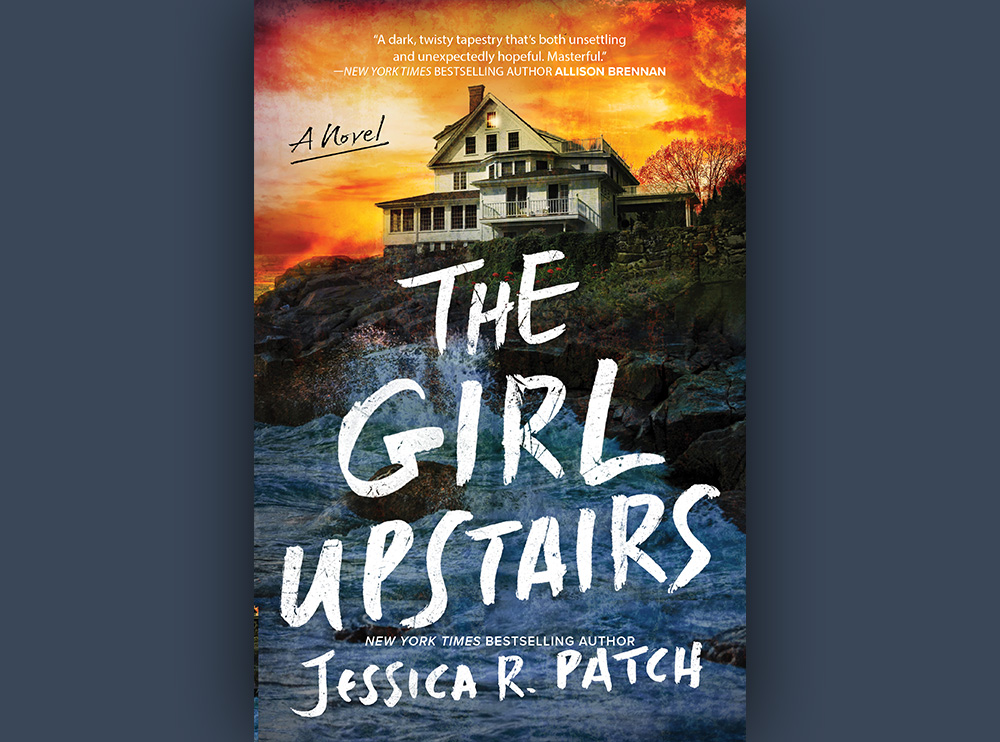
A slow-burn psychological thriller that delivers bone-chilling suspense, making it a perfect fit for fans of page-turning authors like Riley Sager, Ashley Winstead, and Alice Feeney.
Intrigued? Read on to discover the synopsis and an excerpt from The Girl Upstairs by Jessica R. Patch, which releases on April 28th 2026.
She bought this house to save her marriage. Unearthing its secrets might just claim her life.
Gwen McDaniel’s life is broken. But she knows the perfect place to fix it. Cold Harbor, Maine, an idyllic small town with views of Acadia National Park, is where she used to vacation with her parents as a child. Here, she and Steven can start over, renovating their cliff-side fixer-upper while patching up their marriage. Soon, everything will be better.
Except from the moment they arrive, Gwen sees and hears things, and it’s more than just the drafts and shadows that are part of any old house. Steven downplays her fears, warning her not to fixate on problems as she has in the past. But Gwen spent years as a homicide detective, and her instincts don’t lie. Something happened here. Proof comes when she rips up the attic’s carpet to discover a chilling message carved into the wood underneath.
As Gwen delves into the history of the house and the Cold Harbor community, she begins to piece the fragments together. And gradually, a terrifying picture emerges: A missing girl. A house of horrors. And a dark, decades-old nightmare that is more haunting than Gwen ever imagined…
Chapter 1
She can breathe easy since she feels no consequences.
I, on the other hand, feel suffocated every day.
“What are you thinking?” Steven slips his hand in mine as the U-Haul trailer bounces behind us. He rubs my wedding ring with his thumb. We’ve been married almost eleven years. I was thirty and thought we would have forever, grow old together. Now I’m not so sure that’s going to happen.
I cast a glance at him; the crinkles around his eyes have deepened in the past year, but his hair is still full, dark and wavy with only a few traces of silver. The right lens of his glasses is smudged, but I don’t comment; however, it’s going to bug me now. Steven rattles my hand in his. “Deep thoughts, huh?”
Yes. But if I tell him she’s on my mind, the atmosphere in the SUV will plummet by twenty degrees, and the rest of our night will go to pot. He’s made it clear I am no longer to discuss her, mention her or look her up online. It’s over. We’re moving, and that means forward living and thinking, which doesn’t include her. She’s in the rearview mirror—back in Baltimore.
Cold Harbor, Maine, is the place where we’ll settle and plant new roots. Kick off the Labor Day weekend by laboring to move in. I squeeze his hand and smile. “I’m thinking I’m ready for this new chapter in our lives, and we should hurry inside the house, make it our own. Settle in.”
We bought the most perfect home on the cliffs overlooking Cold Harbor. I knew we had to snap it up, and it was a steal. We put down an offer sight unseen—minus the photos—and then Steven flew out a few days later to do the walk-through while I stayed home and packed and finalized the sale of our Baltimore home. It sold for a mint and fast.
Gotta love the seller’s market.
Moving here and fixing up this house will be the perfect way to start over, keep my mind off her and begin a new chapter. Find myself—as Steven puts it.
Find myself? As if I’m lost.
The past few weeks have been a whir of busyness. But he’s acted excited, and I do mean acted. Steven says leaving his prestigious career at Johns Hopkins could be for the best, and he looks forward to working in a small-town clinic. But I don’t buy it. Probably because he’s not selling it well.
I’m not happy about why we’re leaving, and I’m not selling it either.
As the green sign signals we’re approaching Cold Harbor, my heart beats faster, and my stomach twists and turns like a rickety wooden roller coaster.
He brings my hand to his lips and kisses my knuckles. “I’m happy to see you happy.”
Okay, maybe I’m selling it better than I thought.
“This will be good for you, Gwen. A chance to throw yourself into something productive.” A slight scowl creases his brow. “Something healthy.”
Bristling, I let his passive-aggressive remark go unanswered. I’m sick of my emotional and mental health being tossed in my face like a cold wet rag. Steven is a primary care physician. An excellent doctor. Recognized for his clinical work as a 2020 inductee into the Johns Hopkins Community Physicians Academy of Clinical Excellence. Which makes him a terrible patient himself and a know-it-all concerning my mental health, which is not his specialty. Internal medicine is what he’s good at.
“Yeah,” I murmur. “It really is gorgeous here. Much prettier than the photos or what I remember as a child.”
“I told you,” he says.
We’re surrounded by forest, and the leaves haven’t quite changed color. That will come later this month and peak mid-October. Fall is my favorite. I love the blending colors of terracotta, crimson, gold and chocolate. Love the colder nights and crisp mornings.
“Yep, you did, and you’re right.” Steven is always right, even when he’s wrong.
“I thought we might have a picnic dinner tonight out by the cliffs, overlooking the water. Might even kindle that firepit that’s out there. Just the two of us.” He kisses my hand again. I shift and look at the car seat.
“And Baby Tara, of course.” She’s in her seat, eyes closed and a pacifier in her mouth. She’s precious with soft caps of brunette hair, like Steven, and deep blue eyes, almost brown. Steven and I both have brown eyes.
Now it’s Steven’s turn to stiffen. “Of course.” He clears his throat. “Can you call Teresa and let her know we’re five minutes out? She’s going to bring the keys by.” Cold Harbor is Gilmore Girls–ish, which means no one lives that far away. Steven says Teresa as if he’s known her his entire life. She’s twenty-four and single with everything in the upright position and gorgeous walnut hair. Total opposite of me.
“Sure.” I dial, and her perky voice pierces my ear.
“Oh, awesome! I’m already here, actually, excited to hand over the keys to you. This is my second house I’ve sold since becoming a real estate agent. I think I already told you that, though.”
Four times, but who’s counting? “You did. Congrats. See you in a few.”
After ending the call, I take in the blue skies and gorgeous scenery as the road winds upward. Our house is nestled in a cluster of woods and overlooks the harbor. We’re secluded, and to be honest, after city living, I’m here for it. As a former homicide detective with the Baltimore PD, I’m peopled out. Criminals and good humans, though I’ve rarely found a human good. We all harbor secrets, cover up sins with lies and learn how to deceive others and ourselves. I’m cynical, but that’s par for the course when you see what I do—did—every day.
The narrow road winds through a tunnel of trees, their branches arching overhead like a canopy, filtering the afternoon light into dappled gold. Our driveway veers off halfway down, a gravel path that crunches beneath the tires and leads to our new house—secluded, quiet and wrapped in green. Before this, we lived in a cramped row house in Baltimore, hemmed in on both sides by nosy neighbors. Their dogs barked like alarms at all hours, and their kids shrieked in the street until dusk. I hated both—but for different reasons. The dogs were relentless, the kids unpredictable. Noise without pause, chaos without end.
We approach the large, ancient home, and my belly hitches. I rub it and frown at the unsettling feeling. As a child, I loved our vacations in Acadia National Park. Me, Mom, Dad all camping, hiking, playing in the water and roasting hot dogs. Maybe that’s why I chose here to live. I want that again. Good times. Making fond memories. Losing Dad six years ago to cancer was hard, and Mom passing from an aneurism a year ago even tougher. She would have loved visiting here, moving in with us even. We now have the room. Many rooms, and I hope to fill them all.

We park but don’t exit. Instead we take it all in silently.
The house looms over the harbor, its whitewashed exterior faded. It perches on the bluff like something forgotten, left to rot against the salt and wind. The porch wraps around the front, its boards warped and buckling. I can tell they’ll protest beneath my feet when I approach. Two barrels of dead flowers flank the doors.
The windows are the worst—too many, too large. They stare blankly, smeared with age and dust, clouded, like the house has been watching for so long it’s gone blind.
According to Teresa, the house caught fire in 1980, but it was contained to the main floor’s primary room and the bathroom beside it. Tragic accident around Christmastime.
The roof curls at the edges, blackened with damp, and the chimney stands like a broken spine, bricks crumbling away one by one.
Behind it, the forest presses in. The trees of Acadia stand silent, the pines too still, the birches stripped bare like reaching bones.
Something about the house is jarring. Not just old or neglected. Plenty of houses wear their history in their walls, in their beams, in the way the air inside feels heavy with time, but this one feels like the years left behind something that never quite settled.
We finally step out of the vehicle. I stand a few feet from the porch steps. The wind shifts, cold and sudden, and I swear the house exhales. Like it’s been holding its breath.
Like it’s been expecting me.
Teresa leans on her black Volkswagen Tiguan and chats away, but the icy pull of the house has made me miss whatever she said. The pictures couldn’t have been photoshopped, could they? Are homes like people? Some photogenic, others not so much.
Teresa’s grinning now, but I can’t focus. My lungs seize as my insides flush like I have the flu. I might be sick.
Sweat breaks out like an underground fountain springing up across my body, and I rest my hand on the SUV to steady myself. Panic attack. Why now? Why in front of Steven and Teresa?
Steven strides to her, ignoring me, thankfully.
His hand is already outstretched in greeting, greedy to claim hers. Slow down, tiger. She isn’t going anywhere. I might not be either. My legs are frozen in place.
Teresa continues discussing the house’s potential with him, but her words are garbled due to the blood whooshing in my ears.
Finally, he turns back to me. “Gwen, you okay, hon?”
“Yeah.”
Teresa clutches her chest. “I hope it’s not the history of the house making you uncomfortable. I told your husband it was a long time ago, but no one likes to hear a child was murdered in the home they’re buying.”