

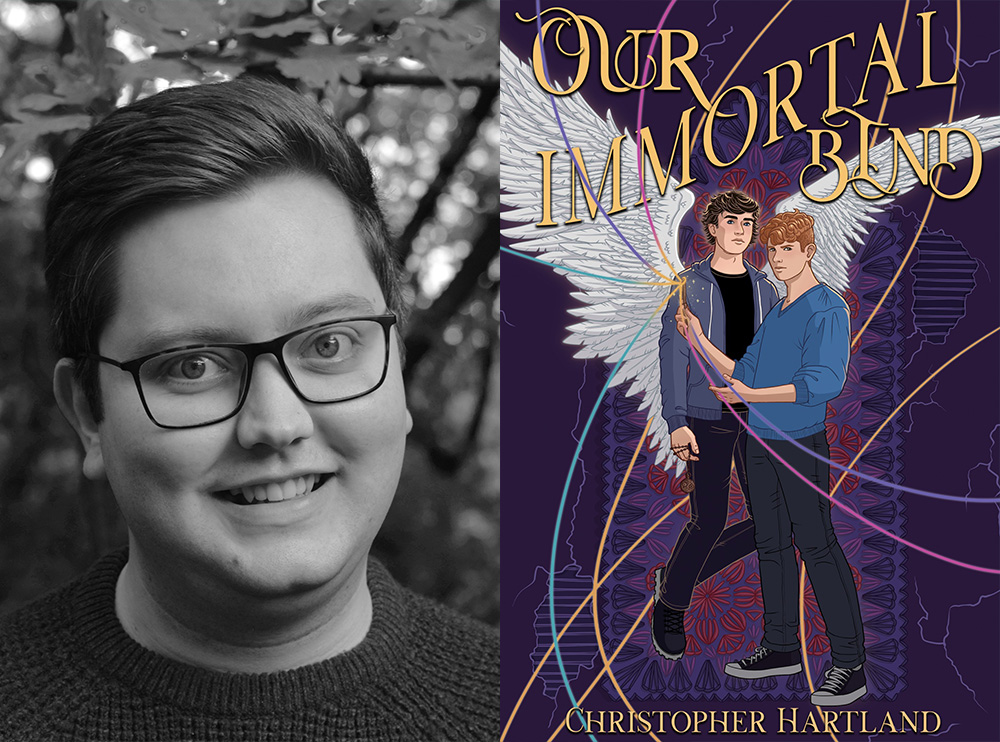
We chat with author Christopher Hartland about Our Immortal Bind, which is a story of love, loss and magic with queer and autistic representation at the forefront. PLUS you can read the first chapter at the end of the interview!
Hi, Christopher! Can you tell our readers a bit about yourself?
I’m a queer, autistic author based in West Yorkshire, UK. My debut novel, Against the Stars, came out in 2023 and Our Immortal Bind is my second novel. Outside of writing fiction, I work as a content writer/editor for an educational publisher, having previously been a school librarian and a science teacher (I know, it’s quite the odd mix). I’m a fan of fantasy, sci-fi, and queer romance.
When did you first discover your love for writing and stories?
As cliché as it sounds, I’ve been coming up with stories for as long as I can remember, but I think it became particularly intense after I started watching Doctor Who at seven years old. I went from coming up with ideas for Doctor Who episodes to eventually writing original stories. Well, I say original – in my teens the stories were definitely riddled with stolen elements of the things I was a fan of. I wrote my first novel-length story in my first year of university (as a distraction from the stress of a physics degree), but it took a few more attempts before I had something good enough to be published.
Quick lightning round! Tell us:
- The first book you ever remember reading: Charlotte’s Web by EB White – though I think I more clearly remember the animated musical film than the book itself.
- The one that made you want to become an author: Northern Lights by Philip Pullman – His Dark Materials remains my favourite trilogy of all time.
- The one that you can’t stop thinking about: Mistborn by Brandon Sanderson – I read it recently having heard all the hype and now I’m completely obsessed.
Your latest novel, Our Immortal Bind, is out March 31st! If you could only describe it in five words, what would they be?
Magical, emotional, political, adventurous, romantic.
What can readers expect?
A queer, autistic love story set against a fast-paced, high-stakes fantasy quest with a unique magic system and afterlife lore. There are also political themes that will hopefully particularly resonate with queer people (but also anyone who has ever been oppressed).
Where did the inspiration for Our Immortal Bind come from?
As someone who doesn’t believe in an afterlife, I enjoy seeing fictional explorations of what an afterlife could be. So, I wanted to create my own. The story began with the concept of a labyrinthine network of corridors lined with doors, each of which corresponds to a person who will step through that door when they die. I also pulled on some elements of Greek mythology to expand upon the world. Then came the characters.
Having been diagnosed as autistic after writing Against the Stars, I wanted to write an explicitly autistic character in my next novel. There’s a trope often seen in media, where rather than having an autistic character there will be some otherworldly being (such as an alien or magical creature) who exhibits autistic behaviours (such as struggling with typical human social cues). I decided to play with this trope by having an otherworldly being (in this case, the half-angel son of Death) who is also canonically autistic (though he is unaware of this at the start of the novel).
Another common trope is that of magic being used as a metaphor for queerness, especially in settings where the use of magic is illegal. Oftentimes, the characters in the stories that use these tropes aren’t actually queer, they just end up going through elements of the queer experience via the metaphor of magic. For my second main character, therefore, I decided to create a canonically queer warlock in a world where the use of magic is deeply restricted by law. I also included an allegory for conversion therapy.
Were there any moments or characters you really enjoyed writing or exploring?
I had a lot of fun writing the scenes where magic is used. In Our Immortal Bind, witches and warlocks can see the threads that form the fabric of the universe and they can weave these around their metal wands much like weaving wool around a crochet hook. I really love how this has been represented on the cover.
I also particularly enjoyed writing Orpheus as an autistic character and his journey to learning about that part of himself. Being autistic myself, it’s quite likely that I’ve accidentally written autistic coded characters before since I see the world through an autistic lens, but in Our Immortal Bind I wanted it to be explicitly clear. I hope any autistic readers feel seen through Orpheus’ internal monologue.
Did you face any challenges whilst writing? How did you overcome them?
This was the first time I was writing a novel after having signed the contract for it, rather than having finished the entire thing already. Because of this, I was working to a deadline and wasn’t simply writing for the love of it (though of course the love was still there). This was hard to get to grips with, but it was a useful learning curve for me and I now have a much better understanding of how to keep myself motivated and get into a proper writing routine.
What’s next for you?
I’m reworking a contemporary romance as I’ve realised it’s not as finished as I’d hoped, and I will be querying it with agents when I’m done. I’ve also got various fantasy and sci-fi ideas in the early planning stages. Time will tell.
Lastly, what books are you looking forward to picking up this year?
Piper at the Gates of Dusk by Patrick Ness, Unapologetic Love Story by Elle McNicoll, Survival Show by Juno Dawson, Heartstopper Volume 6 by Alice Oseman, and Espíritu by Aiden Thomas. I’ll also be slowly catching up with Brandon Sanderson’s Cosmere.
EXCERPT
Chapter One
Orpheus
The blue door is my favourite. It always has been. I’m not sure what it is that sets it apart from the rest. Perhaps it’s the pattern of cracks along the wooden surface which I love to run my fingers over. Or maybe it’s the particular shine of the brass handle in the hallway’s ethereal glow, or even the way you can see the brush strokes in the paint (despite the fact that it was never actually painted). In any case, it’s the door I come to when I’m feeling overwhelmed or need a moment of peace.
That’s what I desperately need right now: peace. The man’s screams still echo through the labyrinthine network of corridors. I sit in front of the blue door with my eyes closed and my wings wrapped around me, a feathered barrier against the noise. My breaths keep coming, thick and fast, as I try to calm myself. I reach out and place my hands against the wood, focusing on ripples and natural warping, searching for the cracks.
Mother’s still out there somewhere with the screaming man; of that I am certain. Last I saw, she was holding him to her chest, enveloping him in her winged embrace. I hope that’s enough to calm him. His hysterics could lead to corruption, and that’s not a fate I’d wish on anybody. Sometimes I wish I could be more like Mother, stoic in the face of terror. But that’s not me. When the screaming started, I ran. I turned down corridors, weaving in every direction, until I reached the blue door.
Calling it “the blue door” is an overgeneralization, of course. After all, there are infinite blue doors, just as there are infinite doors of every colour in the Halls of Styx. The labyrinth stretches and twists on and on forever, without a blank stretch of wall in sight. Instead, the walls are adorned with countless doors. Some are plain, some are colourful, some are cracked and worn, some are elaborately decorated. All are wooden, and all have a keyhole, but every door is unique. Just as unique as the people who live behind them. Not that they have any idea – at least, not as long as they’re alive.
I often ask people what went through their mind when they saw their door opening. The answer, more often than not, is pure confusion. I suppose that makes sense. The humans of the mortal world are used to the laws of physics, as Mother once explained. They aren’t accustomed to seeing a door appear out of thin air, nor do they expect a previously invisible space to be revealed when the door opens. And yet it’s an experience that every human goes through.
I can’t blame them, therefore, when they react the way the screaming man did.
It was all going so smoothly. Mother had just finished with one of the most peaceful souls I’d ever seen, so I was all too happy to join her in guiding the next one. I followed her to a crimson red door, which she unlocked with one of her many keys, and the man was stood behind it. Dark‑skinned and broad‑shouldered, he seemed perfectly calm upon seeing my mother, even when his gaze fell upon his own dead body at his feet.
Mother was in one of her most common forms – not the cloaked skeleton of her predecessor, but a tall blonde woman in a long white dress. Her white wings were stretched out behind her, and she was bathed in light. It’s a form a great many humans picture when they imagine an angel, and thus it is the one she often chooses.
She stepped over the threshold, held out her hand to the man and led him back through the door before closing and locking it. Her ring of keys remained tightly clasped in her spare hand.
“Hello,” I said to him.
And then the screaming started.
***
An hour passes before the echoes abate – a mortal hour, that is. Time is a funny thing in the Halls of Styx: it doesn’t work the same way as in the human world. It couldn’t, otherwise how would Mother be able to open the doors of every human at the moment of their death? Much like the Halls themselves, time here twists and turns in all sorts of directions. But mortal time still matters, especially for me.
Still, I keep my hands on the door, drawing comfort from its surface. I sometimes wonder what it’ll be like on the day that this door opens. Will the person on the other side come calmly, or will they scream? The calm ones are far more common. In fact, of all the psychopomps so far, Mother has the most successful record. By and large, the humans follow her willingly all the way to the afterlife. I help where I can, or at least, I like to think I do. I talk to the humans about their lives: where they’re from, who they loved, what their dreams were, whether they were happy. It comforts them, I think, and Mother has never stopped me. But that’s not the only reason I do it. I find humans fascinating – their cultures, the rules of their world. It’s all so unfamiliar to me.
Most of the time, they tell their stories with a hint of sadness. They’ll shed a tear or two, but they’ll stay calm and collected. There are some, however, who don’t. Some will lose control of themselves completely. They won’t stop asking what’s happened to them, and Mother’s calming aura won’t affect them. Sometimes they get aggressive. They scream and lash out. I hate what happens next, so I never stay to see.
The fact that the screams have gone now is a good sign, though. Hopefully, Mother managed to bring the man to his senses rather than lose him to corruption.
“Orpheus!” Mother calls, snapping me out of my reverie.
Her voice is close, and a moment later, she turns the nearest corner to see me sat beside the blue door. Her wings are folded in now, and she’s no longer gleaming with light.
She smiles. Well, she gives the hint of a smile. Hers are never the beaming variety I’ve seen on the occasional human. It’s a smile of acknowledgement, not of joy.
“I thought I’d find you here,” she says.
“Is he okay?” I ask, my memory flooding with the man’s screams.
“Yes. It took some time, but he followed.”
I breathe a sigh of relief. I hadn’t realised how tense my body had become.
In the reigns of previous psychopomps, when corrupted sprits were far more common, many would find their way back to the human world. The spirits would slip through the cracks at the very edges of the psychopomp’s realm and find their way home, but they’d no longer be themselves. The humans found their own words for the corrupted spirits: ghosts, wraiths, poltergeists, and all manner of other phantoms. The Halls of Styx aren’t so easy to escape from, however, not with Mother’s complex design.
One of the keys in her hand begins to glow, an old, rusty‑looking thing, bright and hot as though set alight. Mother glances down at it, then back at me.
“Are you joining?” she asks, her voice its usual absent tone. There’s no emotion behind the question. She simply wishes to know.
I pause. I don’t want to go through what just happened again. I feel like my heartbeat has only just returned to normal. But reactions like the man’s are a rare thing, and if I only have the chance to speak to one more human today, I’d like to end on a high.
I nod, and without a second thought, she turns and walks away, leaving me to follow.
***
The door Mother opens has a natural dark‑brown colour. It’s dotted with knots, and the edges are warped, but the brass handle is ornately decorated with curled flourishes. When it opens, the scene behind it is one I’ve witnessed many times. The decor may vary, but the machinery to either side of the single bed always gives away that I’m looking at a hospital. Stood to the side of the bed, where her body still remains, is an elderly lady. Her white skin is lightly tanned and adorned with wrinkles. Her hair is silver and falls in short curls. She turns to face Mother and smiles.
“I’m ready,” she says.
This happens a lot with older people: they don’t often protest. Mother reaches out her hand, and the woman takes it, following her back through the door into our domain.
“Hello,” I say. “What’s your name?”
She looks surprised to see me, but happily replies, “Elodie. And you?” Her language is different to the man from earlier – French, I think – but it comes as naturally to my tongue as any other.
“Orpheus.”
We’re already walking down the corridor, Elodie’s hand still in Mother’s. We move slowly but with purpose. This will be Elodie’s final journey.
“Do you mind if I ask you about your life?” I say.
Elodie chuckles. “What do you want to know?”
I resist the urge to say “everything”. Human lives are complex. They need a starting point to talk from, or they won’t be able to decide. But there are so many elements to the mortal world that it’s hard for me to know what to ask. So I start where I usually do: vague but focused.
“Were you happy?”
Elodie’s lips curl into a gentle smile – a smile that, over my time hearing the stories of humans, I’ve come to learn implies contentment.
“In the end,” she says, “yes, I was. Happier than ever, in fact.” She looks ahead, down the endless corridor, staring off in thought. “But I wasn’t always. For a long time, I wasn’t living as my authentic self. I was hiding.”
“What do you mean?”
She turns back to me. Her brown eyes glisten, brimming with tears, but her smile remains. “When I was a child, my mother used to tell me that one day I’d meet a man who would sweep me off my feet and make me the happiest person alive. She said I’d love him, and he’d love me, and we’d have children who we’d love even more.” She sighs. “But I didn’t understand her. I’d never been even slightly attracted to boys, and I told her as much.
“‘That’s just because you’re a child,’ she’d say. ‘You’ll change your mind one day.’ And she was almost right. I did meet a man, and he did sweep me off my feet, and I did love him. But not in the way he loved me. I loved him as a friend and nothing more. We had children together, and the love I had for them was greater than anything else, just as my mother had predicted. But still, I was not in love with my husband.”
We turn a corner into a curved corridor, Mother still leading the way. I can tell she’s listening to the story, even if she won’t ask questions.
Elodie continues. “I knew, deep down, the reason why. While I had never felt an attraction towards men, I definitely had towards women – many times. But I had never acted on those feelings. I wanted to be faithful to my husband and couldn’t bear the thought of breaking his heart.” She sighs again. “But then, when our children were grown and having families of their own, my husband died.”

“I’m sorry to hear that,” I say. Death can be quite upsetting for humans, so I hear.
“Thank you, dear. It was hard, but in a way, it was also freeing. For the first time in my life, my feelings for women didn’t bring me shame. In fact, I found myself rather excited by them. And that’s what led me to meet Camille.” Her face lights up as she speaks the name.
“Camille?”
“The most beautiful woman I ever met. I came to love her deeply, and she loved me in return, all the way to the end of my life.”
The tears fall now, but I know they’re not tears of sorrow; they’re tears of joy. Elodie reached the end of her life genuinely happy as her true, authentic self.
She tells me more about her time with Camille: the days they spent in Paris, their trips to the beach, the night Elodie invited her children to meet her, the joyful meal they all shared together. I listen to her stories with absolute focus, picturing it all in my mind, only stopping her to ask for more detail, but eventually, her story comes to an end. We’ve reached the gate.
The corridor stretches out before us. There are no doors here, just vacant walls that give way to a vast white nothingness. The three of us stop.
“This is where you leave us,” Mother says, looking at Elodie but reaching out a hand to the void.
“Where does it lead?” She looks nervous. I imagine the gate is quite intimidating for humans. Much like the doors, it defies the laws of their world. “Nowhere and nothingness” is a difficult concept for them to grasp.
Mother replies with one word: “On.”
Elodie nods. She looks from Mother to me, thanks us both, then walks forward, into the void. Much like the floor, walls and ceiling, she fades away. Gone forever.
Another key starts to glow.
“Are you joining?” Mother asks again, not leaving any time to dwell on Elodie’s departure.
I continue to stare at the gate. “No. I think I’ll go to bed, if that’s okay.”
She leaves without a word.
***
Since the Halls of Styx are infinite, they don’t truly have a centre, but that’s where I imagine my house is. Before Father came here, the house didn’t even exist. Mother has no need for such a human space, after all. But she created it for him, the same way she created the Halls themselves, crafting a structure out of thin air.
Mother doesn’t speak about Father much, and I don’t know whether it’s because it hurts for her to remember him or because she’s ashamed. It’s probably a bit of both. According to every rule of the Angelic Order, I shouldn’t exist. The only humans allowed in the Halls of Styx are dead, but when Father was here, he was completely alive. Mother has never told me the full story, so all I know is that he somehow managed to pass through a door alive and fell in love with Mother, and together, they had me.
I also know that he looked like me. Same dark hair, gangly frame and pale skin. Same wide blue eyes.
“Like the ocean,” Mother used to say, “or that door you love so much.”
I enjoyed the first comparison. I’ve never seen the ocean up close, but it’s one of the many things I long to visit in the mortal world.
The house, so I’m told, looks like what humans would refer to as a cabin – all wooden and cosy, filled with blankets and cushions and an ever‑burning fire. It sits in the centre of a circular room made to look like woodland. The trees are sparse but tall, stretching up to the illusory ceiling. They’re based on one of the previous psychopomp’s realms, the Styx Forest. This is the one place in the Halls of Styx that is intended to replicate the human world. It even has a day and night cycle, despite the lack of an actual sun. The ceiling takes the form of an eternally cloud‑filled sky. It helps me keep track of the biological clock I’m bound to thanks to my human half.
Unlike Mother, who can change her form at will, the only thing separating me from a basic human appearance is my wings. And that means I age. In mortal terms, I’m around sixteen years old – almost an adult, at least in a lot of the cultures that I’ve come across when speaking to the humans.
My room is upstairs, and aside from the bed, it is filled mainly with stacks and stacks of my diaries. Well, I call them my diaries. In a way, it would be more truthful to call them other people’s. I may write in them, but the words belong to the humans. I grab the one nearest my bed, along with a pen, and turn to the first blank page.
The diaries are where I write the stories the humans tell me. It’s my way of remembering them. I often look back at my oldest ones and try to recall their voices as I read them. I title the new page Elodie and start to write her tale. I wonder how long it will be before I forget her voice. It gets harder to remember the more time passes. Still, the stories remain, even if the voices don’t.
I once asked Mother why she doesn’t ask the humans about their lives the way I do.
“I used to,” she said. “But I found, after a while, that all the stories started to sound the same. Humans often fall into predictable patterns.”
I didn’t ask how long the “while” was, but I hope I never experience the same feeling. Sure, there can be some similarities between their stories, but even if the beats are the same, each human’s rhythm is unique.
I finish writing Elodie’s story with a full heart and a tired mind.
That’s when the bells start ringing.