


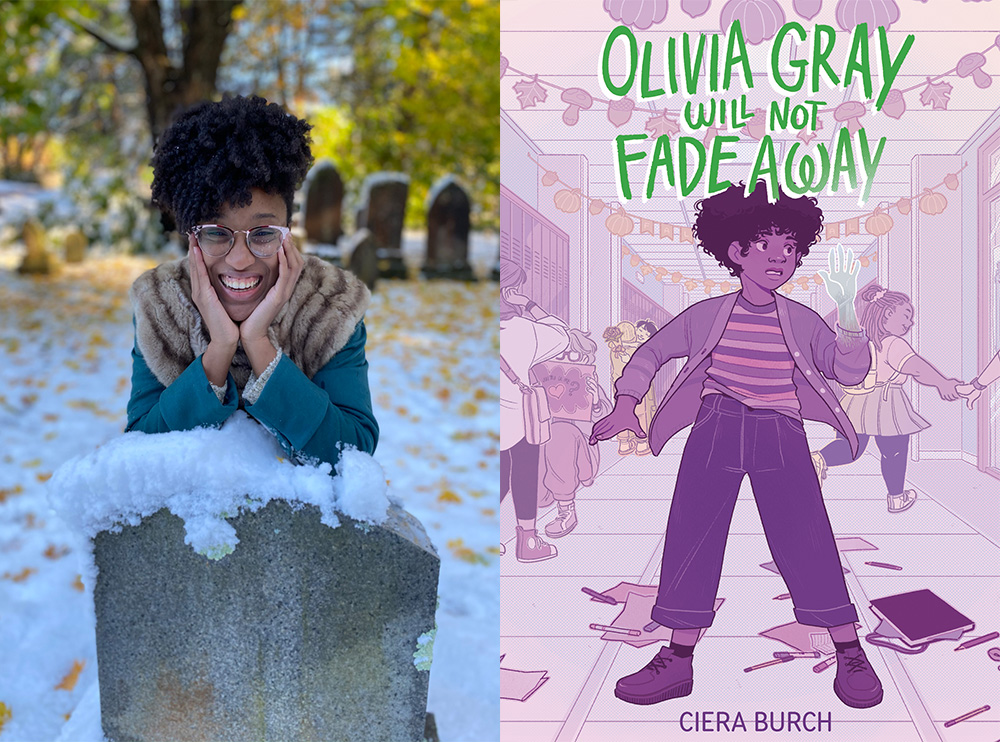
Guest post written by Olivia Gray Will Not Fade Away author Ciera Burch
Ciera Burch is a lifelong writer and ice cream aficionado. She has a BA from American University and an MFA from Emerson College. Her fiction has appeared in The American Literary Magazine, Underground, Five Points, Stork, and Blackbird. Her work was also chosen as the 2019 One City One Story read for the Boston Book Festival. While she is originally from New Jersey, she currently resides in Washington, DC, with her stuffed animals, plants, and far too many books.
About Olivia Gray Will Not Fade Away: A middle schooler navigates the challenges of feeling invisible—literally and figuratively—as she comes to terms with her asexual identity in this poignant speculative novel perfect for fans of Ellie Engel Saves Herself and Jennifer Chan Is Not Alone. Released March 17th 2026.
There’s nothing like the rush of rolling a Nat 20.
You watch the die, twenty-sided, rattle in its tray and hold your breath and then…success. A critical success. It brings with it the type of certainty that you rarely get in real life—that you’re going to do something cool, that you’re going to impress your friends, that, in the world of this game, at least, you’re about to make some kind of difference.
Dungeons & Dragons—D&D for short—is the kind of game that saves lives. It allows hours-long escapes into fantasy worlds the way novels can, except with friends and in a way where your every action can affect the plot and the world and people around you.
I found D&D during the pandemic thanks to a friend, through an actual play show on Dimension20 called A Court of Fey and Flowers and was immediately hooked. It had all my interests—Regency-esque period drama, collaborative storytelling, and dramatic bird cousins. Most importantly, however, it had Aabria Iyengar, a Black woman who was the DM, Dungeon Master, running the show. As a Black woman who loves nerdy things and loves storytelling even more, it opened my eyes. All I’d known about D&D before was the brief glimpses I got in media like Stranger Things, a group of nerdy, mostly white, boys or men sitting around a table in someone’s basement getting way too into make believe. But Aabria, and many others at that table, made me realize that there was space for me, too, in the D&D world.
As a writer, I usually do things alone. I’m used to controlling things when it comes to creating stories. I make up the characters, I decide where it’s set, I figure out what the plot is and if there’s a bad guy and who it is and how their big, bad plan is going to work. It’s all me, alone, at least in the writing stages. Sure, I can share my ideas or certain passages with my friends and family, but they aren’t in my brain, they can’t get the full scope of my excitement (or despair) or understand my hyperfixation when it comes to my characters.
D&D is different.
When I play a character, shoutout to my level 13, half-warlock, chaotic neutral girl, Shara, I’m only playing a character. My group and I are piecing things together as we go in the sandbox of our DM’s world, and my every action affects my fellow players and vice versa. We have to pivot on the fly or face the unexpected attention of a cult or try to explain to an immortal principal that we were not the ones who used an animated skeleton to drive an automaton across a college campus, thank you very much.
We’re walking, talking, and breathing storytelling, every one of us…and we’re doing it together.
My D&D group, affectionately known as The Fools, is made up of Brisin, Moira, Nephyra, and, Shara, plus our DM, has been a large part of keeping me sane for the 3 years that we’ve been playing. If we’re not playing, we’re often messaging back and forth about our last session or our upcoming session, or every what-if you can imagine when it comes to our girls. Every single Thursday, I never fail to be amazed by the story we’re telling together—the longest, most complex story I’ve ever been a part of.

The rise in popularity of D&D in the 2020s coinciding with the pandemic, and the years after, is no surprise. People, quarantined or locked down wherever they were, with little chance for outside connection, were lonely. They were spending a lot of time online or watching TV or flexing new creative muscles, but not a ton of time able to focus on the interpersonal of it all. I could watch actual play shows for hours at a time, and I did, but the urge to play, to create a story alongside other people, only grew until I went online and found my group. The connection wasn’t instant, of course. We started off as strangers. But as our characters grew and learned from each other, so did we. We figured out how our characters would react to things and how we wanted to shape the world and how we worked best together (or awfully, depending on the narrative we wanted to help foster) and the dice, that massive element of chance, helped shape our stories alongside us. Sometimes for the better, sometimes for the worse.
One of my favorite things in D&D is called the help action. You can give another player advantage, meaning they can roll two dice and take the higher result, but usually you have to describe how you do that, mechanically speaking. I love it because while you’re helping a real-life player at the table, your character is helping theirs too. You’re experiencing a connection on two levels—real and fictional—and the impact is two-fold. Even if you fail, you have the trust and belief of your fellow player, your fellow human, even if it’s for something silly, like trying to flirt with a werewolf.
In my newest book, Olivia Gray Will Not Fade Away, D&D isn’t the main focus, but it is pivotal to Olivia’s growth. Thanks to her friend, Jules, it provides Olivia with a language to help navigate the difficulties of her real life and ultimately provides a creative outlet where she can be seen by the people she loves, no matter how others might perceive her…or not. All of us have probably felt invisible before, even to ourselves, but sometimes all it takes is for one person to see you for who you are to turn things around.
And besides, a Ring of Invisibility is a legendary item.