


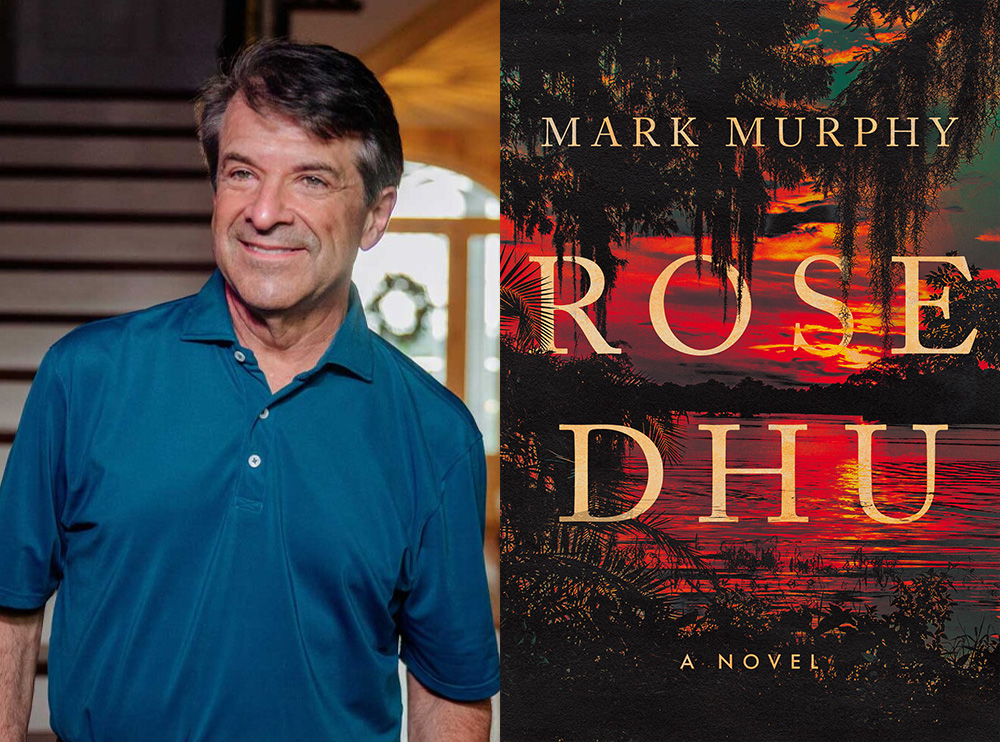
Guest post written by Rose Dhu author Mark Murphy
Mark Murphy is a native of Savannah, Georgia. He’s worked as a fast-food worker, marine biologist, orderly, ordained minister, and gastroenterologist, his current “day job.” When he’s not healing the sick, he writes anything he can—newspaper columns, short stories, magazine articles, and textbook chapters. Rose Dhu is his third novel.
About Rose Dhu: A prominent surgeon vanishes, leaving her devastated and close-knit Southern community sitting on a powder keg and a detective, Frank Winger, fighting against his own personal connections to the victim’s family, on the hunt for the truth. When back-door dealings and long-forgotten enemies reveal themselves, will Frank be able to distinguish fact from fiction to figure out what happened to the surgeon? Or will her whereabouts stay shrouded in the shadows of Savannah’s live oaks?
In his 1951 novel Requiem for a Nun, William Faulkner famously said, “The past is never dead. It’s not even past.” This line is the distilled essence of the Southern Gothic subgenre, which has its origins in the dark and complex writing of the two-time Pulitzer Prize recipient from Oxford, Mississippi.
Southern Gothic literature explores the ruin and decay of the post-Civil War American South. Violence, racial prejudice, a cultural fixation on a confabulated fiction of faded glory, and a pervasive subtext of the grotesque all make Southern Gothic literature a uniquely rich American literary tradition. Faulker, who died in 1962, is the undisputed godfather of Southern Gothic. Other writers of his era notable in the subgenre include Flannery O’Connor, Carson McCullers and Eudora Welty.
More contemporary Southern Gothic writers include notables like Alice Walker, Cormac McCarthy and Jesmyn Ward. Modern offerings in other media, including highly acclaimed video productions such as the first season of the True Detective series and the Gillian Flynn miniseries Sharp Objects, reflect the same elements.
My new novel Rose Dhu is a dark, atmospheric thriller in the Southern Gothic tradition, so I thought it might be fun to look at some of the works that inspired me.

Absalom, Absalom! by William Faulkner (1936)
Thomas Sutpen, a white man born into poverty in western Virginia, moves to Mississippi in the 1830s. Ruthlessly pragmatic, he wishes to rise above his nondescript beginnings through the product of his own formula, which he terms his “design.” He builds an ostentatious plantation (Sutpen’s Hundred), takes a wife and embarks on a quest for an heir. His obsessive search for power, status and immortality, driven by pride and scarred by past humiliation, is ultimately undermined by his lack of empathy and inherent blindness to the human costs of his own design. Presented in fragmented fashion, largely through other characters’ recollections and with conflicting, sometimes unreliable narratives, this is a challenging read, but Faulkner himself said it was “the greatest novel of the 20th Century.” Many critics agree.

To Kill a Mockingbird by Harper Lee (1960)
This Pulitzer Prize winner, loosely based upon Lee’s observation of her own family and an event that occurred in her hometown of Monroeville, Alabama in 1936, involves elements of racial injustice in the postwar South. Told through the eyes of Jean Louise “Scout” Finch, who is six years old at the beginning of the book, it relates Scout’s relationship with both her brother Jem and a neighbor child named “Dill” Harris, who visits his aunt’s home every summer. The three children are both fascinated by and terrified of a reclusive neighbor, Arthur “Boo” Radley, who has not been seen for years. All of which is placed in the foreground of Jem and Scout’s father, Atticus, representing Tom Robinson, a black man accused of raping a young white woman. While innocent, Robinson is remanded to prison and dies while trying to escape and the Finch family is left to deal with the brutal aftershocks of the trial.
This book is one of the most widely read novels of the 20th Century. Interestingly, the character of Dill Harris was based on the author Truman Capote, a childhood friend of Lee’s.

Wise Blood by Flannery O’Connor (1952)
This was Savannah native O’Connor’s first novel. Hazel Motes, recently discharged from the service after World War II, returns to his family home in Tennessee to find it abandoned. He takes a train where he meets Enoch Emery, an 18-year-old zookeeper who has been kicked out of his home by an abusive father. Emery introduces Motes to the concept of “wise blood,” the idea that he has an innate knowledge of how to conduct his life without the need for external guidance. After witnessing a “blind preacher” and his daughter create a ruckus in the street, Motes decides to begin an “anti-God” street ministry but he is imitated by a local con artist named Hoover Shoats, who renames himself Onnie Jay Holy. Holy begins to grow rich from his anti-God “ministry,” which angers Motes, who retaliates by killing Holy’s “prophet,” a homeless alcoholic.
With its pervasive religious imagery (a classic O’Connor feature; she grew up in the literal shadow of Savannah’s Cathedral of St. John the Baptist), incredible descriptive features and dark humor, Wise Blood has been ranked as one of the top 100 novels in the English language.

Beloved, by Toni Morrison (1987)
Another Pulitzer Prize winner, this work was inspired by the true story of a former slave named Margaret Garner. Set in 1873, Sethe is a formerly enslaved woman living in Cincinnati with her 18-year-old daughter Denver and the ghost of her other daughter, who died as a toddler. Sethe meets a man named Paul D, whom she had known at the plantation they’d been enslaved at, Sweet Home. Paul D drives out the ghost of Sethe’s daughter and convinces them to leave their home for the first time in years to go to a carnival. When they return, a young woman named Beloved is sitting in front of the house and soon Sethe and Denver are charmed by her. Paul D is seduced by Beloved, but during sex, his mind is filled with horrific memories from his past life as a slave. After he tells friends at work about his plans to start a new family with Beloved, a coworker shows Paul D a newspaper clipping about Sethe killing her infant child to keep the child from being enslaved. Paul D confronts Sethe and she confesses that she killed her eldest daughter, who was two at the time, to keep her from being carried back into a life of slavery. The daughter’s tombstone was inscribed with only one word: Beloved.
This complex novel, filled with magical realism, is an exploration of how slavery fractured family relationships and how repressed memories of past trauma can haunt people years later. Sethe and Denver can only move on with their lives after exorcising Beloved’s ghost, who represented the traumatic choices Sethe was forced to make because of her own brutal past.

Midnight in the Garden of Good and Evil, by John Berendt (1994)
A true-crime story which blurs the lines between reality and fiction, this book follows the aftermath of the 1981 shooting of Danny Hansford, a local male prostitute, at the hands of his employer, notable Savannah antique dealer Jim Williams. The story is told through the recollections of various colorful Savannah personalities, including Williams himself, the transgender performer The Lady Chablis, Emma Kelly, the “Lady of a Thousand Songs,” the charismatic playboy Joe Odom, a “root doctor” from South Carolina named Minerva, historic preservationist Lee Adler, and attorney Sonny Seiler, the owner of Uga, the University of Georgia mascot. Although he took some artistic liberties with the story, Berendt insists that the book is “99 percent true and 1 percent exaggeration.” Midnight spent remained on the New York Times bestseller list for 216 weeks. Its cover, featuring photographer Jack Leigh’s iconic shot of the “Bird Girl” statue from Savannah’s Bonaventure Cemetery, is one of the most famous literary images of the past half century.

The Underground Railroad by Colson Whitehead (2016)
This National Book Award and Pulitzer Prize Winner is the story of Cora, a third-generation slave on a Georgia cotton plantation who escapes with another slave named Caesar, using yams from her small garden plot that nourished her own mother Mabel during a prior escape years earlier.
In Whitehead’s alternative world, the Underground Railroad is an actual physical railroad that can transport slaves to freedom, and entire states ban Black people under penalty of death. Whitehead’s skillful prose and blending of the horrors of the true history of slavery with a reimagined past transports the reader to the harrowing era of the Civil War. During her travels, Cora experiences hope, despair, tender kindness and brutal violence as she heads north to freedom.
The novel is both horrific and hopeful, building on the Railroad conductor’s admonition to look outside as she speeds through to find “the true face of America.” Cora says that she could not see that face, but she “felt it, moved through its heart.” The novel reflects how far we have come as a nation—but also how far we have yet to go.
The 2021 Emmy award-winning Amazon television miniseries based upon this work was mostly filmed in Savannah.

Sing, Unburied, Sing by Jesmyn Ward (2017)
This novel, set in the fictional town of Bois Sauvage, Mississippi, was the recipient of the 2017 National Book Award for fiction. The principal character is Jojo, a 13-year-old biracial boy. Jojo has assumed many adult roles in the absence of his white father Michael, currently incarcerated for drug-related charges, and the fragile state of his mother Leonie, an addict struggling with grief over the recent drug overdose death of her brother. Jojo cares for his younger sister Kayla and helps to run the family’s small farm with his maternal grandfather Pop (Alton), a veteran of the Civil Rights era and a positive influence on Jojo, and Pop’s wife Mam, who is dying.
When Leonie learns that Michael is to be released, she takes Kayla and Jojo with her. The ghosts of Richie, a boy Pop knew when he was incarcerated years earlier, and Leonie’s brother Given all lend their voices to the narrative.
Richie is trapped, unable to move on to the afterlife, and he journeys back to Bois Sauvage with Jojo’s family in hopes of finding out the circumstances of his death from Pops. After the truth about Richie’s death is revealed, Mam dies, Given’s ghost goes with her into the afterlife, and the inadequacies of Leonie and Michael as parents are exposed.
This modern-day Southern Gothic tale touches on the same elements so prevalent in other similar works: Magical realism, the idea that the past refuses to stay buried, and the way that the sins of the past can leave an indelible stain on future generations.
The American South is a complex region with a unique history. The dark legacy of slavery, coupled with its status as the only American region to have ever been defeated in war, make it a fertile ground for literary exploration. I hope that readers can see Rose Dhu as a worthy addition to the rich Southern Gothic heritage.



These are some of my favorite books, and although I seem able to comment, I’m not able to ‘like’ the post. I was able to ‘like’ another post elsewhere on this site.