


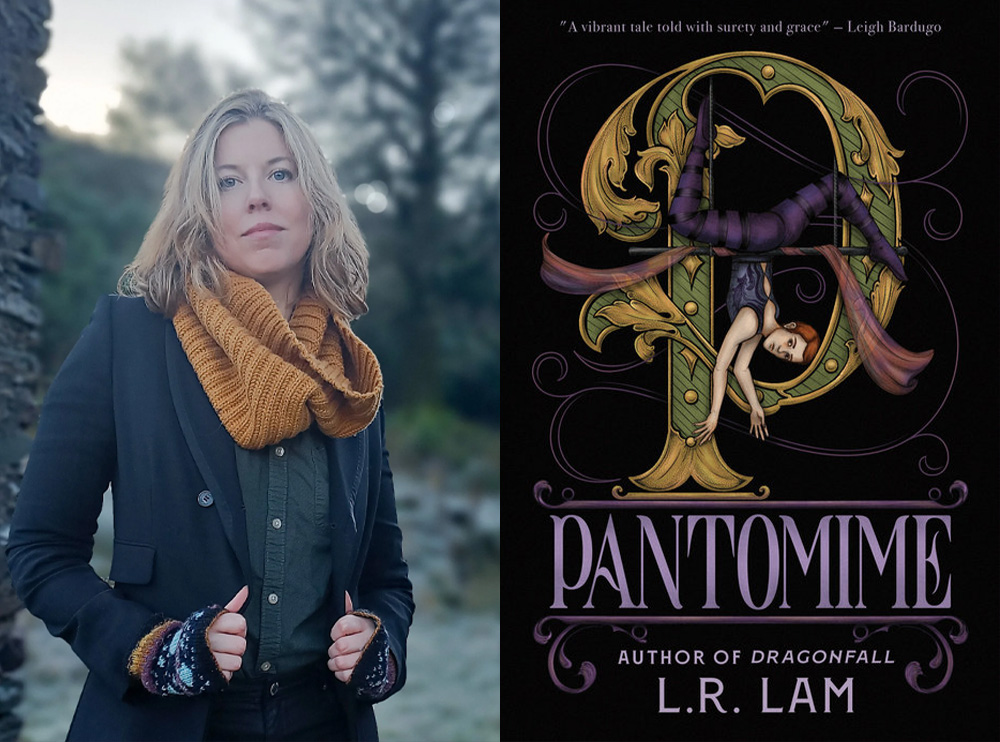
Guest post written by author L.R. Lam
Originally from sunny California, L.R. Lam now lives in cloudy Scotland. Lam is a Sunday Times Bestselling author whose work includes epic fantasy romance Dragonfall (The Dragon Scales Trilogy), the near-future space thriller, Goldilocks, feminist space opera Seven Devils and Seven Mercies (co-written with Elizabeth May), BBC Radio 2 Book Club section False Hearts, the companion novel Shattered Minds, and the award-winning Micah Grey series: Pantomime, Shadowplay, and Masquerade. Their short fiction and essays have appeared in anthologies such as Nasty Women, Solaris Rising 3, Cranky Ladies of History, Scotland in Space, and more. Lam’s romance alter ego is Laura Ambrose. In addition to writing, they work as a book coach.
I’ve done something most authors don’t have an opportunity to do, and I’m fully aware how lucky I was to be able to do it: I rewrote my debut series twelve years later.
Pantomime first came out in early 2013, when I was 22. I’ve just turned 37. Pantomime was actually pretty groundbreaking, if I do say so myself: it was the first young adult novel with an intersex protagonist in any genre, as far as I can tell. I’ve aged Micah to turning 18 in the first volume this time around, so it’s now more crossover adult. It’s a gaslamp fantasy set in a secondary world starring Micah Grey, who was raised as Iphigenia Laurus, or Gene, the daughter of a noble family, but runs away from a life of corsets and crinoline to join R.H. Ragona’s Circus of Magic as an aerialist’s apprentice. Yet the circus has dangers of its own, real magic might be returning to the world, and poor Micah Grey is caught in the middle of it.
Its first release was fairly quiet, through a new imprint and a smaller publisher. It was nominated for a few awards and even won one. The trilogy was cancelled about a month after the second book came out due to the imprint closing, which was as crushing as you’d imagine. In 2016 and 2017, I was able to re-release and complete the trilogy through another publisher, but it again was a fairly sedate release without a US publisher. After my latest fantasy series, starting with Dragonfall, took off, I had the somewhat ridiculous idea to try pitching Micah Grey again to my current publishers. Samantha Shannon and Elizabeth May had launched their series in 2013 and recently reworked The Bone Season and the Falconer volumes. So why not give it ago? To my surprise, the plan worked. So here are seven things I learned while rewriting my trilogy.


1. Turns out I cannot be remotely trusted to do minor edits on much older work
This was the big one. I went in fully expecting to do more minor edits. I thought I’d be able to. My editor gave me some excellent additional notes, and I re-read the trilogy and made my own observations of what didn’t work. But I quickly realized my writing style has changed so much in the fourteen years since I wrote Pantomime, and even in the nine years since I wrote Masquerade, that it was difficult to add new scenes without the joins showing quite dramatically. Even parts where I didn’t change much, plot-wise, the prose itself needed fairly heavy reworking. Here are the track changes between the original Pantomime and the copyedited version of new Pantomime. I deleted the page breaks to try and fit as much into the screenshot as possible.

The result is, frankly, hilarious.
I’d hoped Shadowplay and Masquerade might be lighter and go quicker, but it turned out that wasn’t the case, either. Practically no sentence was left untouched. It was much more work than any of my team expected, myself included. I’ve published a million words in between these series, taught creative writing at a university for seven years, and have worked as a writing coach at The Novelry for an additional two years. I think I’ve learned a thing or two in that time. I’ve also always been someone who pushes myself to level up in terms of craft, so if I could see a way to fix it, I figured I might as well make it better. I should have realized that it’d take more than minor edits to bring everything in line with my current writing abilities, but hindsight is 20/20, and I am pleased with how much stronger the series is in its new iteration.
2. Layering foreshadowing is much easier when you know what’s actually going to happen next
The first time I wrote this series, like most writers, I had some plans for the later volumes, but I wasn’t exactly sure how everything would shake out until I actually wrote them. When writing my various series, there have, of course, been instances where I wished I could go back and add something to earlier volumes, but once it’s sent to print, it’s pretty much set in stone. So, it was an interesting opportunity to be able to rework all three books back-to-back and be able to layer in foreshadowing, add easter eggs, and in general make things more cohesive than before. Because at certain points I was even working on the volumes concurrently—there was even one week where I was finishing proofs of book 1, reviewing line edits of book 2, and structurally editing book 3 at the same time—I could even sometimes sneak in tiny tweaks to aid elements in the later volumes. The result is a smoother reading experience for the reader, I hope.
3. Tightening pacing & economy of prose
Past me sure did like to go on—I had some very lengthy descriptions of the circus and atmosphere, which were lovely, but did slow the pacing down considerably. There were also a few instances where I had two individual scenes that were accomplishing plot-relevant beats, but as a more mature writer, I realized I could combine two decent scenes into one stronger scene. I also noticed where I was sometimes hitting repeat beats instead of raising the obstacles of the plot, so I deleted a few chapters or scenes. Pantomime is now twenty percent shorter than it was the first time around, but conversely, I feel like there’s more plot, deeper characterization, and I didn’t sacrifice atmosphere, either. I was just better at making the prose economic. The ending of old Pantomime was also always a cliffhanger, but in the new version, it’s less abrupt. Shadowplay became slightly longer, and Masquerade’s word count stayed roughly the same, but I likewise feel like I’m doing more with those words.
4. Adding more magic
Pantomime is gaslamp fantasy, but especially in the pre-published initial draft of Pantomime back in 2012, I really kept my cards close to my chest on the magic front. It read much more like alternate history with the vague whisper of magic. I strengthened that in the initial edits, but added even more this time around. The world of Pantomime has Chimaera, people with magical powers who are returning to the Victorian-inspired world. There are some who are human-like in appearance, and others who have some animal attributes. I added more Chimaera to all three volumes. Magic is also condensed into neat gadgets called Vestige, and I added a few more types as well, as well as (slightly) clarifying up my rules of magic. It makes it more firmly fantasy and enhanced the worldbuilding. I extended the climaxes of all three volumes to make them more exciting, magical, and dramatic, as well.
5. The art of nuance & tone shifting
Certain elements of the original trilogy were not the most subtle. In the old version of Shadowplay, first published in 2014, I had a character say his goal was to “make Elada great again,” which I deleted as that phrase has read rather differently in the years since. The circus especially had some rather dark elements in the older version, and there were a few instances of groping and unwanted sexual advances that, in retrospect, weren’t needed. Often, I found the implied threat worked just as well, if not better. I made certain things a little gentler and less edgy for the sake of being edgy, too. I wouldn’t call the series cosy fantasy, but I do think it’s now cosy-adjacent, with the undercurrent of danger.
6. Strengthening or deleting subplots
Related to the foreshadowing point, this was the first time I wrote a trilogy, and past me introduced a lot of subplots that had to be wrapped up within the third volume. I deleted a couple of these. There was also a subplot in Shadowplay that was introduced and wrapped up within a few chapters. I did a lot of unpicking and restitching to thread it through more of the book and work better.
7. The impact of knowing myself more
I wrote Pantomime while closeted. I came out as bisexual partway through the series a little earlier than I necessarily wanted to. There was a lot of discussion around #ownvoices at the time, which is a great movement in many ways, but there was also occasional pressure to disclose one’s own sexuality to prove you were “allowed” to write certain stories. I came out as nonbinary a few years later. So reworking Pantomime with a deeper understanding of gender, sexuality, and my own identity was quite personal and important, and that change in myself was subtly echoed through every part of the series in the edits.

The first time the series was released, I was also encouraged not to mention outright that Micah Grey was intersex and nonbinary—it was marketed as a twist, which didn’t work particularly well on a textual level as I’d never written the book intending for it to be one. It made it harder to promote the series, as not centering the central themes and making Gene and Micah seem like two characters rather than the same character pre- and post-transition meant the story sounded a little generic when I spoke about it. The intent wasn’t malicious, and as a younger writer, I didn’t push back on it at the time.
Now, I’m able to speak about its themes much more openly, but the world itself has changed so much even in the last ten months since I pitched the series. I have no idea if I’m going to be harassed for doing so. But I know what the earlier iteration meant to so many past readers, and I know that it might end up meaning a lot to many future ones, so I am trying to be brave.
Those are a few things I learned while re-writing and re-imagining my debut series. I’m glad that I asked if it could have another lease of life, and that my current publishers welcomed it with open arms.
Now, I must let Micah Grey go a final time. I will not re-write this series again (nor do I want to!). As Bil Ragona, ringmaster of the Circus of Magic says: let’s fly, me lovelies.