

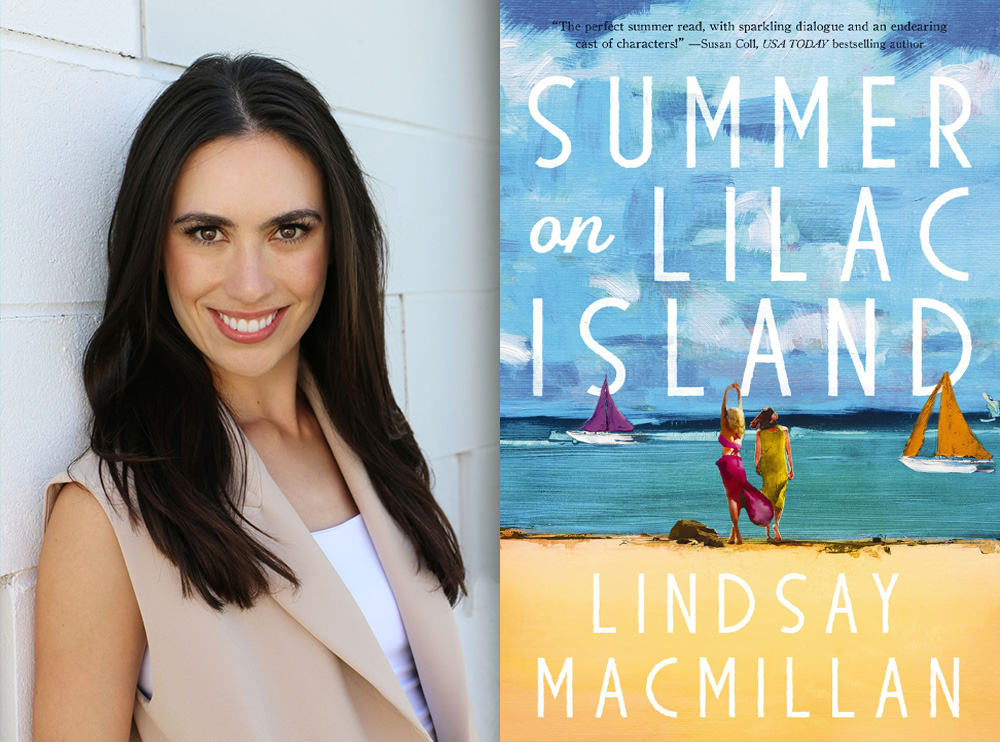
Guest post written by Summer on Lilac Island author Lindsay MacMillan
Lindsay MacMillan is an author, speaker, and creative entrepreneur. A Dartmouth graduate and four-time TEDx speaker, she left her role as a vice president at Goldman Sachs to follow her passion for writing. This is her third published book and her debut women’s fiction novel. Visit her online at lindsaymacmillancreative.com
About Summer on Lilac Island (out 1 July 2025): A witty and heartwarming escape about mothers and daughters, small-town dating, and the surprising ways we find our way home.
I often get asked the same question after a book comes out: “How much of this is true?”
It’s a fair question. My novels tend to center on emotionally ambitious women navigating their careers, relationships, and identities across backdrops like Wall Street, London, and small-town Michigan. And yes — I’ve lived in all three places. But the answer isn’t as straightforward as readers might expect.
My first novel, The Heart of the Deal, was directly inspired by my years working in finance while secretly chasing a more creative life. At the time, I was a Vice President at Goldman Sachs. I wrote before sunrise and on weekends. The book follows a young woman wrestling with the volatility of her career, friendships, and identity. While the romantic plotlines were fictional, the emotional core — especially the friendship between Rae and Ellen — was heavily inspired by my own life.
Writing that novel was cathartic. It helped me metabolize the absurdity and beauty of my twenties. And in crafting Rae’s journey — quitting her corporate job, leaving a stagnant relationship, and taking a chance on herself — I unknowingly charted a blueprint for my own life. Years later, I too left finance and ended a long-term relationship at age twenty-nine.
Writing Rae’s story gave me the courage to live mine.
I don’t just write my characters — they write me. They become mentors, mirrors, and muses.
My second novel, Double-Decker Dreams, took me across the Atlantic — both literally and creatively. The story is set in London, where I had relocated after leaving New York. It’s about a woman dreaming of a glamorous life abroad and a rom-com-worthy love, only to discover that maybe fulfillment isn’t in far-off fantasies, but in something quieter and closer to home.
That character was less like me. I was writing the life I thought I should want — returning to Michigan, settling down with the safe, stable guy. I even tried to follow her lead. But my spirit had other plans. Writing that book helped me see where I was living out someone else’s story instead of my own.
Sometimes we write the lives we wish we could live — and in doing so, realize they aren’t actually ours.

By the time I wrote Summer on Lilac Island, my third novel, I was back in Michigan — not reluctantly, but with open eyes. This book was my biggest creative stretch yet. It’s set in a small lakeside town reminiscent of where I grew up, but the story itself is not autobiographical. The mother-daughter relationship is familiar territory, but the characters arrived fully formed. Their desires, their wounds, their quirks — all their own.
This book allowed me to grow — not just as a storyteller, but as a soul. I wrote from multiple perspectives, spanning generations. For the first time, I wasn’t drawing heavily from my own voice or experience. I was listening to others.
In that way, I see each novel as a time capsule. Not of literal events, but of energy, emotion, and evolution. I pull from the places I’ve been, the feelings I’ve carried, the questions I’m still asking. Fiction gives me freedom. It lets me go beyond what’s happened and explore what could happen. It’s where memory meets imagination — and something new is born.
The deeper I go into my writing career, the less I rely on autobiography. And in some ways, that’s a relief. I can write more boldly, more playfully, more expansively. I trust that what wants to come through will — whether or not it’s based on my life.
Because truth doesn’t only live in what happened.
It lives in what we can imagine.
And fiction, at its best, is the bridge between the two.