


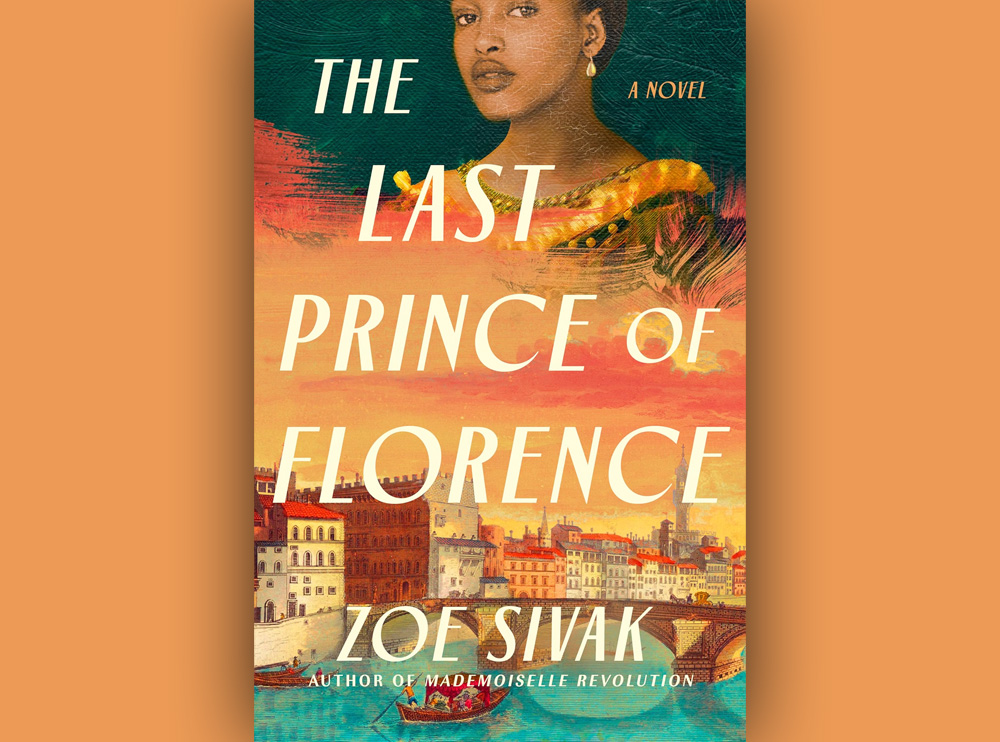
Based on the true story of Alessandro de’ Medici, this sweeping novel follows a Black woman’s secret plot to put her son on a Renaissance throne.
Intrigued? Read on to discover the synopsis and an excerpt from The Last Prince of Florence by Zoe Sivak, which releases on November 17th 2026.
In 1490, a dark-skinned baby girl arrives at the Santo Spirito foundling hospital with a bronze dagger strapped to her chest. Raised by Iye, a scarred African nurse who teaches her to fight and survive, Simonetta refuses the only futures offered to foundling girls: nun or wife.
She has bigger plans.
Years later, when a midnight brawl leaves exiled prince Lorenzo de’ Medici owing her his life, Simonetta talks her way into the legendary Medici family—and finds herself falling for the beloved Medici son. But her dark skin and sharp tongue make enemies, and when the family accuses her of witchcraft, she’s forced to reveal her secret weapon: she’s pregnant with a potential Medici heir.
Alessandro’s birth should secure her place in the family. Instead, it makes her their prisoner.
Her own ambitions thwarted, Simonetta is determined to do anything—lie, cheat, and kill—to put Alessandro on Florence’s throne. European empires feed on the growing African slave trade, and the biracial boy threatens everything her enemies believe about power, bloodlines, and Simonetta’s legacy.
As the gulf between mother and son widens, Simonetta must choose between the crown she sacrificed everything for and the son who wears it.
EXCERPT
Ospedale di Santo Spirito, Roma
April 1500
Simonetta da Collevecchio smiled at the enormous fresco at the entrance of the Ospedale di Santo Spirito, or the Hospital of the Holy Spirit.
The painting dwarfed her—Simonetta was short for almost ten, with thick arms and legs, and eyes that curved upward like a cat’s—so the fresco’s subject looked over her knotted tangle of braids.
A wealthy woman dangled a newborn by the foot. The child’s skull had been struck and bled onto the stone below. Other mothers tossed their unwanted babies into the river, where unwitting fisherman caught their gray-skinned bounty in silvery nets.
By accepting all foundlings with open arms and hearts, as de-creed by the late pope, the hospital aimed to prevent infanticide by cruel, wanton women.
But the foundlings still died, except they died swaddled and hungry in the infant ward.
Simonetta only knew her mother was a dark-skinned slave from Collevecchio. But in abandoning her, she made Simonetta an innocente. She also made her free.
Abandoned children, the innocenti, were washed clean by the nurses and nuns of the hospital in all ways.
She hurried back to the group of girls—dressed in the same black kirtle and red apron emblazoned with the double cross of the hospital—at the chapel for predawn prayer.
Some of the girls wore ribbons, coins, or crosses as necklaces: each token arriving burrowed in their swaddling clothes to mark the child. For most, they only had the stub of their umbilical cord dangling from their bellies—sometimes still damp with blood.
Simonetta had arrived with a dagger and a flood.
“You came to us wet like a fish,” Nurse Lucia told her when she came back to the hospital a few weeks prior. “And armed.”
At nine, Simonetta still never went without the strange dagger at her hip: she kept it tied at her waist and hidden behind her new apron.
She knelt down carefully so as not to jab herself in the thigh, keeping to the very back of the group of praying wards.
After a minute of mumbled recitations, an older girl at her left spoke in a whisper, “You’re new.” Simonetta had only been at the hospital for a few weeks, but each day was so similar that it may as well have been years.
The design of the hospital ensured that the chants of Lauds traveled throughout the halls, allowing them to speak. “Hello,” she said, a bit stiff. She smiled to soften her awkwardness.
“My name is Sancia,” she whispered back. Her Italian sounded harsh and quick to Simonetta’s country ears, like a true Roman’s. Sancia seemed at least a little interested in her, which she didn’t want to ruin by saying something stupid.
“I’m Simonetta.”

In Simonetta’s old village, her main companions were the few shepherd boys who considered her more a curiosity than a threat. She stood out as the only negro, but here she was one of several. Of the seventy wards living in the conservatory, she’d noticed at least five. Sancia made six.
“Not many girls come back to the foundling hospital,” she said. Sancia shuffled a little closer with large, expectant eyes.
Simonetta did not know what to say. It was rare for a girl to return.
Before the age of eleven, the children lived with foster families who were paid for the service. As half daughter–half servant, Simonetta served in Widow Bartolomeo’s modest household: she foraged for mushrooms, mended clothing, plaited the widow’s hair, chased the Tiber’s frothing currents for as long as she dared while pretending she was the She-Wolf hunting for her human pups, Remus and Romulus.
But the lucky few girls who did not die—or the unlucky few who didn’t get adopted into their foster families—they came back to the hospital.
Sancia patted her arm, Simonetta’s anxiety poorly hidden. “It’s hard at first, but you will get used to it.” Sancia gave her a serious once-over. “Did your foster family not want you? You don’t look crippled.”
“My fosterer died,” Simonetta explained. “And none of her grown children could afford another mouth. The work was not so very bad, and I did not have to pray so often at the farm.”
Sancia rubbed the wooden button hanging from her neck where a cross would be. The wood gleamed in the candlelight, shiny from the oils in Sancia’s fingers touching it over the years. “They pretend like we’re little nuns,” she said with a snicker. “Until they make us little wives instead.”
She liked Sancia’s accent the longer they spoke. She sounded so metropolitan.
One of the more devout girls turned to shush her, but Sancia stuck out her tongue.
“Not if I can help it,” Simonetta murmured with more passion than she’d ever said a prayer. “I only just returned to Rome—they cannot sell me to some bumpkin.”
“The Feast of the Pentecost is coming up,” Sancia said, referring to the fiftieth day after Easter. Everyone made the sign of the cross, signifying that Lauds was coming to an end and they would return to their beds until dawn. “They let us out of our cage then, and you’ll get your taste of Rome.”


