


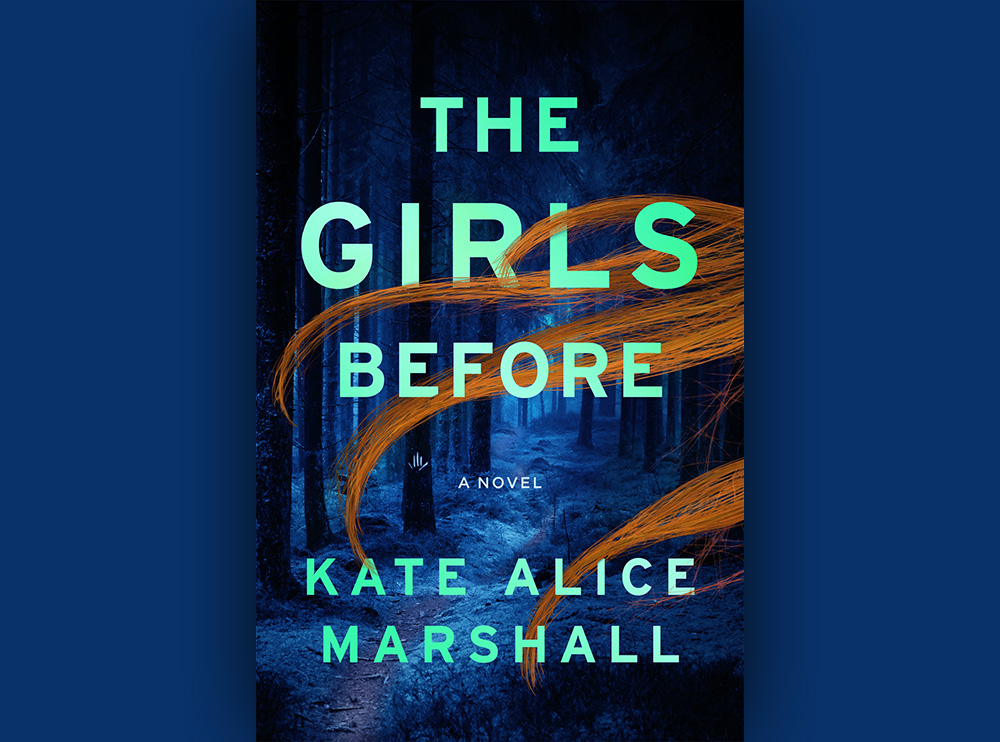
Kate Alice Marshall, bestselling author of What Lies in the Woods, No One Can Know, and A Killing Cold, is back with the thrilling new novel Ashley Winstead calls, “magnetic, shocking, heartbreaking, and unputdownable.”
Intrigued? Read on to discover the synopsis and an excerpt from The Girls Before by Kate Alice Marshall, which releases on February 24th 2026.
There is a girl in a basement.
The door has stopped opening.
The light is gone.
Stranger is trapped in the dark, with only her imagination and the scribbles on the wall left by long-dead girls to keep her company. Nearly out of food and water, she makes one last attempt to escape. But if the door opens at last, will it mean salvation, or only the beginning of her fight to survive?
Audrey is a search and rescue expert who never stopped looking for her ex-best friend, Janie, who disappeared when they were teenagers. Janie used to love the local legend of a forest witch who saves girls from bad men, but Audrey knows now that for every one saved, there’s always another one lost. When she stumbles upon evidence in the forest that a teenage runaway might have actually been kidnapped from land belonging to the town’s most prominent family, she will have to dig through decades of secrets to reveal the biggest one of all: what happened to the girls before.
Below
I don’t know how long I’ve been down here in the dark. Three days? Four? Maybe longer since the door at the top of the concrete steps (twelve steps: the bottom one is cracked; it will try to catch your foot) has opened. Since I last saw the rectangle of light and the shape that cancels it.
That’s how I think of my captor: the shape, the shadow. Never a person, never a beast or a monster, not even really a thing but an event. There is an arrival and a departure. And in between—I blot it out, like the shape blots out the light.
Always it comes, and always it leaves, and always it comes again. Until now.
I’ve never been alone down here for this long. Except that I’m not alone, not really. I’m never alone because the other girls are here. They carved their names in the secret place—their names, their words, their warnings. Instructions passed from one dead girl to another in the hopes that one of us might survive. And with their names, I have conjured them, here in the dark where there is no difference between opening your eyes and closing them, between the waking and the nightmares. Their whispers are a gossamer sound, like insect wings being drawn over one another. Their shapes are gossamer, too, hallucinatory, flickering at the edge of the nothing that is my vision—glimpses of gleaming hair, pale limbs, bruised throats, and gaping wounds. I have no idea how they actually died, but I can never imagine them whole.
It’s good that it’s been so long since the door opened, one of the girl whispers. Maybe it won’t ever open again, another says.
A girl with sparks of auburn in her hair gives a hiss. If the door doesn’t open, the food will run out.
So what?
So she’ll die.
I know they aren’t real. My mind has invented them to stave off the madness of a world without light, without any sound but my own breathing, the horrible beating of my own heart.
These are the things that are real: A wooden bed frame. A thin mattress, stained, occupied by things that scuttle over my limbs when I sleep. A cold chain, one end anchored to the wall, the other to the manacle around my ankle. The quarter circle the chain affords me: six steps to the corner, no more. The toilet, the plastic crate, the supplies inside it. The world beyond my fingertips: concrete walls, everything gray. Milk crates against one wall. A table, two chairs (I have been allowed to sit there, sometimes). A broom and dustpan in the corner (I have been instructed, sometimes, to use it). A light switch on the wall, far out of reach.
And the stairs. Twelve steps. The door at the top. If I am fast enough, someday. If I am strong enough, someday. If the chain is gone. Then I can climb them.
But the door has not opened, and the gossamer girl with cherry gloss lips is right. The food is running out. Is almost gone. And the door has not opened.
In the pure black, a silvered hand brushes mine, and a dead girl whispers in my ear:
You are running out of time.
Above
We forget how eager the world is to swallow us up, how deep and
hungry the wilderness remains. It’s surprisingly, hauntingly easy to
vanish.
At 3:23 a.m. Wednesday morning, Bryson Lee, age four, slipped out the back door of his family’s vacation home. The motion activated camera recorded Bryson as he walked across the short stretch of grass, looked back over his shoulder, and then continued on into the woods. The camera shut off.
It’s been thirty-seven hours since then, and the weather is turning.
I pull off the road, angling for the canopies, emblazoned with the local Search and Rescue logo, that are serving as the command center for the search efforts. I haven’t made it far up the gravel drive before I have to park on the grassy lip between road and trees.
Vehicles jam up the rest of the strip—everything from rusted pickup trucks to a shiny new Tesla getting its wheels baptized with their first splash of real dirt. Some of them I recognize as belonging to other volunteers with Search and Rescue. Others go with the locals who keep wandering up to the incident command post looking for a way to help or to gawk, neither of which is particularly useful. The last thing we need is dozens of untrained locals flooding the area, trampling evidence or getting lost themselves. Even less useful: the TV vans.
If all Bryson Lee needed was manpower and enthusiasm, his survival would be a done deal. But it takes more than that. In the US, it’s easy to get the impression that the wild has been overrun, hemmed in, tamed with trails and GPS and an omnipresent thrum of human activity. True isolation is nearly impossible to find, with a road only a few miles off no matter where you drop yourself, but a few miles is more than enough for a grown adult to vanish into. Much less a four-year-old boy in dinosaur pajamas. The area he headed into is hundreds of acres of wilderness bordered by privately owned land that’s only a notch less dangerous for a kid his size.
We’ll find him, I tell myself, as I have several times an hour for more than a day. Like every other time, I believe it. Whenever a search ends in tragedy, I wonder if it’ll cure my hopeless optimism or break me entirely. But after ten years of weekends and evenings and every sick day I get devoted to SAR, I’m still a hopeful fool.
I scan the crowd as I grab my gear from the back seat. The biggest cluster of bodies is off to the left, centered around a man and a woman. The man has paired an expensive haircut with department store flannel, radiating the sort of engineered man-of-the-people look that suggests political ambitions—though Andrew Hill has steadfastly denied those rumors. His sister Melinda, on the other hand—crisp white blouse and navy blazer, her eyeliner immaculate and her dark hair offering not a wisp out of place—has never wanted anything else.
What the hell are they doing here?
“Back already?”
I offer a weary smile to Len as he approaches—whip-thin, soulful brown eyes, eyebrow split with a silvered scar. His deputy’s uniform is decidedly rumpled; yesterday’s five o’clock shadow is turning full scraggle. My instinct is to put my arms out, to hold on to him like I have so many times before, with his heartbeat thumping right in my ear, his knobby spine under my flattened palm. But he’s working, and so am I.
“You know me,” I say instead. I nod at the stack of flyers in his hands, each one featuring a picture of a beaming Bryson. “Flyer duty?”
“I’ve been handing them out all day,” he says. I nod. Posting flyers is the standard task for untrained volunteers. Half of Franklin is probably papered with the things by now. “You look like crap, by the way. What are you running on?”
“About two hours of sleep and two gallons of coffee,” I say, stifling a yawn. We’re walking together now, heading for Tamara, a woman with the shape of a wine cork and the no-nonsense attitude of a union boss. She’s heading up Operations, which means handing out assignments. Right now she’s got her hands in her pockets, scowling at nothing in particular. “Where’s your boss?” I ask Len. “Parked in front of the nearest news camera?”
“Nah, he’s busy telling the county sheriff how well he runs this town.” Franklin’s so small Len is one of only two full-time deputies. Our police chief is exactly as competent as the job requires, and refusing to retire so his ex-wife doesn’t get a cut of his pension, which leaves Len to do most of the heavy lifting. “The Hills are the ones getting the screen time.”

“What are they even doing here?” I ask.
He raises an eyebrow. “It’s their land.”
“Seriously?” I’d missed that detail.
“They’ve been hovering all day,” he says. “Making noise about getting us anything we need, all the resources in the world, et cetera. Trying to out-soundbite each other.”
“Think she’s going to run again?” I ask idly. Two stints in the House of Representatives ended abruptly when Melinda resigned to undergo treatment for breast cancer—prompting speculation about Andrew taking her place—but the cancer is gone, and Melinda has never once let her brother take something she views as hers.
“The answer to that question is on a long list of things I don’t care even a little bit about,” Len informs me. He gives me a sidelong look. “But you know them better than I do.”
“I don’t know them at all,” I murmur, and at that moment, Andrew Hill looks straight at me. His head comes up; his shoulders stiffen. I wonder if he, too, is remembering the rumble of a truck engine. His hand tangled in copper hair. But, no—he would be thinking of a different encounter altogether. One that didn’t reflect well on either of us.
But Andrew Hill doesn’t matter. Bryson Lee does, and he’s out there now, scared and alone and alive.
Tamara’s voice brings my attention back to the present. “Good, there you are, Lucky,” she says, using a nickname I’ve mostly grown not to hate. Len gives me a wave and fades back, returning to his task. Tamara turns her perpetual scowl on me. “I’m putting you with Rick’s team. He’s got the maps. You’ll be bordering private land we don’t have permission to enter, so stay in your area.” Frustration is evident in her voice. We can only go on private property with the owner’s permission, and it’s shocking how often that isn’t forthcoming.
“Got it,” I say, nodding, and swivel my head until I catch sight of Rick. He’s standing with two other volunteers. There are dozens of us crawling these woods right now.
“You sure you’re good to go?” she asks me, gaze probing. “One hundred percent,” I assure her, though my limbs feel like lead and my eyes are gummy. She just grunts. If she hadn’t forced me to go home for a few hours, I’d have been here straight through and she knows it.
I extract myself from her attention and hustle over to Rick. Rick’s a slender guy, hair gone gray, eyes sharp. He’s soft-spoken but a steady leader, which means Tamara sticks him with the new bies more often than he’d like. The other two volunteers with him are an older woman I’ve met a couple of times and a new guy who’s probably twenty but looks about twelve and whose name exits my mind immediately.
Rick hands out assignments. The role of medic goes to the other woman; I’m unsurprised to be tasked with navigation. Sometimes I joke that the reason I’m so obsessed with the missing is my own seeming inability to get lost. It’s nonsense, of course. It doesn’t take a therapist to pinpoint what started me down this road. One girl. Not missing, not really, because to be missing you have to be missed.
She’s just gone.
My eyes sweep left and right as we head to our assigned area, my gait steady but unhurried as we make our way down narrow footpaths through the underbrush. This close to the commotion, it’s hard to imagine a kid wouldn’t know which way to head for rescue, but you never know. Could be hurt. Could be scared out of his mind and not able to process what he’s hearing. Kids this age tend to find a spot to sleep—I found a girl curled up in a sunbeam once, a couple of hours after she got separated from her family on a hike.
New Guy keeps pace with me. “Those parents must be losing their minds,” he says. “I can’t imagine.”
“I don’t think anyone can, really,” I say. I don’t spend a lot of time thinking about the families—not until the search is over. That pain and fear, even borrowed, is too overwhelming. I have to stay focused, keep myself in this honed-knife state, my belief untarnished. We will find them. I will find them.
EXCERPTED FROM THE GIRLS BEFORE. COPYRIGHT © 2026 BY KATE ALICE MARSHALL. EXCERPTED BY PERMISSION OF CEDAR & PINE, A DIVISION OF MACMILLAN PUBLISHERS. NO PART OF THIS EXCERPT MAY BE REPRODUCED OR REPRINTED WITHOUT PERMISSION IN WRITING FROM THE PUBLISHER.