


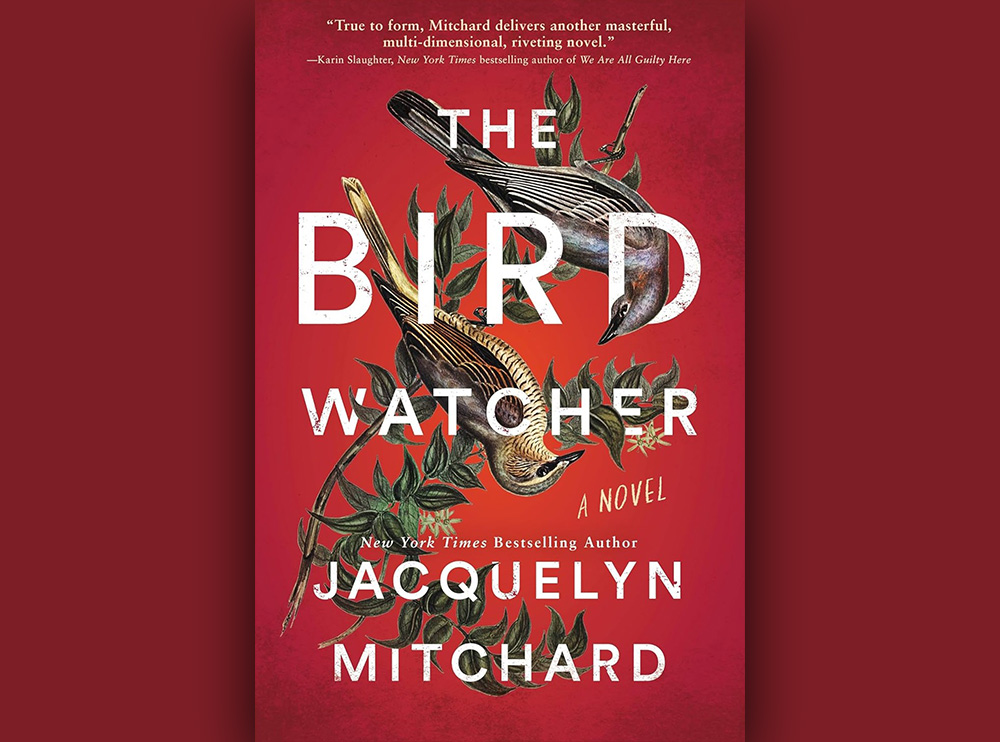
From New York Times bestselling author Jacquelyn Mitchard comes a page-turning drama that explores the beauty of female friendship; the relationship between money, power, and sex; and the very human desire to protect the ones we love most.
Intrigued? Well read on to discover the synopsis and an excerpt from The Birdwatcher by Jacquelyn Mitchard, which releases on December 9th 2025.
When she is convicted of a double murder, Felicity Wild, a brilliant grad student turned high-priced escort, declares, “I may not be innocent, but I’m innocent of this.”
Reenie Bigelow never doubted it. A jury may have given Felicity a life sentence, but Reenie knows that her childhood best friend is not capable of murder. And so Reenie, a journalist, decides to use her deep connections to Felicity’s past to unravel the truth.
The more she uncovers, the more Reenie is convinced that the story the prosecution told is wrong, despite the puzzling fact that Felicity said not one single word in her own defense. But there’s one thing Reenie knows for certain: Felicity would never lie.
Women on trail for murder don’t wear pants.
In a simple navy blue shirtwaist dress, Felicity stopped just short of the door of the courtroom as the sheriff’s deputy removed the shackles around her wrists. If I hadn’t been staring at the door, hoping for a first glimpse of her, I would have missed that very real, very ugly moment. By the time she took her seat at the defense table, she looked like the homecoming queen she was once, not like an escort who killed two clients in cold blood. Dark hair brushed her chin in an angled bob. Huge glasses that matched her dress framed her strange amber eyes.
For a moment, I was reminded of what Leo Tolstoy said, not about all happy families being alike, but about how amazing is the delusion that beauty is goodness. Soon, everyone in this crowded courtroom and beyond would see that this was no delusion. Everyone would see what I saw—that beautiful Felicity was indeed good.
I would make sure of it.
“Please rise,” said the bailiff as the judge, a short, buxom woman, her auburn natural skillfully tipped with platinum highlights, swept in. “The court of the Second Judicial District, criminal division, is now in session, the Honorable Maria Brent presiding . . . State of Wisconsin versus Felicity Claire Copeland Wild, cause number . . . Miss Wild is here present in court with her attorney, Mr. Damiano . . .”
I opened the dark pink leather folder embossed in gold with Fuchsia: The Journal of Culture. Culture, indeed. Culture at Fuchsia was formally designating “captivating coral” as the color of the season. At this moment, being from Fuchsia embarrassed me, and that wasn’t entirely fair to the publication, which did do serious journalism along with the froth. After all, my editor had green-lighted this story, despite her strong reservations. At Fuchsia, we’d run stories about the wage gap, critical issues in women’s health, and how sexual harassment wasn’t just for twentysomethings. This, however, was different, a salty brew of true crime and memoir for which I would be, as my father would say, punching above my weight. Serious journalism was what I set out to do, like my mother before me, but I slid instead into an easy job, penning marshmallow prose about purses. Felicity had set out to be a scientist, a wildlife biologist studying birds. Like arrows shot in the dark, both of us had gone wide of the target.
Judge Brent told Felicity her rights. “Miss Wild, you have the right to the presumption of innocence, which means the state bears the burden to prove you are guilty of this offense beyond a reasonable doubt, which does not mean beyond any doubt, but beyond the doubt that a reasonable person might have . . .”
I drifted in and out of the recitation, staring at Felicity’s attorney, an elegant, compact guy whose bold chin and dark eyes would not have been out of place in that lavish photo feature we’d done about corporate class, and at Felicity, whose calm demeanor astonished me.
“Count one alleges that the defendant on or about December 31 in Dane County, the state of Wisconsin, did willfully, unlaw- fully, deliberately with premeditation and with malice aforethought kill and murder Emil Laurent Gardener, a human being . . . on or about January 4, did willfully . . . Cary Elias Church.”
Judge Brent then said, “The maximum possible penalty on count one is life imprisonment. Miss Wild, do you understand that penalty?”
Felicity murmured, “Yes, Your Honor.”
It was just like in the movies. I was just a fashion reporter. I knew nothing about covering a trial.
But I knew Felicity.
She was once my best friend. She had once saved me. Had she not, I would have been sitting exactly where she was now— accused of murder, except that in my case, there would have been no doubt of my guilt. It was irony in the first degree.
Now I would repay that old debt. I would dig deep into her shadowy present life and our shared past. I would find out how the brilliant biology student who seemed poised to take on the world gave up all her bright dreams to become a sex worker. If there was a truth that could set Felicity free, I would find it. For I knew that she was not capable of murder just as surely as she knew that I was.
“The maximum possible penalty on count two, the willful murder of Cary Elias Church, is life imprisonment. Miss Wild, do you understand that penalty?”
Finally, the judge said, “Mr. Damiano, how does your client plead?”
Her lawyer nodded to her, and Felicity, her voice low and assured, said, “Not guilty, Your Honor.”
As she spoke, I studied her. She was still so beautiful. But what had I expected? A twitchy, hollow-eyed flat backer with skin the texture of a cantaloupe? She was barely twenty-seven, just like me, and she came of good stock, sturdy, attractive Anglo-Saxons, the sort of generic white people who used to monopolize Hall- mark TV movies. We were built to withstand cold precipitation.
A fast flurry of discussion then ensued about setting a trial date, some months out, and then, suddenly, everyone else was standing and gathering up their things. I had no idea that an arraignment for such a serious charge could take fifteen minutes.
“What’s going on? Why is it over so fast?” I asked the reporter next to me. She was easily in her sixties, with the face of a grizzled bartender framed by golden Cinderella curls. “People said arraignments take hours.” She gave me a withering side-eye and I could hear her thinking, Loser.
“They do, usually.”
“So why is this different?” I glanced down at the police report secured to her clipboard. I asked, “Where did you get that?”
“I asked for it. Anybody can get one if the cops feel like giving it to you that particular day. It’s public record.”
“Don’t you have to file some kind of request?”
“Only if they try to wriggle out of it. Honey, are you a reporter?”
My cheeks burned. I’d blushed more in this half hour than I had in four years of high school. “I am. But for a fashion magazine.”

“Not a lot of material here,” she said.
“Nope.”
“So?”
“I’m covering this because I grew up with the defendant. We
were friends.” I added, “She could not have done this.”
“Yet here we are,” the reporter said. “Still, you’re a hundred percent right. She’s presumed innocent. You heard the judge.” She added, “I’m Sally, by the way.”
“Reenie,” I said. “Irene Bigelow.”
Later, when the older reporter and I knew each other better, I would find out that Sally Zankow was famous. She worked for National Public Radio, and her crime features and commentary were heard all over the country. Having covered crime since her hair was naturally that golden, she knew police and prosecutors all over the Midwest as well as she knew her own siblings. She would teach me the best lesson I ever learned as a writer: Contrary to what you saw on TV, you didn’t have to be afraid to ask anybody anything because, most of the time, that person would tell you what you wanted to know. People in and around law enforcement were big gossips. I would also find out that what I initially took for disdain toward me among the rest of the reporters, who grew daily in numbers once the trial was underway, was really something else. The cable TV reporters especially, who were many as rabbits and paid like mice, envied me my pretty clothes—as well as the fact that I would probably never have to stand on the street in a blizzard watching fire- fighters carry the blackened bodies of children from a firetrap tenement.
“Death threats,” Sally said. “That’s why this arraignment was sequestered.” There had been death threats against the judge, against Felicity, and even against her defense lawyer. Nobody was sure what it was about this case that inflamed so many crazy callers. Arraignments normally took place in batches, with defendants sometimes waiting for hours for their case to come up lest they lose their moment, which would mean starting the whole process over again.
“How long will this take?” I asked Sally.
“The whole trial? Weeks for sure, once it gets going. Could be a month or more.”
We’d worked our way to the aisle by then . . . and it was as Felicity, at the door, was waiting for her shackles to be replaced that she glanced around her and finally saw me. Her face opened with a recognition so poignant tears flooded my eyes. She was too far away for me to hear her speak but I could see her mouth move: Reenie. A smile ghosted across her face, briefly revealing her enviable dimples.
I had tried half a dozen times before this moment to reach Felicity, but my petitions to visit were turned away, my phone calls refused, my letters unanswered. Now, clearly, she had changed her mind. She was grateful for the presence of someone from home.
So I was shocked when Felicity mouthed the words, Go away.
Excerpted from The Birdwatcher by Jacquelyn Mitchard, Copyright © 2025 by Jacquelyn Mitchard. Published by MIRA Books