


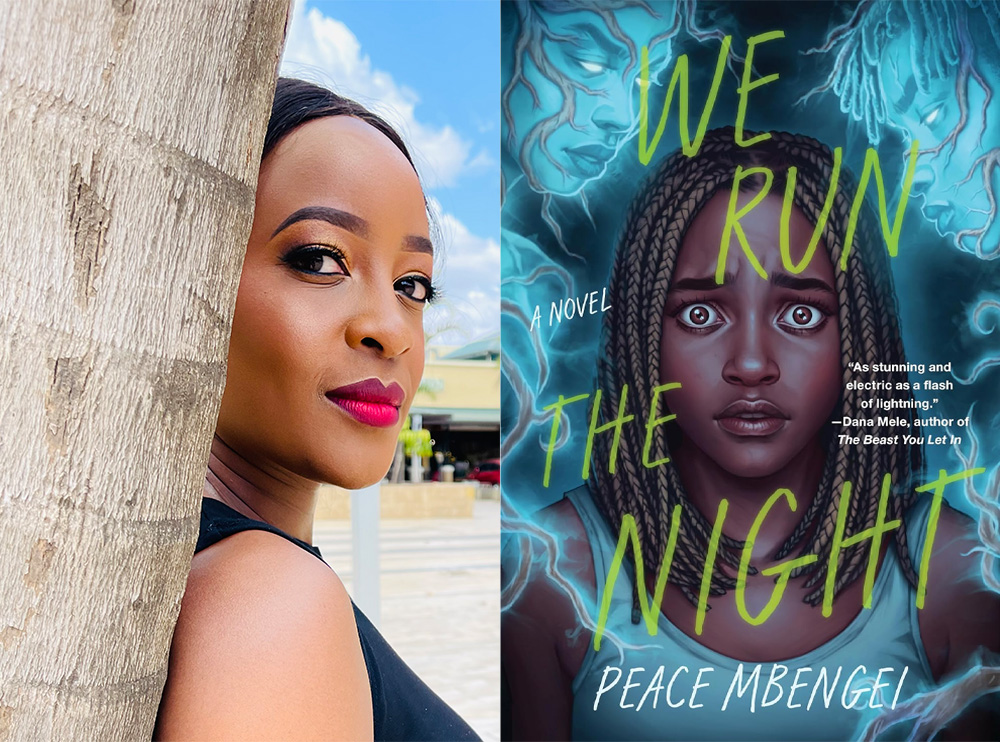
We chat with author Peace Mbengei about We Run The Night, which sees an elite, isolated Kenyan boarding school terrorised by supernatural entities, grotesque maladies, and strange transformations in a chilling YA horror debut inspired by the urban legend of “night runners.”
Hi, Peace! Can you tell our readers a bit about yourself?
I’m a Kenyan-born author and medical doctor. I’ve always been drawn to stories that sit at the intersection of the strange and the familiar, especially stories that take something from folklore and let it become a little more unsettling. Outside of writing and medicine, I’m usually reading a wide variety of fiction, watching something suitably creepy, or spending time with my family.
When did you first discover your love for writing and stories?
I think I was a storyteller before I realised I was a writer. I grew up in a family where stories were a big part of everyday life, and my parents had a library at home. We also had limited screen time, which meant I had plenty of opportunities to disappear into books and my own imagination.
I remember one day when I couldn’t find a new book to read, and I had the very simple realisation that I could just write one myself. My first novel was handwritten at school during recess when I was nine, and I would share it with my classmates. Looking back, it was probably very ambitious for a nine-year-old, but I loved creating stories and having other people read them.
As I got older, I started writing more seriously, putting conversations, scenes, and little ideas onto paper. Eventually, those little pieces became stories, and I realised that writing was a way of making the worlds in my head tangible.
Quick lightning round! Tell us:
- The first book you ever remember reading: It was a book by Enid Blyton. I can’t quite remember the title.
- The one that made you want to become an author: Things Fall Apart by Chinua Achebe.
- The one that you can’t stop thinking about: Sadie by Courtney Summers.
Your debut novel, We Run the Night, is out September 15th! If you could only describe it in five words, what would they be?
Folkloric. Supernatural. Emotional. Creepy. Haunting.
What can readers expect?
Readers can expect an isolated boarding school, night runners emerging after dark, an increasingly terrifying countdown, and a girl trying to figure out what is really happening before it’s too late.
But underneath the horror, there’s a lot about grief, guilt, friendship, bullying, identity, and the complicated ways we deal with loss. I wanted the supernatural elements to feel frightening, but also deeply rooted in the emotional lives of the characters.
And there are definitely some things in the book that I hope will make readers think twice the next time they hear footsteps outside after dark.
Where did the inspiration for We Run the Night come from?
The inspiration came from several different places.
As a child, I had a personal encounter with a night runner during a family vacation, and that interaction stayed with me. Night runners are part of Kenyan folklore, often described as people who disturb others at night and are believed to be possessed by spirits. That experience left me with a very particular fear of what might be moving around in the darkness when you couldn’t see it.
Many years later, I saw students running at dusk and found myself wondering: what if they were trapped at school with night runners? What if the place that was supposed to keep them safe became the place they couldn’t escape from?
The tree came from somewhere much more personal. When my father died, a tall tree grew right beside his grave, and I’ve always liked to imagine that it was his way of refusing to completely fade from the world. My father was also a storyteller, and we had always meant to write a book together. So when I began writing We Run the Night, I thought about how I could bring him into the story. In a way, writing him into the book felt like keeping that promise and letting us write the book together after all.
All of these seemingly separate ideas eventually coalesced in my mind and became Taji Academy.
Were there any moments or characters you really enjoyed writing or exploring?
I really enjoyed writing the moments where the ordinary world starts becoming strange. A boarding school is already such an intense environment: you’re surrounded by strangers, you’re away from home, there are rules about everything, and there’s very little privacy. Adding something supernatural to that felt like dropping a match into a room full of gasoline.
I also loved developing the relationship between Shani and the strangler fig. What initially began as an eerie element became much more important during revision. The tree became connected to Shani’s mystery, her father’s death, and some of the novel’s ideas about transformation, justice and forgiveness.
I particularly enjoyed exploring forgiveness because I didn’t want it to mean forgetting what happened or pretending that harm didn’t matter. For me, forgiveness in the story is much more about releasing yourself from something that has been consuming you. It isn’t absolution.
Did you face any challenges whilst writing? How did you overcome them?
Revision was probably the biggest challenge. The first draft was very different from the book that exists now. I had to learn to let the story change, even when that meant abandoning things I’d originally been very attached to.
One of the biggest changes was giving the strangler fig a much more significant role. During revision, I realised that some of the emotional and supernatural threads I’d been exploring could be brought together through the tree. That helped the story feel more cohesive and gave the horror a stronger emotional foundation.

I’ve also learned that sometimes the best way through a difficult part of a manuscript is to stop trying to solve it perfectly. I’ll step away, let the problem sit for a while, and come back when I can see it differently.
This is your debut novel! What was the road to becoming a published author like for you?
It was full of a lot more waiting than I ever expected. I started out writing scripts for television and plays, then moved into short fiction for magazines before eventually finding my way to novels.
Although We Run the Night is my debut novel, it certainly isn’t the first novel I’ve ever written. Becoming a published author wasn’t one dramatic moment, but a long accumulation of rejection, learning, rewriting and trying again. There were plenty of moments when I had no idea if any of it would lead anywhere, but I kept writing anyway.
What’s next for you?
More writing, more horror, and more stories that bring African folklore into spaces where readers might not expect to find it.
I’m currently working on other projects, including another YA story rooted in East African folklore. I’m also interested in exploring different kinds of suspense and stories about family and identity.
For now, though, I’m trying to enjoy the surreal little milestone of having a debut novel in the world.
Lastly, what books are you looking forward to picking up? Any you’ve read so far this year that you’ve enjoyed?
I’m always drawn to books that make me uncomfortable in the best possible way, particularly horror and suspense with strong characters and an interesting sense of place.
This year, I’ve been on a serious Freida McFadden binge. I can’t seem to get enough of her books! The Coworker has been my favourite so far, and I love how quickly her thrillers pull me in and keep me guessing.
I am also really looking forward to reading Tomi Adeyemi’s The Sirens and Riley Sager’s The Unknown.