
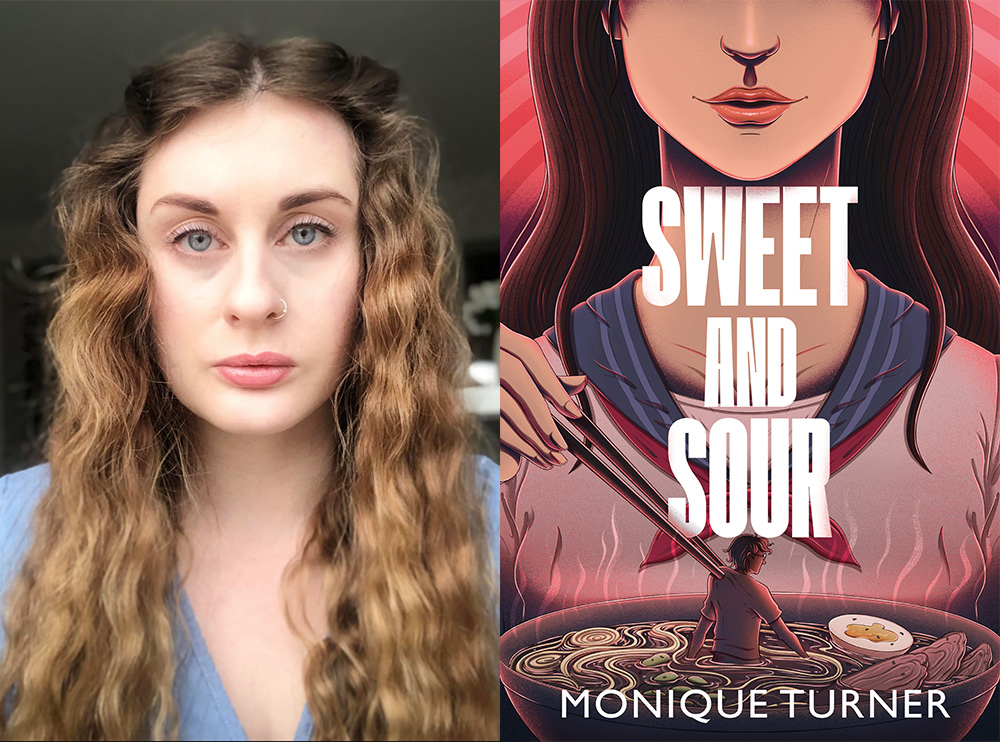
Guest post written by Sweet and Sour author Monique Turner
Monique was born and raised in the cold north of England on a diet of strong brews and thick gravy. Whilst growing up, she struggled to find her place in the world, so she vowed to create stories where those who don’t fit in can finally feel like they belong. When T.M. Turner isn’t writing, she can be found roaming the southern coast.
About Sweet and Sour: Drawing on her experience of working with influencers, the story explores internet culture and the encroaching use of AI in creative spheres. Funny, dramatic and with a deliciously dark ending, Sweet and Sour is perfect for those who love a Black Mirror twist. Out January 15th 2026.
The internet.
Once a digital library and bustling art gallery created by humans for humans, now a wasteland of artificially generated brain rot.
Dead Internet Theory doesn’t just sound like a conspiracy conjured in a dark corner of the web anymore, does it? With every piece of content that passes our digital devices, we’re forced to question whether what we’re seeing is even real.
From news articles to images, and videos to comment sections under posts of well known social media influencers, the internet has become an echo-chamber for fake news, advertisements, and soulless content meticulously tailored to feed the narratives of those who benefit from an uneducated and docile society. Suddenly, all those old dystopian films no longer do justice to the hellscape we’re living in.
My young adult thriller, Sweet and Sour, follows a group of teens as they navigate the ever changing online world. Technology has advanced beyond their understanding of it, and Mikah and his friends are left to reconsider their own place within the digital age.
In the seven months I was writing this story, all my predictions for artificial intelligence in the creator sphere morphed into reality. Publishing houses are now replacing human translators with AI, creators are being forced out of their own sectors by systems that can generate twice the content in half the time, AI actors have been unveiled, and chatbots are being used to exploit and violate everyday people.
The rise of generative AI raises a lot of questions about creativity, what it means to be an artist, and the personal integrity of those who use it without thought. AI systems can produce text and images en mass in seconds, at a fraction of the cost to a commission from a human, while human creators often take days, weeks, or even months to produce a piece of art. It’s easy to see why so many are drawn to the advantages of using generative AI, but does that make it right?
We were sold the idea that artificial intelligence would one day take up all the boring human tasks so that we could focus on the things that feed our souls like painting, writing, and making music. But somewhere along the way, generative AI swallowed these artistic outlets, making it nearly impossible for people to make a living from such skills. Yet, it’s human creativity that helps shape society by teaching empathy and forging connection through shared experience.
I wanted to explore this bleak new landscape in my novel, by having the characters learn what it truly means to be human through acts that cannot be experienced by artificial intelligence: bleeding, eating, feeling, and suffering.

However, Mikah and his friends quickly discover that most people are too tired to fight back anymore. AI can mimic pretty much anything and audiences are willing to accept content in any form, so long as its entertaining enough to make them forget why they needed an escape from reality in the first place. Their battle to save the internet from AI media transforms into a bid to save people from themselves.
One of the main points I want readers to take away from this book is that artificial intelligence itself is not the problem, it’s the people behind it who profit from the stolen work and violation of others. When we talk about the damage AI is causing, we need to address the people backing and funding it, not the systems themselves. When we erase the fact that it is humans causing harm to other humans, we lose sight of where accountability should fall.
In Sweet and Sour, Mikah is forced to look the real enemy in the eye. It’s not the soulless robot beside him, but the audience pretending to be on his side while demanding more than he can physically give, thus leaving room for AI to swoop in and meet the request for endless entertainment that human creators can’t sustain.
I wanted the ending to leave readers with questions and space to theorise on what happens next in the world, to generate their own conclusion. Our over reliance on chatbots to give us the answer has killed our ability to use critical thinking, the thing that sets us apart from systems that rely on data and pattern recognition instead of conscious observation. So, to be able to piece together the ending when its not explicitly laid out, is an act of rebellion in a world desperate to stop us from thinking for ourselves.
SWEET AND SOUR by Monique Turner is out now in paperback (£8.99, Chicken House)