


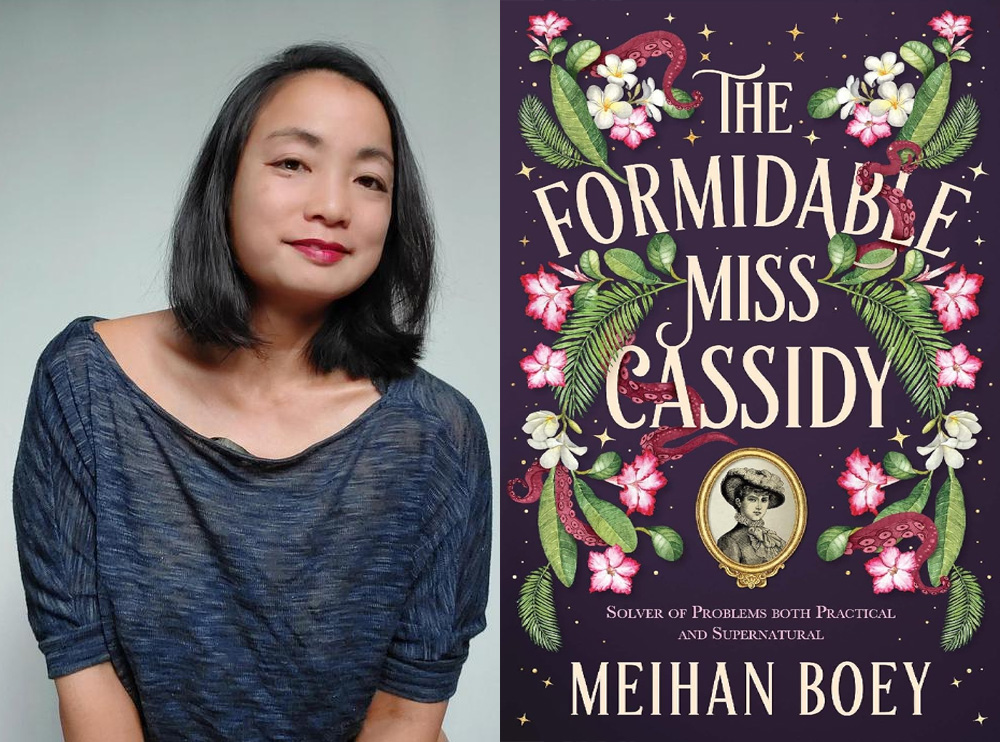
Guest post written by The Formidable Miss Cassidy author Meihan Boey
Meihan Boey is the author of the novels The Formidable Miss Cassidy, which was the co-winner of the 2021 Epigram Books Fiction Prize and winner of the 2022 Singapore Book Award for Best Literary Work; and The Enigmatic Madam Ingram, a finalist for the 2023 Epigram Books Fiction Prize; as well as the science fiction novella The Messiah Virus. She is also the vice president of the Association of Comic Artists of Singapore and has scripted several comics, including Supacross and The Once and Marvellous DKD. She is a dedicated comic book and manga fan, an enthusiastic gamer, a persistent triathlete, and not yet a Super Saiyan, though she keeps trying.
About The Formidable Miss Cassidy: A Scottish governess arrives in Singapore to take up her new post, only to find a host of problems await that require her very unique skills in this award-winning and incredibly entertaining historical fantasy novel. The Formidable Miss Cassidy arrives in U.S bookshelves on 16 September from Harper Perennial.
Picture this. It’s 1890s colonial Singapore. You’re a respectable governess from Great Britain, one who just might bear some resemblance to the mythical Mary Poppins (and also to Buffy the Vampire Slayer, but we digress).
You, Miss Cassidy, have been hired to chaperone the last living daughter of a British family in Singapore. You disembark into a new, sweltering, cheerfully chaotic world of sights, smells and scenes both intriguing and perplexing.
You’re unfazed. You’re adventurous. You’re ready to face this brand new world, with all its challenges.
But then you meet your employer, and you hear the whispers.
“They are haunted by a pontianak”.
“What is a pontianak?” you ask. But nobody wants to tell you. The old Chinese amah, the young Malay street vendor, the handsome Indian law derk, the flirtatious Straits Chinese businessman – they’re welcoming and friendly, but they won’t answer.
Well, it’s best you find out, and soon, before you find yourself bereft of home, employment, and reputation, in this alien land far away.
Welcome to the world of The Formidable Miss Cassidy.
*
If you’ve never met a pontianak (thank goodness), you’ll get to know one in the pages of The Formidable Miss Cassidy. In fact, the pontianak, and the other hantu (spirits) of my part of the world, is the reason this book exists. Why should we in Singapore, Malaysia, Indonesia, Philippines etc have a monopoly on the gruesome nightmare beasts of our childhood? Share and share alike, I say!
And the most famous nightmare by far is my lady Miss P (we don’t say her name after 8pm, and I don’t know what time you’ll be reading this…).
Throughout Southeast Asia, everyone knows her. She has a variety of different names; in Singapore, she is the pontianak. She’s hard to describe, this monstrous female, to someone who has not grown up alongside us. Part vampire, part avenging fury, part Struwwelpeter, all horror.
She haunts our childhoods, a creature more terrifying and complex than anything Hollywood could imagine. She is a terror so grim, Stephen King would quake; a monster so unstoppable, Dracula would run screaming.
She has two faces, and first presents as a woman of astounding beauty. Her long dark hair unwinds in the night breeze. Her nails are long, graceful, sharp, like a Thai dancer’s gleaming extensions. She infuses your senses with her frangipani perfume. She haunts the night with her high, birdlike laughter. Her voice seems far away – but she is right behind you.
The last thing you see will be the transformation of her beautiful face to hideousness. The last thing you feel will be her nails, plunging into your belly, eviscerating you body and soul. The last thing you hear will be a childlike cackle, like the call of a koel. Ke ke ke ke
But who is she, you ask? She must have come from somewhere…?
Well, she comes from the dark places of Southeast Asia, going back generations beyond reckoning. Wherever women have been wronged, the pontianak has risen.
Her exact origins are muddied, but most regional folktales agree she is a wronged woman, either one who has died in childbirth, or the spirit of that wronged woman’s stillborn daughter. (The word ‘anak’ means ‘child’). A creature of rage, she rises because someone has robbed her unfairly of life.
She lives in banana trees, and to this day you will find shrines and offerings amid many of the banana groves of Southeast Asia, notwithstanding that we are almost all now Muslim, Hindu, Buddhist, Taoist, and so forth, none of which religions prescribe a particular caution or reverence towards banana trees. In Singapore, where young men serve mandatory national service and are compelled to go thrashing through what remains of our jungles, it is standard practice to apologise, profusely, to a tree before peeing on it, and to avoid damaging banana trees altogether. After all, you don’t know whose home that tree is.
But the most terrifying thing about the pontianak is that her victims are not confined to a type. She is an equal-opportunity huntress – for preference she gravitates towards pregnant women (out of resentment, perhaps?) and wayward men, but she will take anyone who stumbles across her path. Nobody is safe amid the banana trees at midnight.

In popular culture, however, she has long been reinvented into our personal avenging Fury. Books, movies and stories told around campfires whisper the same cautionary tale – primarily to men.
You’d better behave. Be a good boy and go home to your wife. Leave your wife alone at night to go carousing, and the pontianak will be waiting for you under the light of the full moon. You’ll be mesmerised by her beauty, and lean in for a kiss. And she will – pop! – suck your eyeballs right out of your head.
(One assumes, in this day and age, that the pontianak – who has never been picky, after all – will render the same service regardless of your gender and sexual identity.)
You can’t blame me for wanting the rest of the world to meet her, can you?
The pontianak is a monster, but we are proud of her. She is Queen of the Monstrous Feminine. A story told at a time when women had limited power or protection, she was our last resort. It was the looming threat of her unstoppable vengeance that allowed vulnerable women to warn men: be careful how you treat me.
Her story has lasted millenia, alongisde all the women she has perhaps saved.
Are there ways to escape her? Well, I’ll let you find out, alongside Miss Cassidy.
*
It’s a warm evening in 1890s Singapore. Miss Cassidy’s British employer, the perilously and mysteriously sickly Captain Bendemeer, is walking beneath the banana trees in his garden. It is late. The moon is bright.
Miss Cassidy is paying close attention.
The scent of frangipani is rising…